Showing posts with label depression. Show all posts

Tuesday, 16 June 2020

Week Thirteen - Perception


Another week, another post where the blank page has been open for 24 hours and half an idea is floating around in my head as I try to pin it down.

I think it vaguely ties in with what I said a couple of weeks ago about how it's sometimes hard to judge where you are in a relationship (short-hand for an interaction with someone else - not exclusively 'romantic') and how it can impact on self-esteem despite best efforts.

As most things often do, it starts with music.  Music is brilliant obviously - having that ability to conjure up a person, place or moment in time based on a few notes played in a certain order is something special.  Part of the problem of course is that it works both ways - for every moment you want to remember, there's usually something you're trying to forget (and obviously they're always the songs that stick in your head).  To steal from Jay-Z's Blueprintalbum title - it's a gift and a curse.

This starts with a track from The Streets' 2008 album 'Everything Is Borrowed' - namely "I Love You More (Than You Like Me)"
james acaster repertoire | Tumblr
'Perfect Sound Whatever' by James Acaster is a great read about music and mental health


Of course the thing with music that makes it so brilliant is that the interpretation becomes personal to us.  I can't ever understand what prompted Mike Skinner to write that song but I know that those 10 words - I think I love you more than you like me - have almost become a kind of shorthand for my perception of many of my relationships.

That's not to say it's actually true by any means of course, but that perception is sometimes difficult to disentangle yourself from.  I'd been trying to think about why that is and I think it's down to certainty - or more specifically, a lack of it.

Most of the time I'm fairly clear about what I'm thinking, even if actually articulating it is somewhat difficult (*cough* case in point *cough*) but knowing what someone else is thinking or feeling is a lot less clear and is often where our old friends Worry and Anxiety pop round uninvited and put their feet up on the sofa.

Objectively there's nothing to worry about of course - those relationships you've had for years have stood for that long because they're built on solid foundations.  Nothing to worry about right?
Well Yes, But Actually No | Know Your Meme
I love this one


"What if they didn't understand what I meant when....?"
"What if I upset them when...?"
"What if they're mad because...?"
"What if they don't want to be friends anymore...?"

I had my eyes opened at StressControl last year when I found out that not everybody thinks these things and worries about them like I do.  If you're one of those people, then kudos to you - but it partly felt like my reality was being torn down and rebuilt.  Again, objectively of course people don't all think like that because it makes very little logical sense.  But it's hard to free yourself from that when it's been your perception for so long.

Under the old regime there were a few tried and tested options when those questions started floating around:
  1. Seek any kind of constant reassurance (explicitly or implicitly) that the last thing I'd said hadn't been misinterpreted or that you'd not upset the status quo
  2. Qualify what (I thought) I'd done wrong in a painstaking level of detail that would make War & Peace look like a short story
  3. Assume I'm burdensome and a distraction that people would happily do without (not in that way - chill)
  4. Shut down - don't make the effort because it can't or won't be reciprocated in the way I expect - better to not bother than show vulnerability


Sorry I Annoyed You With My Friendship - Gif | Annoyed, Friendship
Point number 3


Point number 4


Sorry - a lot of relevant memes this week...

And so, via a slightly circuitous route, we come back to Mike Skinner and the woes he and I share - "I think I love you more than you like me".  The last couple of points on that list above are the kinds of things I associate that line with - being at the extreme of one feeling while perceiving that everyone else is at the far end of another.

That perception genuinely feels hard to get over sometimes, though I've learned that often it's the arbitrary expectations that come with the perception that compound those difficulties.  Relationships can't be quantified or measured - they're things we know, feel and trust in.  

Worry and anxiety can make us question those things we know to be true, and have faith in and so, like with most things, it's the same few tricks that help us through.  What would we tell a friend feeling that way?  What is the likelihood that the thing we're obsessing over is actually happening?  How do we make mental space to be able to evaluate what we're thinking and experiencing in a rational way?   If in doubt, play the greatest hits right?

I envy the people that have that in-built way of just knowing this stuff is all OK without it being a large number of conscious thoughts.  Maybe you're all sociopaths or something?   Sorry - what I meant by that was..... please don't be mad at me.... are you upset....? Etc etc forever and ever...

(Oh - in diabetes news, I've had four consecutive days with bloods all under 10mmol so I guess I'm cured or something... - come for the sadness, stay for the diabetes)

Stay safe. Love you (more than you like me) x

Tuesday, 2 June 2020

Weeks Ten and Eleven - (Im)balance

Predictably I missed last Monday as it was a Bank Holiday and I had a week off.  I missed posting yesterday because I wasn't sure I had the right words to be able to articulate what I wanted to say.   I'm still not sure I do but let's see where this goes eh?

Since I last posed, I've edged a year closer to 40.  Facebook memories see to suggest I'm forever bound to say "older but not wiser - haha" and that absolutely feels true in one sense, but maybe less so in another.

Over the last year, I think StressControl and CBT have taught me some sense of self-awareness that I wasn't really conscious of before.  Whether I'm actually wise enough to be conscious of it in the moments I need to is a wholly different matter.

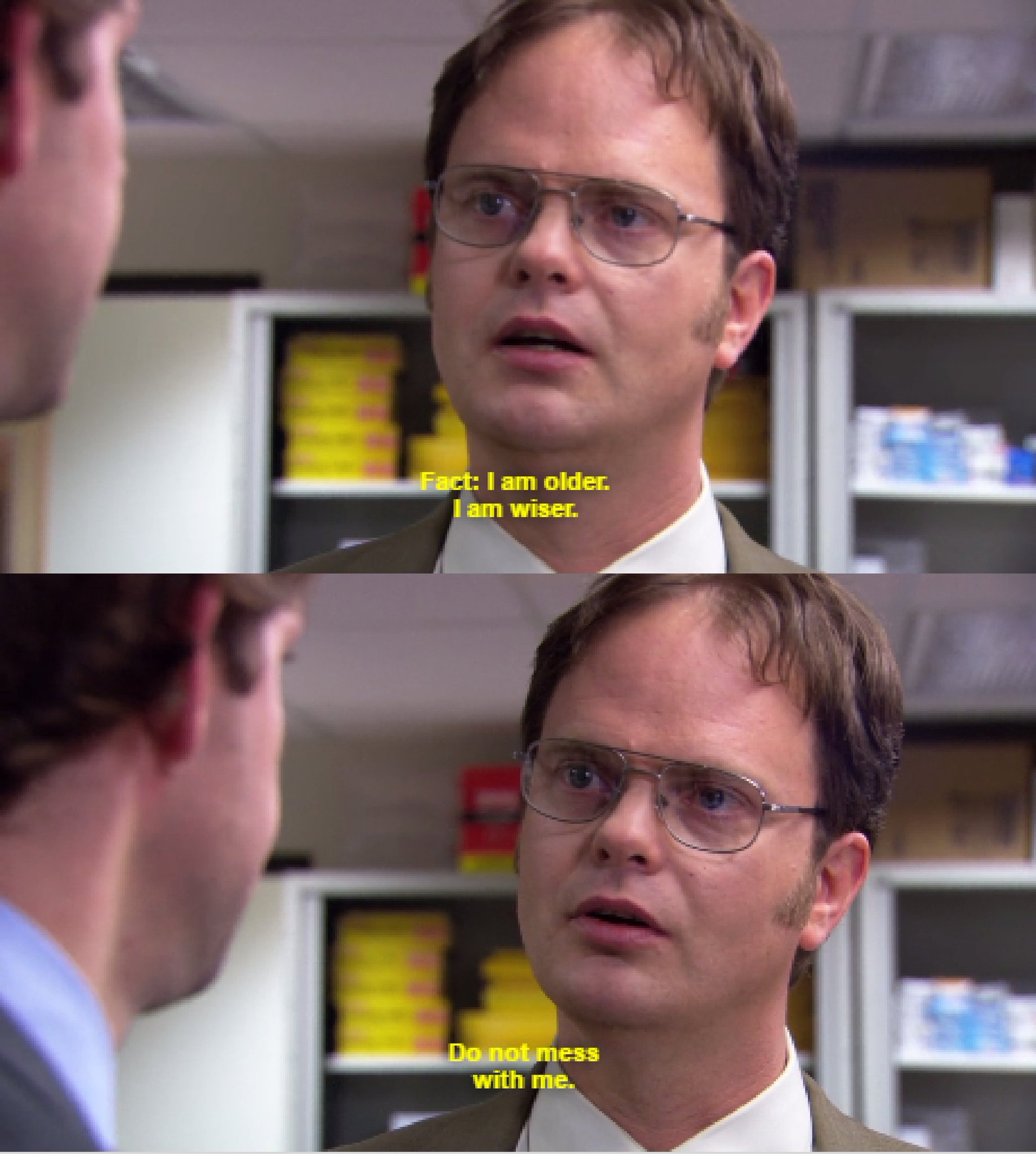
Dwight Schrute on Twitter: "https://t.co/ENkQrYSh0E"
Absolutely I am Dwight

One of the main themes at StressControl was about how we often judge ourselves more harshly than we would others and are our own worst critic.  At CBT we talked about how powerful meaningful relationships are and how they can make a really positive difference to how we feel.  I guess that latter part at least is familiar to many people right now given that lockdown has many of us distanced from those people we rely on.

I think where I've often felt like I've struggled is in finding those relationships.  I've got a catalogue of reasons why that's the case - you can leaf through that at your own leisure - but I think I large part of it is down to not being able to understand where the right balance (or equilibrium - get some mileage out of that economics degree) is.

But this is where the words dry up a little.  I'm not sure how to get that final point down:

    a) without coming across with an inflated sense of self-importance 
    b) succinctly or 
    c) in any kind of way which actually gets to the heart of what I'm trying to say

I guess the point is that I often feel like I mis-judge what those friend/relationships should look like or what the dynamic is.  Pushing way too hard when there's no need, cutting myself off entirely because it's easier than working through what the middle ground should look like or just driving myself crazy with self-doubt, worry and anxiety.  Where this was bad before, lockdown has made it a lot worse.

Jaboukie Young-White Me to My Anxiety People Are Focused on ...
Imbalance

I've thought about referring myself back to IAPT but I'm still not sure I'm clear on the thing that would be most helpful so I'm keeping that in my back pocket for now.  I've thought about seeing a GP though that's kind of a nuclear option I'd rather not take.  And there's no way I'm going near a surgery right now in any case.

I think I've got most of the tools and knowledge to be able to make this better (there's the wisdom) but it's still difficult to take that mental step back and use them objectively.  That bit is really hard, and the nagging self-doubt that asks whether I am good enough makes it tougher.

It's ridiculous when you see it like this - but seeing it like this is the tough part

As this blog becomes progressively about mental health and less about diabetes, I probably need to grab food so I don't have a hypo in a meeting later on.

Stay safe x

(And don't worry, I've ordered Lego)


Monday, 11 July 2016

5000 Days with diabetes

Today marks a milestone for me.  It’s my 5000th day with diabetes.  It’s nothing special in itself I suppose – I’m coming up on 14 years since my diagnosis, and many people have lived with this thing for a lot long than I have.  But 5000 days… that’s worth considering.

Generally, looking back on life, we often find it hard to believe how naïve we were about a lot of stuff – laughing at our younger selves for not knowing things that seem so obvious to us now.  My relationship with diabetes is no different.

I remember my diagnosis.  It was the start of my graduate year at university, and I’d been flicking through a magazine when I happened upon a side-bar that was talking about some symptoms of Type 1 diabetes.  Reading through it, I was mentally crossing them off… tired all the time, drinking a lot (of water!), needing the toilet all the time… This had been happening to me for over a week.  I could never drink enough water to quench that thirst, no amount of Mars bars would give me energy to stop feeling lethargic (...seriously).  I couldn’t see the notes on the board from the front row of lectures.

So I went to see the campus GP and told her I’d read a magazine and I thought I had diabetes.  To be fair, I’d have been sceptical in her position – I suspect it’s the equivalent of Dr Google these days.  But  I had a blood test and got a call the next day…

“You’ve got diabetes.  I need you to go to the diabetes centre at the hospital…”
“Er…” *looking at lecture schedule* “I could go Wednesday afternoon?”
“I need you to go NOW.  Right now!”

And that changed my life.  There’d been a kid in my class at primary school who had diabetes.  He was insanely resilient – you never really saw much indication of it at all – he just got on with doing what other 8 year olds do.  We all knew he had to have a needle (and this was the 80s so it was proper needles) but that was it.

Now I was sat in a room in a hospital with my parents who’d just bombed up it the motorway, with a nurse (Vicky Clancey) who was telling me I had to inject myself every day (along with a lot of other information).  I think I asked if I could just have a pill or something not utterly terrifying but to no avail.  I came home with a mountain of papers, booklets and more medical supplies than you can shake a stick at and I got on with it.

Over the next decade or so I had a complicated relationship with diabetes.  I worked hard some of the time, and saw the benefits of it on that half yearly report we’re all so familiar with now.  Other times I gave up entirely.  I took insulin when I was supposed to, but testing became a thing of the past – used only to justify eating when I was low (both blood sugar and emotionally).  And I spent time in between those extremes, giving my health the minimum attention it needed.

I think all that changed about four years ago.  The chance to take part in a clinical trial looking at insulin pumps and education courses (here’s link to an article discussing the results) was a huge turning point in my life with diabetes.  It finally allowed me to fill in the huge gaps in my knowledge, gave me the opportunity to meet people in the same boat as me and let me see that there was a world of other people that I could talk to.  I spoke at the Diabetes UK Professional Conference earlier this year about how DAFNE changed my life, and I don’t think I could ever possibly state how much that is true (you can read/watch more about my relationship with DAFNE on the Diabetes UK Taking Control site).

So I look back at myself now, after 5000 days of counting carbs, injections, finger­-prick tests (sometimes!), set changes and I can’t help but laugh.  I wrote on the very first post on this blog (which started as a London Marathon training blog) that “Whilst I’ve been diabetic for the last 10 years, I’ve…never let it define who I am”.  I don’t think that could be any further from the truth now – at least in some sense.

I used to be a terrified young adult who’d never really accepted this… thing… he’d been given.  Someone who was scared to ask for help, didn’t want to hear about complications because I was too young - that stuff will never happen to me right?  Someone who felt so low he gave up looking after himself for almost two years without a thought to the consequences.

Now, it’s different.  Diabetes is absolutely a huge part of my life – it has to be.  I feel part of a community that I can ask for help whenever I need to, and I’ve made some truly amazing friends as a result of this condition.  It’s still not always easy by any means, but it finally feels like that millstone around my neck has turned into something a lot more manageable and, dare I say it, more positive than I’d ever expected.

I don’t think you can live with a chronic illness without experiencing highs and lows (…sorry) but I think it’s about how we emerge from them that really matters.  We all carry battle scars as a result of diabetes (physically and mentally), but we’re still here, we’re still fighting and we’re still living, not just surviving.

How I felt back in October 2002 is completely alien compared with my outlook on diabetes today.  You go through a lot over 5000 days and how you use that life experience is so important.  I’ve gone from being a naïve 21 year old to a 35 year old who understands so much more than I thought possible (or at least I think I do...). 

I’ll be almost 50 by the time I reach 10,000 days with diabetes.  There’s going to be a lot more to learn, but I finally think I’m up to the challenge.

Friday, 11 October 2013

Mental Strength

This blog was first posted on the Diabetes UK blog site

When discussing diabetes, it can be quite easy to revert to familiar topics depending on who you speak to. Talking to other people with diabetes can lead to trading war stories about particularly unpleasant hypos or serious hospital stays as well as what type of therapy they use to manage their condition. Talking to people who don't have first hand experience of diabetes can turn into a discussion about being type-aware or explaining (for what may feel like the millionth time) that yes, you can have a biscuit/chocolate/piece of cake without needing serious medical attention.

What doesn't get possibly as much discussion are the mental aspects of having diabetes. I'm by no means an expert but I think it's important to make time to give these 'hidden' aspects as much consideration as other factors.

I think it can be quite easy to bypass how you feel about having diabetes because living with it becomes such a normal part of your day, you don't necessarily stop to think about it.

What prompted me to consider this quite recently was the set of forms I received as part of my REPOSE 6 month follow up. The premise is quite simple - you're faced with a number of statements and asked to score them on a scale of 1-5 based on your experiences over the last 4 weeks (e.g. very likely to very unlikely, extremely important to totally unimportant etc.)

That sort of process in itself isn't anything new, but what it does offer is a chance to reflect on those moments when you might have felt sad, angry or frustrated and not consciously understood the reason why.

Some of the questions are quite generic and deal with how you rate your quality of life overall, how you feel on a daily basis and so on. Others ask you to consider how living with the specifics of diabetes affects your relationships with the people around you and your day to day activities or future ambitions.

Whilst I wouldn't dream to speak definitively for anyone else, I'm sure that at some point, many people with diabetes have experienced some sense of anger or frustration that relates to their condition and I know I certainly have. What I don't tend to do is reflect on those feelings and either rationalise them or find someone who can help me with them.

If I were to ask you how much you feel burdened about having to think about your nutrition or how frustrating you find the fact that others don't understand your treatment, you might not give them too much thought. Hopefully for the vast majority of people, such things really aren't factors in your day to day life. However, for some people, struggling through on new regime of insulin therapy or coming to terms with a recent diagnosis can leave them feeling stranded and alone.

Whether you've been diabetic for 12 weeks for 12 years, you're bound to go through difficult times at some stage and but it's being able to manage them that is important.

My lowest point came after about seven years after my diagnosis (I'll have been a fully paid up member of the T1 club for 12 years in October). I got to a point where testing my BG and seeing constantly high numbers would make me feel depressed so I stopped testing regularly. I don't mean that I'd test once a day, I'd be lucky if I tested once a week. As a result my HbA1c rose steadily and I was going to 6 monthly hospital reviews armed with more and more constructive excuses and promises that things would be different next time. I'd be economical with the truth with my family because I felt ashamed I wasn't looking after myself when really I didn't want to admit that I either felt too exhausted to do it, or I couldn't remember how. This continued for about 18 months before I eventually came clean and with the help of my wonderful wife, I started to get things back on track.

I'm incredibly lucky that I have a very supportive family and a great relationship with my specialist team that helps me through the tougher times. There's also a lot of other support out there in various other guises and there's also a growing online community of people with diabetes who can listen and help you.

Filling in my 6 monthly review forms has been a cathartic experience and a reminder that whilst things might feel good today, I've also experienced some serious low points and managed to come through them relatively unscathed.   If I'd had to fill in the same forms a few weeks after getting my insulin pump, I know for a fact that the answers to some questions would have been markedly different but being able to reach out for support to the right people at the right time has made me stronger.