Showing posts with label diabetes. Show all posts

Tuesday, 9 June 2020

Week Twelve - Paths not taken (or things I wish I'd known)

I drew a blank yesterday when I sat down to write - there was something there but I couldn't quite see it.  It vaguely came to me as I stared at the ceiling at something-past-midnight so let's go.

I should preface this by saying that it's Diabetes Week (8th to 14th June 2020) and so while this won't entirely depart from the mental well-being stuff I've talked about for the last three months, I was reflecting on my experiences specifically with diabetes more than usual last night.

I was trying to remember how old I was when I got got diagnosed with type 1 diabetes.  I always start by telling myself it was the October of my graduate year at university as I remember it being a fairly isolating experience in many ways.  But that's not true.  The date I mean - it was isolating in a lot of ways.  I remember trying to explain it all to a couple of my course-mates (and fellow 5-a-side colleagues) and how lower GI stuff like Shreddies would help.  "Shreddies - keeps diabetes locked up til lunch" still makes me smile.  But that must have been the start of my third year which was October 2001.

And that means next year will be 20 years with type 1 - half my life.  After that point it'll be something that'll be the bigger part of my experiences, not the smaller part.  Those 20 years without diabetes would always be a static thing, but soon that block of time will become a decreasing minority.
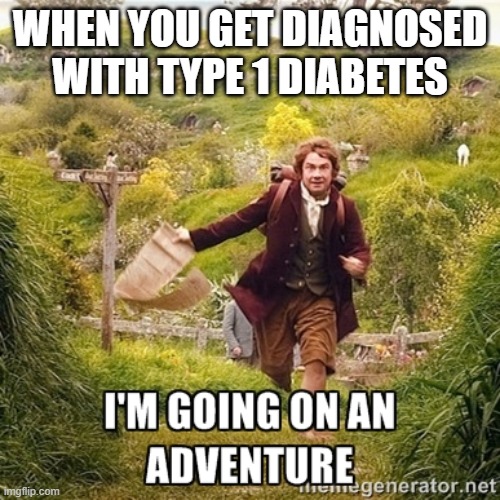
Memes for all occasions

Looking back at the start of this adventure I was woefully ill-placed to deal with it - not that there's ever really a good time to get diagnosed with a chronic condition but still...  A few ridiculous things really stand out from those first few months.  I remember being told to make sure I'd eaten before playing football at university so I'd cram all sorts in before a match and wonder why I was sky high afterwards.  I started off on mixed insulin so there wasn't really a concept (that I'd be told about at least) of correction doses so I just lived with it.

When I switched to basal/bolus a year or so later, that felt like a little more freedom, but I was still walking around with way too little knowledge in my head.  That's diabetes knowledge for those giggling at the back...  While I finally had the tools to finesse my own self-management, I didn't have the understanding.  One unit for 10g of carbs seemed to work, but I'm sure it took years for me to ask what would happen if I did insulin without food and finally understand if my levels were high I could just do insulin to fix it.  Seems so obvious now, but it was alien to me for so long.

And (as I gratuitously wield my crowbar) it got me thinking about other paths I'd not taken because of things I didn't know or was scared of finding out.  Opportunities I didn't take, places I didn't go, girls I didn't ask out, invitations I turned down... all because I was unsure of myself or scared.

Justin Whang 🐙 on Twitter: "Crazy how the "you posted cringe ...

I think what it made me realise (at nearly 1am...) is that the stress and anxiety that I've really only consciously started to be aware of has actually been around for a really long time.  Looking back, some "coping" mechanisms have been fairly common over the years (however cringe-worthy they were and how hard they are to let go of), some of the anxiety symptoms probably date back over 25 years.

So I think there are a lot of things I wish I'd known.  All the stuff I've accumulated over nearly 20 (TWENTY) years of living with diabetes would obviously have been hugely beneficial way back in 2001.  But I've been struck again by how much the mental aspects have been so important. Not just in terms of missing out on lived experience, self-confidence or self-esteem, but that overlap with managing the physical bits.

I had a conversation with someone recently about how easy it feels now to instinctively know what my insulin doses should be, and that the textbook answers don't reflect what I intrinsically know to be true about my own care.  But whilst that trial and error, and learning from those mistakes has been tough at times, it feels easy in comparison to understanding and managing things that aren't tangible or don't manifest themselves as physical problems to solve.

I don't know... it makes sense to me, and if you can relate too, that's good.  Happy diabetes week.  Until next time

Stay safe x

Monday, 18 May 2020

Week Nine - Any End In Sight?

I've definitely been trying to focus on One Nice Thing over the last week and it's kinda helped to some degree.  I had a few photos printed up as part of an early... *ahem*'th birthday present and they looked exactly as I'd hoped.  It'll be nice to have those memories on show if I get round to hanging them within the next five years.

Dubrovnik from the city walls


A view of Ambleside in the Lake District


I'm also squarely looking forward to a week off at the end of this week and spending some time not thinking about email and Zoom.  If the weather holds, we've cracked it.

I also managed to have a diabetes clinic appointment over the phone which was a lot less stressful than trying to find somewhere to park at the hospital and be staring at the walls of the waiting room forever.  Nothing too major to report - still work to do to stave off more hypoglycaemia episodes but as I've said in one of these blogs before - I feel like I'm taking the rough with the smooth when it comes to diabetes right now.

My consultant talked about pump upgrades again and is desperate for me to switch to the Tandem t slim pump and basically set myself up with a closed loop system of sorts that would probably reduce the number of lows.  I'd have to give up my funded Libre and then totally self-fund a Dexcom G6 (for about £2500 a year).  I'm going to take some time to think about it properly - it's a lot of money, but potentially a big difference in quality of life.  If you're using it all together and have any insight, I'd love to hear about it.

This flip side of this week's coin is just the relentlessness of everything.  Obviously this situation is tough for everyone in different ways.  I know I've felt it mentally - some days more than others and some weeks more than others as well.

Cross off date possible with two subDomainTextFormat? · Issue #260 ...
A calendar image that lined up to today's date (if not day) was a happy coincidence


Having something to aim for makes a big difference and I think that's what I certainly feel is lacking.  Most of the time I don't feel too put out by the restrictions - in fact I think it's lead to some positive changes overall that I really want to hold on to.

But there are times when being locked in that cycle of shower, eight hours of video calls, cook dinner, load/unload the dishwasher, TV, bed feels a bit like Dr Strange battling Dormammu in the time loop (yes we've watched all the MCU films).

There are definitely days where I question the futility of that - if all I'm working towards is more of the same, then is there any point in that effort?  Not in a harmful way I should probably add.  I've always tried to put as much of myself as possible into what I do and I don't feel like I want to pull back from that necessarily, but it's taking a toll right now.

All work and no play makes Jack a dull boy


I think the trick here again is to focus on the short term 'ends' and the compress the horizon for everything.  It's all an adjustment for everyone and knowing that I don't always handle the internal aspects of things like this particularly well, I should be more conscious of how I approach it.

Bank holiday next Monday so will inevitably forget to post.

Stay safe x

Monday, 11 May 2020

Week Eight - One Nice Thing

At least I think it's week eight... I know lockdown officially began on March 23rd but I'd definitely been working at home for about a week and a half before that.

Some of the days do have that sense about them and at times it definitely feels like they're merging into an amorphous blob of stuff.  Some days fly by and then others seem to draw themselves out forever.  A three-day weekend definitely helped me reset to a large degree but there's something about this situation that's exhausting.  A couple of days with no alarm and no real need to do very much or even get beyond the garden feel like they've wiped me out.  I'm fairly sure it's down to the mental effort we're expending trying to keep on an even keel.


Most of this last week's diabetes problems have been about keeping out of the red and in the black which I will admit has felt a little relentless at times.  After some extensive research over the last few days, I think I'm close to publishing a paper confirming that bourbon biscuits have little to no effect on blood sugar whatsoever.  I am also implying that they therefore have no calories either...  It'll pass as it always does, but feeling like you're constantly scouring the kitchen cupboards for something to eat can be another layer on top of everything else you're trying to think about.

A couple of things sprang to mind this week.  Firstly that it's felt harder at times to maintain that 'deep breath, think before you speak' approach to communicating, whether that's at home or at work.  I think the current climate (sick of writing that) and how far we are into this way of living gets to us all at some point, and it's almost inevitable that some part of us will snap, however briefly.  It's also easy to have our head down thinking about our own situation, when the reality of it is that everyone has their own version of that too.  I'd like to think I've been generally conscious of that - what feels like 40 hours of video calls a week means you can't help but understand people's circumstances, but it's no bad thing to be more explicit about it in my thinking.

The other thing is really to think of One Nice Thing about the day and try and hold on to it.  After StressControl I tried to write three positive things down from each day before I went to bed as a reminder that the stress and anxiety was always balanced out by other things.  I've lowered the bar a fair bit for the time being, but hoping it continues to make some small difference.

After a couple of glorious days, the weather turned yesterday so we had some ultimate comfort food in meat and potato pie


This was the sunset on Thursday after my dad got taken to hospital (and thankfully discharged with antibiotics about 8 hours later)


Managed to order some Lego that's usually only available from one shop at Legoland in Denmark - they've made it available online due to COVID


It's still a massive set of ups and downs and it's the same for everyone I talk to as well.  In some sense, it's hard to take comfort from the fact that everyone is on this relentless roller coaster, but at the same time it's kinda reassuring that everyone can almost certainly relate to how you're feeling at any given moment, even if it remains largely unsaid.

Safe safe alert safe x


Wednesday, 9 October 2019

Controlling Your Future

If you want to catch up you can find the pre-sessionweek one ("What is Stress?")week two ("Controlling Your Body")week three ("Controlling Your Mind"), week four ("Controlling Your Thoughts") and week five ("Panic and Sleeping Well") posts in the links


And so StressControl comes to an end.  The title is from one of the slides in this session, but there was an open understanding that it's something easier said than done.  We followed a broadly similar approach as previous weeks, this time looking at our personal wellbeing and then covering a quick summary of the previous five weeks.  I'm going to talk a bit about wellbeing here as well as covering some of the things I've noticed or that have changed since I started, as well as what some next steps might be.

Wellbeing


In week one, we covered the idea that stress is a continuum with high levels of stress at one end, and low levels at the other.  This is a distinction worth making because it's not the goal to eradicate stress entirely, but to try and put ourselves towards the lower end of this particular spectrum.  If we think about stress as this horizontal line, wellbeing can be thought of as a similar, vertical continuum with poor wellbeing at the bottom and good wellbeing at the top.

The World Health Organisation talks about these two extremes as 'languishing' and 'flourishing' and of course, the idea is to move ourselves towards the flourishing end more often than not, whilst also increasing our ability to manage our stress.  As with anything worth knowing, overlaying these two concepts gives you a handy 2x2 matrix:

Recreated on my phone so more simplistic than it should be, but you get the idea...


Obviously we want to be in the top left as often as possible and in the bottom right as scarcely as possible, and because we're people, we'll often move around all four of these.  Some high level stats suggest that for every 10 people, three are langishing, five are middling and two are flourising and the tools we have at our disposal are aimed at keeping us away from the languishing end of the spectrum as often as possible.

We talked about what sort of things you could do to try and improve your own wellbeing, and with my work hat on for the briefest of moments, I was pleased to see that volunteering your time was something that was encouraged.  Being able to contribute to the wider world around us increases our own personal wellbeing too.  Listening to music, being more physically active, getting more fresh air and practicing mindfulness were all suggested too.  Learning something new or picking up an old hobby came up too and the idea is that our brains value the sense of accomplishment that comes with learning or completing something.

Mindfulness is something we hear more and more of but it was interesting to hear the definition they gave, which was really about focusing on the moment we're in without letting ourselves worry about the future or brood about the past.  It sounds fairly simple when you hear it like that, but trying to let your mind focus purely on what our sense are experiencing right here and right now can be hard.  I think autumn is a good time to try more of that as the leaves change colour, the air gets a little cooler and the familiar scent of fireworks starts to fill the air.  It's definitely something that needs practice, but along with some of the breathing exercises we covered, I think it can be really helpful.

We also talked about the fact that we almost certainly talk to ourselves much more harshly than we would do to anyone else who may be going through something similar. We're often our own worst critic, telling ourselves that something should be easy to do, or that worrying or feeling down is something we can just snap out of, when we'd take a kinder and more gentle approach to friends or family or came to use with the same feelings.  I think we all probably recognise that, and it's useful to think about what our compassionate self would say to our stressed self.

The final thing we covered was something I've heard of before but am yet to try and it's the idea of finding three things to be grateful or thankful for each day.  I suppose the idea behind it is that we're allowing ourselves to think about the positive things we've experienced rather than having that feeling that there's nothing good going on.  I'll see where I get to...

We finished the course with a quick tour back through the other five sessions but I won't repeat those here - links at the top of this post if you want to check out anything particular

What's changed?


So what have the last six weeks meant practically?  Well six weeks isn't really a long time so some of the changes or differences are in their infancy and as they said, it's almost like the hard work starts now when putting these things into practice every day away from the course.

I'll start with the positives:

  • I've definitely used my rational voice more when I'm approaching known stressful situations (e.g. travelling).  I now need to think about being able to have that midset when more unexpected areas of stress arise.
  • I've cut out more caffeine later in the day.  This is pretty difficult sometimes as my work schedule can be a little unpredictable but overall it's an improvement.
  • I've followed some of the progressive muscle relaxation and breathing techniques fairly regularly and I think the breathing in particular has been really helpful.
  • I've started blogging again - admittedly only about this course, but it's got me back into something I enjoy when I feel like there's something worth writing down
  • I've started listening to a bit more music and watching a little less Netflix.  Music has been a longstanding passion of mine but it had become a smaller part of my day and redressing that has been good
  • I've done more to cut out eating/snacking to try and cope with feeling tired or stressed.  Early days but it's a step in the right direction
  • I've gradually started doing a little more exercise.  It's not quite as regular or frequent as I'd like, but definitely feels like a positive step
  • I've only had one tension headache in about two months - that's definitely worth celebrating!

And a couple of things that aren't as good:

  • I'm a lot more conscious that sometimes I just find myself clenching my jaw and I'm not sure how often it's been going on, but it needs to be very deliberate recognition of it before I stop
  • I'm a lot more conscious of a pain or ache in my neck.  I can't work out if it means my pillow isn't quite right, or whether it's just holding tension in that part of my body
  • I'm equally more conscious of the pain I get in my hip/leg that came before, during and after the London Marathon in April so I think I need to dig out the foam roller again for that
  • I still feel knackered all the time

So what next?

We did a wellbeing questionnaire in weeks one, four and six and whilst my score in the stress half of it decreased (10 to 9 to 8), the low mood half remained fairly static (14 to 13 to 14) and I guess that's something to think about.  A lot of the symptoms associated with stress also correlate to the idea of low mood and whilst that might make the stress part of the diagram more manageable, it means you end up being fairly static on the wellbeing axis.

One of the facilitators suggested I ring up the IAPT wellbeing number and book in for some one-to-one discussion about disentangling the stress and anxiety from the low mood.  That feels like a pretty big step.  Part of me thinks that it should be easier having done this course - remember it took six months for me to ring up to book onto this in the first place.  Having taken the first couple of steps it should be easier to take the next few.  But it also feels hard to put yourself in a vulnerable place to talk about something you probably don't really understand yourself.

I'm going to keep plugging away with the techniques we learned on the course, and keep reinforcing the positive things I've started as best I can.  Progress isn't perfectly linear in things like this and it's OK to have the occasional step backwards as long as you're taking a couple forward too.  And I'm probably going to make that call...

If you made it this far (both on this post and throughout the course) then I hope it's been helpful in some way.  Everyone's experiences and circumstances are different so use what you can and discard the rest.  Hopefully I'll keep coming back to the keyboard more often than not - the focus can be quite cathartic sometimes.

Diabetes UK are running a hugely important campaign about improving the provision of and access to a variety of emotional support services. People with diabetes are twice as likely to suffer from burnout or difficulties with their own mental health compared to those without the condition. Some estimates suggest that one in ten people with diabetes are clinically depressed. You can read more about the vital It's Missing campaign by following the link. My story is just my story. If you need to talk to someone about how diabetes is making you feel, you can ring the Diabetes UK Helpline on 0345 123 2399 or you can ring Samaritans 24 hours a day on 116 123

Tuesday, 1 October 2019

Panic and Sleep

If you want to catch up you can find the pre-sessionweek oneweek twoweek three and week four posts in the links

Welcome to week five - dealing with panic and getting a better night's sleep.  Instead of covering these with the usual 'theory/practice' approach, I'm going to talk about them as two separate topics as that's really how we went through them in the session.  We were down to 10 (plus three people observing) yesterday which is a far cry from our 20 we started with, and I was a little surprised as I'd expected sleep to be a big draw.  One of the facilitators actually said that many people book onto StressControl explicitly for the sleep info as it's something that a lot of people want to know more about.  But first - panic:

Panic


We talked about what panic is and how those extreme feelings linked to fight or flight can, in some circumstances make us feel like we're dying.  A lot of the symptoms of panic are (unsurpisingly) similar to those of stress or anxiety - sweating, dizziness, heart palpatations, clammy hands, shortness of breath etc... Some regular readers may also notice that these are also symptoms some people experience when having a hypo (happy Hypo Awareness Week by the way...) so understanding the cause is really important.

We also talked about panic can be a response to a particular situation (confined spaces and having bloods taken from my arm), or can also be 'out of the blue' panic.  If you've never had a panic attack, it's not something I'd recommend.

In terms of management, a lot of techniques we've covered over the last few weeks came in to play.  Focusing on breathing is key as it helps us regulate our internal biology. We talked quite a bit about hyperventilating and how this adds to feelings of panic as you're upsetting the oxygen/carbon dioxide balance whichcan fuel some of the symptoms.  It's not something I have a lot of personal experience with though.

Aside from breathing, remembering to engage our rational voice helps - you might feel like you're going to faint, but if you never have, is that a likely outcome or is the fear fuelling the problem?  We didn't cover avoidance in relation to panic so based on my own experience, I can tell you I actively do avoid situations that involve confined spaces where I can.  I can't avoid blood taking though so it was reassuring that my own personal brand of coping (deep breaths, play some music, focus on something else) is largely in line with proper advice.  I think it's helpful to add in the rational thinking bit too though (although I very nearly did genuinely faint once...)

Sleep


It did feel like sleep was the thing with the biggest build up, so it may be disappointing to here how it was nearly all grounded in the most mundane, common sense approach imaginable.  As with most things throughout the course, it's reassuring that there's nothing too complicated to learn that's brand new, but also makes you wonder why you can't always see the easy common sense stuff for yourself.

We covered difficulty getting to sleep as well as difficulty staying asleep - I guess the difference between quantity and quality of sleep.  Very few silver bullets here, but some of the things worth remembering are:

  1. Avoid caffeine before bed (and bear in mind it can stay in your system for up to eight hours)
  2. Reduce hot drinks closer to bed time (although the benefits of an Ovaltine are the exception there)
  3. Alcohol might help you get to sleep but it can affect the quality of your sleep and you shouldn't end up being dependent on it
  4. Eating a big meal before bed means your body will be digesting if after you've gone to sleep which again can affect the quality of sleep you get
  5. Cool (but not cold) temperature is best - around 18 degrees.  I felt particularly vindicated by this point as I'm a fan of sleeping with the window open
  6. Reduce noise and light where you can (ear plugs, blackout blinds) but playing white noise can reduce the affects of environmental noise
  7. Reduce screen time before bed (even where there are blue light filters)
  8. Keep your bedroom for sleeping and not working, emails etc

We also covered how even small changes can have an impact so if you're struggling with sleep then some of these may be for you.

I think what I found frustrating here was the X factor that diabetes can chuck into the mix.  I didn't have a decaf coffee after about 5pm yesterday, cooled the spare room (early start means I get the spare room) and had ambient noise that I know helps me get to sleep.  And then I had a hypo at 2am and was up for about 40 mins before getting up at 4:40am...  

I guess you can only control what you can control, but the impact that diabetes can have on sleep is catastrophic sometimes.  I also know that weeks like this where I'll be sleeping in four different beds in seven days means I'll struggle.

So we're nearly at the end - next week is the final week of the course where we'll link all these bits together in an attempt to have a more concrete plan about improving our wellbeing and thinking about how we continue the work after the course has finished.  All the hard work is still to come I think as it's the ability to stay focused on these techniques away from a weekly structure.

Hopefully this has been helpful - see you next week.

Diabetes UK are running a hugely important campaign about improving the provision of and access to a variety of emotional support services. People with diabetes are twice as likely to suffer from burnout or difficulties with their own mental health compared to those without the condition. Some estimates suggest that one in ten people with diabetes are clinically depressed. You can read more about the vital It's Missing campaign by following the link. My story is just my story. If you need to talk to someone about how diabetes is making you feel, you can ring the Diabetes UK Helpline on 0345 123 2399 or you can ring Samaritans 24 hours a day on 116 123

Tuesday, 24 September 2019

Controlling your actions

If you want to catch up you can find the pre-sessionweek oneweek two and week three posts in the links


Anakin Skywalker is out, Peep Show is back!  This week at StressControl was focused on being able to control our actions and understand how the things we'd covered in previous weeks (effects on our body and controlling our mind) link together.  

Before we started, we re-did the wellbeing questionnaire from week one.  I think I'd slightly improved more scores but only by one point each.  Interestingly I still scored higher for low mood than for stress/anxiety so there's something to think about in that!

We had the trusty Theory - Coffee - Practice triumvirate to guide us through the session.  I scribbled quite a lot down this time, rather than solely relying on the printed materials as my reference for afterwards.

Theory

As with last week, the most simplistic thing to understand is that if stress can affect our actions, then being able to exercise control over our actions gives us an element of control over stress.  This is true for our thoughts and for the physical effects of stress too.

Firstly, some of the common ways we act when we're stressed.  I suspect these are familiar to many of us at some point, but note this is by no means an exhaustive list:

  • Argue
  • Bite your mails
  • Withdraw
  • Anger outbursts
  • Cry
  • Take longer to do [certain] things
  • Go quiet

The bold ones are certainly some that I identify with, although I'm not sure whether being a serial nail biter since I was about nine years old means I've got 30 years of stress to control... It also serves as a reminder that while we feel the physical and mental manifestations of stress ourselves, there can often be consequences for those closest to us.

One of the other key things we talked about was the idea of Avoidance and the short vs long-term trade offs that can have for us.  It's fairly logical and sensible once you hear it, but I definitely needed it spelling out to be conscious of it.

It goes like this:

If there's a particular situation or task that you know will cause you anxiety, your natural reaction is to avoid it.  In the short term that's great because it's reduced your anxiety.  The issue is that in the long term, it'll undermine your self-confidence and mean dealing with the stress or anxiety is increasingly hard.

The first part of that might be pretty obvious, but avoidance is telling ourselves we can't cope with a situation and so we withdraw and identify threats we wouldn't otherwise have considered.  

Going back to session one and the key principle of facing our fears we see the opposite.  Facing up to something rather than avoiding it is likely to be worse for our anxiety in the short-term, but it's building up our confidence to deal with stress in the long-term, which will have a positive impact on both self-confidence and self-esteem.

Practice

"So how do we do that?!" I hear you cry?  It's grounded in the idea of 'testing reality' and then engaging our rational/conscious voice (from session three) to do some problem solving.

Reality testing is really asking ourselves to consider two outcomes:
  1. What's the consequence if the thing we're worried about happens?
  2. What's the consequence if something else happens?
Remember the Big 5 Challenges?  We can use those to help answer the first question by being more conscious of our rational voice instead of our stress voice.

So then we problem solve:

  • What problem do we want to solve?
    • Figure out something that's well defined that would make us feel less stressed or anxious
  • What will happen when I face my fear?
    • Use the skills from controlling our thoughts to make our rational voice the dominant one
  • Brainstorm
    • What are the different courses of action I could take here?
  • Choose the best option(s)
    • Simple pros and cons of our options, and some honesty about whether we think these will bring us immediate success/change or whether we may need to refine them
  • Work out a plan
    • When will we take these actions?  Will it be more than one our our options?  Do we need to use some other skills/techniques (such as relaxation, breathing?)
  • Put it into action
    • Do what we've decided to do
  • Review
    • Did it go how we expected?  Will we do this again?  Do we need a more gradual approach?  Do we need to try something different?
When you read most (if not all) of this, it seems to be fairly common sense, and I think that's really important.  It's not a set of complex behaviours or tools that anyone needs to learn, but it's about being able to take a step back, try and disentangle ourselves from the immediacy of our situation and approach things differently.

There are some helpful handouts in the workbook to go through some situations in detail.  As I said last week, I think the difficulty for me lies in isolating some of these things in the first place.  But it's also not designed to be a quick fix, and most of the work will come after the course finishes.

I feel like I've started to put some of this into practice, particularly around my weekly train travel, but I also know that last week I jumped straight to a set of stress-induced thoughts and behaviours in a different situation, so I've still got work to do.

Session Five is looking at panic and improving sleep.  I only really experience panic in very specific situations so hopefully that'll be some easily translated learning.  I do a lot already to try and improve my sleep, so hopefully there'll be some things I can finesse there too.

If you made it this far, thanks and I hope it was of some use.

Diabetes UK are running a hugely important campaign about improving the provision of and access to a variety of emotional support services. People with diabetes are twice as likely to suffer from burnout or difficulties with their own mental health compared to those without the condition. Some estimates suggest that one in ten people with diabetes are clinically depressed. You can read more about the vital It's Missing campaign by following the link. My story is just my story. If you need to talk to someone about how diabetes is making you feel, you can ring the Diabetes UK Helpline on 0345 123 2399 or you can ring Samaritans 24 hours a day on 116 123

Wednesday, 18 September 2019

The Mind


If you want to catch up you can find the pre-session, week one and week two posts in the links

No Peep Show quote this week, but hopefully you'll see how this one ties in as we go.
I'm writing this one on the train to London having popped a few pills to try and take the edge of the symptoms of a tension headache that somehow seems to have gotten worse overnight.  The symptoms for me are what I imagine it feels like having a kitchen knife stuck in your temple, with the added discomfort of that sensation coming right down your neck too.  Happy Wednesday!

Week three of StressControl is focused on the mind - specifically controlling your thoughts.  They'd mentioned last week that this session was one that many people find helpful, and I think that was generally the case for me, though it left me with a few unanswered questions I probably need to focus on.  Something I neglected to mention last week was the brief discussion of General Anxiety Disorder - a condition that causes people to feel anxious about a wide range of situations and issues rather than one specific thing.  I bring this up now as it may also be relevant later...

Theory


As ever, the afternoon was split into theory and practice, but with a greater focus on practice this week.  We talked about about worry and rumination and that worry is a preoccupation with the future ("what if...?") and rumination is a preoccupation with the past ("if only...").  I think the former is more like me generally speaking, but I know I've over-analysed every word I've said to people in certain situations in the past so definitely a lot for me this week.

My main takeaway from the theory was that stress can affect how we think, which in turn can cause more stress or anxiety creating a fairly viscious circle.  The flip side of this is that if you can identify some of those thoughts and control them, you can control or limit how stress impacts you.  I think that's a fairly common theme (and where this week's image comes into play) - it's not about eliminating stress or anxiety, but being able to reduce, manage and mitiage some the impacts it has.  Rather than dealing in the absolutes of being totally stressed or completely stress free, it's learning to find the comfortable zone in the middle of a fairly vast spectrum.


The other part of the theory that I really identified with was this idea of a grasshopper as an illustration of how thoughts can escalate quickly (i.e. grasshoppers jump quickly from place to place, and we can do that in our own minds too).  An example is to consider someone who doesn't like public speaking.  Being in that situation gives them some of the physical symptoms (see session two), but also means that this impacts their thoughts.  Catching someone yawning while they're presenting could mean a thought pattern along the lines of:
- that person's bored
- everyone's bored
- I'm boring
- I'm no good at this
- I'm useless

Of course there could be a dozen reasons why someone is yawning, such as being tired or too warm, but the mental impact of the stress is to jump to that final conclusion of being useless really quickly.   Side note - I was yawning while they talked through this bit because the room was really warm and I felt very self conscious about it.

I definitely related to that a lot - it felt very real for some situations I find (or put myself) in.  I think what I still find amazing is that this genuinely isn't how everyone approaches things.  I was talking to my wife about how this kind of stuff manifests itself when I travel for work (train is delayed, I'll miss my connection, I won't get a seat, I'll be late, I'll look disorganised and unprofessional, people will think I don't care) and she shrugged and said "I just think I'll get the next train and it'll be fine".

Practice


So the practice was broken down into a three different aspects, but I'll focus on the first two here.  The first was basically a mini mantra - Stand back, remove the blinkers, wait a minute.  The premise is really to not immediately react and have your thoughts escalate, tell yourself to focus on the potential wider factors and take a moment before reacting.  So in the above example, just beause someone is yawning doesn't mean you're useless, peeling back the blinkers means you give yourself time to see the wider possibilities like somone being tired or being in a warm room.  This is 'laying the foundation' for some of the other tools.

Again, it's not about absolutes and removing the anxiety completely, but more focused on the idea of giving the conscious/rational voice the chance to dominate the stress voice in your head.

The other main tool we went through is called the Big 5 Challenges and is a set of questions or challenges to put to ourselves when we start to encounter stressful thoughts to try and give the conscious voice a chance to dominate the stress voice.  

The Big 5 Challenges (with a short example) are:

- What's the worst thing...?   If this thing I'm worrying about does happen - what's the actual worst outcome I could encounter, and is this the same as I'm actually worrying about right now?

- What are the chances...?   I might be worrying about something happening, but how likely is it?  Have I been in this situation before and my worry has been for nothing

- What is this worth....?   Am I spending time worrying about something that is fairly trivial?  Is life too short to be giving up time to this situation?

- Weighing the evidence (The Court Case)   I might be worrying about something, but am I missing some evidence?  I'm worried I look silly but everyone's just getting on with things around me so maybe I'm wrong

- The five year rule   If I look back on this moment in five years (or five months or five weeks) will it really matter?  Am I putting too much emphasis on this now when it doesn't matter?


It's not about using all of these for every situation, but about understanding that one or more of them will be appropriate for a particular situation.   This is definitely helpful for me, and looking at them, I know I've done a couple of these more recently, so it's good to know I'm on the right track.

What's clear is that all of this takes time and it's definitely a longer journey to carry on after the course finishes.  I think that'll be the challenge, because with diabetes it's always a physical thing to understand and treat, whereas with stress, worry and anxiety it's sometimes harder to pin down.

So let's try and tie this together with a rough kind of bow on top.  I talked about unanswered questions at the start, alongside the familiar sharp pain of a tension headache, and I think this is where the difficulty lies.  I understand that the headache is a physical symptom of something and so I can use some of the breathing/relaxation techniques (alongside codeine and paracetamol), but I'm not really sure what's driving that physical symptom - I can't pinpoint a specific thought or feeling that's making me feel particularly anxious, yet here we are.  I'm definitely not diagnosing myself with General Anxiety Disorder, but I think the hard work is going to be in trying to isolate some of these things that might be in my subconscious.

Next week is about controlling our actions.  It's been a long post this week, so give yourself a pat on the back if you made it this far - we should all be doing that for ourselves more often.


Diabetes UK are running a hugely important campaign about improving the provision of and access to a variety of emotional support services. People with diabetes are twice as likely to suffer from burnout or difficulties with their own mental health compared to those without the condition. Some estimates suggest that one in ten people with diabetes are clinically depressed. You can read more about the vital It's Missing campaign by following the link. My story is just my story. If you need to talk to someone about how diabetes is making you feel, you can ring the Diabetes UK Helpline on 0345 123 2399 or you can ring Samaritans 24 hours a day on 116 123

Tuesday, 10 September 2019

The Body


If you're behind, you can read part 1 and part 2 via the links

I've already slipped into a routine of sorts and this is only my second of six visits into Sheffield for StressControl.  There were fewer of us this week (15 down from 20).  Not sure if the rain had put a few people off, or a few had decided after week 1 that it wasn't for them.  One person left after about 10 minutes so I guess we're a smaller group now.  Part of me is desperate to know how standard that is, but the majority of me is focusing on the course.

So this week was about controlling your body.  Next week is about controlling your feelings, followed by controlling your actions in week four.  These are basically the main principles of the Mind, Body, Life model that we keep referring back to.


Theory


The theory half of the session talked a lot about Fight, Flight and Freeze and how we have muscular symptoms of stress/anxiety (such as muscle aches, headaches and shaking) and autonomic symptoms (such as palpitations, sweating and feeling sick).

We also talked about some of the symptoms of depression, which didn't particularly make for brilliant reading when I'd mentally ticked off 11 of the 17...  It was compounded by the fact that the chairs at our meeting place are particularly uncomfortable and so I felt a bit trapped in this cycle of fidgeting and aching whilst reading about the fact that agitation and aches/pains are things to watch for.  The premise of the whole thing was that if you're more conscious of the symptoms, you can apply some of the techniques to try and mitigate some of the effects.

I'll be honest in that I felt like I knew most of the theory already, and some of the exercise from the first week's 'homework' had meant I'd been more explicit with myself about how some of those things were affecting me.  I'm focusing on the positives from each session and so I guess it was good I'm pretty conscious about the effects of anxiety.

Practice


After a quick coffee break, we briefly covered exercise and caffeine.  I'd spotted last week that the good name of coffee may be slightly besmirched and that was kind of the case.  Basically, lots of caffeine can mimic some anxiety symptoms and doesn't help.  Conversely, being more active can have a positive impact on mood and anxiety.

I gave up caffeine entirely about 10 years ago, but as I've had earlier mornings when travelling for work, some has reasonably crept back in over the last few years.  I still mostly drink decaff and I've resolved to only have proper coffee when I'm up before 6am.  I'm also trying to get back into some form of exercise, having basically become a potato since London Marathon in April.  It's one of my short term goals through the course to do 3x20 mins a week at a minimum, and not beat myself up if that's all I manage.

After that we covered some breathing and muscle relaxation exercises.  It can make you feel pretty vulnerable to be doing this in a room with 15 or so strangers, but I committed to it and even after about 90 seconds I could feel something different.  There are audio tracks we can download to aid us, but I'm been using similar things on my phone on and off, so I've resolved to persevere with those for now.

What's next

There weren't a lot of brand new takeaway bits for me this week, but I think that's OK.  Sometimes the time to just focus on some things you already knew can be equally as valuable.  I was surprised at how relaxed I actually felt for just a couple of minutes of breathing/muscle relaxation exercises so I'm definitely committing to more of that over this week.  And I'm on track with my exercise target as well.

Next week is around thoughts, and the sense I get is that it's one of the most valuable weeks of the course.  I'll report back.  Thanks for reading.

Diabetes UK are running a hugely important campaign about improving the provision of and access to a variety of emotional support services. People with diabetes are twice as likely to suffer from burnout or difficulties with their own mental health compared to those without the condition. Some estimates suggest that one in ten people with diabetes are clinically depressed. You can read more about the vital It's Missing campaign by following the link. My story is just my story. If you need to talk to someone about how diabetes is making you feel, you can ring the Diabetes UK Helpline on 0345 123 2399 or you can ring Samaritans 24 hours a day on 116 123

Tuesday, 3 September 2019

One Two Three Four


I'm not sure how long I can keep illustrating these with Peep Show images, but we'll cross that bridge when we get to it eh?  If you missed the first part of this mini-series (of sorts) then feel free to catch up

So yesterday was week one of six on the StressControl course (it's written like that on purpose - it's a course used worldwide so it's more of a trademark than anything else).  If everyone's stress and anxiety manifested itself in the same way as mine, and they'd all have gotten there 20 minutes early and we'd have been done and dusted in plenty of time.  But as they quite reasonably pointed out, we're all people and we're all different. And so a few people turned up 20 minutes late.

I wasn't sure what to expect, so gave myself a small tick for having confidently walked in the door.

There should have been 35 people booked on this six week course.  Twenty people turned up, and four of those were people who'd come along to provide moral support to someone attending the course.  I wasn't the youngest person there, but even at 38 I was one of the younger few which surprised me a little.  It was reassuring that I wasn't the only one who needs this kind of support, and important (like it is for diabetes) to remember that my perspective isn't the only perspective.  I think in this world of politics, health and everything else, we forget the huge spectrum of grey that sits between black and white.   That being said, there was some encouragement to be a little selfish (or to use their wording, 'think more about what's important to you and how you feel').

The sessions are very classroom oriented - two facilitators each stood delivering half the content each from the front, with nobody else saying anything (apart from in the brief coffee break).  I'd expected that - it had been made clear when signing up (and reiterated at the start) that this wasn't any kind of group intervention and nobody would be sharing personal experiences.  It was still odd to sit in silence and just listen and temper that desire to fidget, write or check my phone (all general signs of some anxiety if you're interested).

The sessions themselves are broadly broken into two sections - Information and Coping Skills.  Session was is a little different as it has a lot more of the introductory elements, but I'm expecting from next week we'll have around 40 minutes 'theory' time for a cuppa and then 40 minutes learning different practical skills or techniques.

There's 'homework' though it's all optional and is referred to as 'things to look at in between sessions'.  I've not got into it yet, but from just listening (and having a quick skim through the handbook) it was reassuring to know I have a couple of the techniques in the bank already.  A word on the handbook... it's about 170 bound A4 pages so it's very hefty.


It's supposed to be your go-to set of info both during and after the course and it was refreshing to see that whilst the info covered on the slides is replicated to some extent, there's more context and space for you to think about your own circumstances in there too.

There were two main messages that were reiterated a few times.  One is that the course is really about providing you the tools to 'be your own therapist'.  I completely get the idea and in principle I think it should work well.  Having Type 1 is really about being your own doctor (to some extent) and so in the same way that DAFNE provided skills for that, I'm hoping IAPT will provide skills for this.  My only reservation is about how easy it'll be to manage myself out of these sorts of situations.  But I'm not prejudging it and we'll see how we go.

The other message was 'StressControl in nine words'.  If we remember nothing else, it should be this - which is great except I keep forgetting the middle three:

Face your fears - this isn't about holding spiders on your hand or going bungee jumping - it's more about acknowledging the things that can cause you stress or anxiety and being able to face up to them and use the coping skills to overcome them

Be more active - does what it says on the tin really, and acknowledges that stress and anxiety can cause you to withdraw from being active, which has a compounding effect as being active can help reduce feelings of stress 

Boost your wellbeing - understand the whole picture about yourself, thinking about how your body, thoughts, actions and sleep all interlink to impact your wellbeing

So I think that about sums up the first session.  The title of this post refers to the first four steps (of 10) that we covered in some manner yesterday,  There's a lot of additional thinking and reading to do to be fully up to speed.  I might do a shorter post in the interim that sets out how some of that looks for me (time allowing) and report back on session two next week.


Diabetes UK are running a hugely important campaign about improving the provision of and access to a variety of emotional support services. People with diabetes are twice as likely to suffer from burnout or difficulties with their own mental health compared to those without the condition. Some estimates suggest that one in ten people with diabetes are clinically depressed. You can read more about the vital It's Missing campaign by following the link. My story is just my story. If you need to talk to someone about how diabetes is making you feel, you can ring the Diabetes UK Helpline on 0345 123 2399 or you can ring Samaritans 24 hours a day on 116 123

Tuesday, 27 August 2019

I'll be fine


It's been a while since I've done one of these, so it's a little hard to remember how to start.  I guess, as with most things, it begins in a diabetes clinic.  Back at the start of the year I'd been for another check-up/annual review/pump clinic appointment and got asked if I wanted to complete a mental health and wellbeing questionnaire while I waited.

I dutifully ticked the boxes, added up my score and went in for my appointment.  "Hmmm..." said the doc "are you OK?".  Same as always as far as I was concerned - I'd always find something to worry about, but that's just a background feeling I've always had.  "Yes, but wouldn't it be good to feel a little less worried or stressed about things?" the doctor persisted.   I shrugged - "I guess.  But I'm just always like this so.... it's probably OK?"  She handed me an IAPT leaflet and told me I should ring just to see what they thought.

The leaflet sat on the kitchen table for a few weeks before I finally tidied it up into the recycling.  Six months went by and I was in for another clinic appointment.  I got given the questionnaire, ticked the boxes and pre-emptively picked up another IAPT leaflet from the waiting area.  My scores had improved a little (hell yeah!) but my doctor was still a bit concerned because apparently my scores from January "showed borderline clinical depression".  Give over.
I promised I was going to do something this time and carefully put the leaflet next to my laptop to probably not recycle this time.

It took me a couple of weeks to ring up.  I still wasn't convinced it'd do anything for me, but I know enough to know that stress, worry and anxiety can, at least in part,  be learned behaviour and so this definitely isn't just about me.  I definitely don't want Violet to learn this stuff off me.  So I made the call.

Obviously it wasn't as bad as it could've been (socre one for anxiety there), but it took a bit of peristence.  Having diabetes means the default option is that it makes you anxious, stressed and worried a lot (no shit sherlock), but I've got news for you - I've ALWAYS been like that so I don't think it's that easy.  I talked to the assessor on the phone about how I usually just have this background level of whatever it is - stress and anxiety I guess.  Having diabetes just makes that worse sometimes.  I don't think the anxiety is always caused by diabetes. 

While I was on holiday recently, it was insanely hot and I had full paranoia that my pump cannual was going to come off, so I probably spent every 5-10 minutes (sub)consciously touching that part of my stomach making sure it hadn't fallen out.  Stuff like that is definitely caused by diabetes.  This morning there were delayed engineering works on part of my line, so I drove to the next station on got there 45 minutes early.  'Just in case' I told myself.  In case of what, I'm not sure, but I felt better for being there early.

So... after about 40 minutes on the phone we agreed I should try something called "Stress Control For Long Term Conditions".  It's classroom-style learning with a maximum of 120 people per session (though I reckon it'll be closer to 80).  It starts on Monday 2nd September.
I've got no idea what to expect, other than a course workbook and the knowledge that I can be anonymous if I want.  It's about learning, not group therapy or talking exercises.  Obviously I'm a little nervous (score two...) but perhaps the doc is right - it would be good to feel a little less nervous, stressed or anxious every now and again.

I'll come back next week and talk about how the first session was.  My sense is it'll be beneficial in some way.  I resisted DAFNE for years and that was transformative for me.  I'm not sure 90 mins a week for six weeks will feel as immediately different but I'm hopeful.


Diabetes UK are running a hugely important campaign about improving the provision of and access to a variety of emotional support services. People with diabetes are twice as likely to suffer from burnout or difficulties with their own mental health compared to those without the condition. Some estimates suggest that one in ten people with diabetes are clinically depressed. You can read more about the vital It's Missing campaign by following the link. My story is just my story. If you need to talk to someone you can ring the Diabetes UK Helpline on 0345 123 2399 or ring Samaritans on 116 123

Wednesday, 24 April 2019

Ten Eight Fifty

"Only 26.2 miles to go!" - so says the banner as you leave the London Marathon Running Show at ExCeL in London.  Only.

Most of my blog posts end up forcing some slightly tortured metaphor into a comment on living with diabetes, but not today.  Diabetes is shit, hard work and makes nearly everything more complicated that it could possibly need to be.  There endeth that lesson for today.

The beginning

Training for the marathon has been a rollercoaster and then some.  Having put aside the shock of actually getting through the ballot in the first place, I vaguely rediscovered my love of running, only to end up with pain in my knee that slowed me down quite a lot.  Having managed that, I found some of my old rhythm, but pulled a calf muscle at the start of what ended up being a 10 mile run and took most of December off.

It's fair to say training was as up and down as most of the routes you can find to run around Sheffield.

January came and brought with it new trainers that immediately fixed the burning pain in my shins, and then training got pretty serious.  I had a plan (of sorts) though I daren't write in down for fear of jinxing myself further.  I'd not opened the London Marathon magazine I got in October because it felt too scary to properly face up to it.  Instead I stuck to three runs each week, trying to find routes around London (and Taunton and Liverpool) while I was away with work and sticking to a long run on my old routes while I was at home.

The middle

I think the sweet spot will always be training up to about 16 miles.  It's over half-marathon distance, but it's not so ridiculously far that you dread lacing your shoes up to train.  Once I got to 18, 20 and 22 miles, I'd pretty much fallen out of love with it, and that sense of self-righteousness/smugness that came from doing 12, 14 or 16 miles was replaced with a mix of loathing and nausea.

But something unexpected had happened... I'd somehow managed to do those long distances, up hills and through the countryside at a pace faster than my best time over a marathon course.  By blind luck, will power and some sense of training, I'd actually done something pretty positive.  Doing it, and doing it well seemed like a real possibility!

But nothing is really that straightforward and it all fell on it's arse pretty soon after that.  The start of my first full week of tapering began with a pleasant 8 mile stretch along the Norfolk coastline.  I'd picked up my fifth and sixth blister by this point so was managing pain and discomfort in a variety of ways already.  A couple of days later I went out to repeat the same route - after all it's rare you get to run by the beach in Sheffield.  And then something went.  Not with a bang or crash, but with a twinge and a "ah bastard" muttered under my breath.

I walked/limped the last three miles home, convinced that I'd blown it, that six months of training, pain and sacrifice had been washed away like the tide on the beach.  The last three weeks have been filled with ibuprofen, Deep Heat, massage, phyio and acupuncture - anything to get me ready.  What's been missing is running, and with that comes doubt.

The end

The marathon is three days away and the build up to race day is like the build up to your exams at school.  "Have I done enough?", "What if I just tried a bit more?", "I don't think I'm ready" - all that stuff floods your mind and really it becomes a battle of your own mental state, not your physical one.  I've been preparing myself for the worst because I'm a glass-half-empty person a lot of the time.  It's easier to imagine the bad stuff than the good stuff.  It's easier to think that my leg will give way inside the first mile, rather than think that if I get to Tower Bridge and the halfway point, I've done the worst of it and it's running home from there.

The physio has narrowed my pain down to tight hamstring in my right leg, but is supremely confident that if I'm sensible and leave Mo Farah to run his own race, I'll get round mine.  And she's right. Of course she is.  No it won't be pain free, but it wasn't going to be anyway.  It'll hurt, but I can make it from start to finish.

This is me


What's been hardest to stomach is that fact that I'd put myself into an improbable position that at a month before my 38th birthday I could have run a personal best for a distance I'd not seriously considered until six months ago, didn't really start training for until four months ago, and that I last did 5 years ago.  That's gone now - I know that - but as we're all our own worst critics, I can't stop beating myself up for it, even though it's completely out of my control.

Too many people have put their faith in me for me to not make it round.  Too many people have donated their money to a cause and a charity I care so desperately about for me not to finish.  Too many of my colleagues will be around the course on the day to cheer me, the other 145 Diabetes UK runners, and the other 40,000 people for me to fail.  I might fall a little short of my own standards or expectations, but theirs are the ones that count the most.
Only 26.2 miles to go...


I'm raising money for Diabetes UK because I've lived with Type 1 diabetes for something like 17 years and it's crap.  I manage it pretty well, but it's devastating condition that can lead to sight lost, lower limb amputation and a whole host of other dreadful things that nobody should have to live with.  If you'd like to donate to them, you can do so via my fundraising page, and please believe me that every pound makes a massive difference.  While I work for Diabetes UK, I have no control over how your donation is spent.
 
If you want to follow my progress on the day, you can download the London Marathon app and track me using bib number 10850, or look out for updates before, during and after on my Twitter