Showing posts with label type 1. Show all posts

Tuesday, 9 June 2020

Week Twelve - Paths not taken (or things I wish I'd known)

I drew a blank yesterday when I sat down to write - there was something there but I couldn't quite see it.  It vaguely came to me as I stared at the ceiling at something-past-midnight so let's go.

I should preface this by saying that it's Diabetes Week (8th to 14th June 2020) and so while this won't entirely depart from the mental well-being stuff I've talked about for the last three months, I was reflecting on my experiences specifically with diabetes more than usual last night.

I was trying to remember how old I was when I got got diagnosed with type 1 diabetes.  I always start by telling myself it was the October of my graduate year at university as I remember it being a fairly isolating experience in many ways.  But that's not true.  The date I mean - it was isolating in a lot of ways.  I remember trying to explain it all to a couple of my course-mates (and fellow 5-a-side colleagues) and how lower GI stuff like Shreddies would help.  "Shreddies - keeps diabetes locked up til lunch" still makes me smile.  But that must have been the start of my third year which was October 2001.

And that means next year will be 20 years with type 1 - half my life.  After that point it'll be something that'll be the bigger part of my experiences, not the smaller part.  Those 20 years without diabetes would always be a static thing, but soon that block of time will become a decreasing minority.
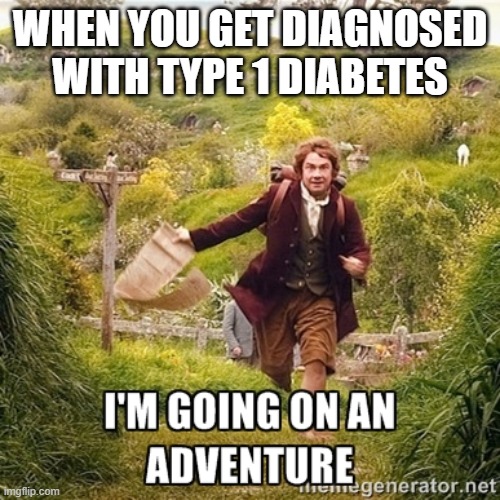
Memes for all occasions

Looking back at the start of this adventure I was woefully ill-placed to deal with it - not that there's ever really a good time to get diagnosed with a chronic condition but still...  A few ridiculous things really stand out from those first few months.  I remember being told to make sure I'd eaten before playing football at university so I'd cram all sorts in before a match and wonder why I was sky high afterwards.  I started off on mixed insulin so there wasn't really a concept (that I'd be told about at least) of correction doses so I just lived with it.

When I switched to basal/bolus a year or so later, that felt like a little more freedom, but I was still walking around with way too little knowledge in my head.  That's diabetes knowledge for those giggling at the back...  While I finally had the tools to finesse my own self-management, I didn't have the understanding.  One unit for 10g of carbs seemed to work, but I'm sure it took years for me to ask what would happen if I did insulin without food and finally understand if my levels were high I could just do insulin to fix it.  Seems so obvious now, but it was alien to me for so long.

And (as I gratuitously wield my crowbar) it got me thinking about other paths I'd not taken because of things I didn't know or was scared of finding out.  Opportunities I didn't take, places I didn't go, girls I didn't ask out, invitations I turned down... all because I was unsure of myself or scared.

Justin Whang 🐙 on Twitter: "Crazy how the "you posted cringe ...

I think what it made me realise (at nearly 1am...) is that the stress and anxiety that I've really only consciously started to be aware of has actually been around for a really long time.  Looking back, some "coping" mechanisms have been fairly common over the years (however cringe-worthy they were and how hard they are to let go of), some of the anxiety symptoms probably date back over 25 years.

So I think there are a lot of things I wish I'd known.  All the stuff I've accumulated over nearly 20 (TWENTY) years of living with diabetes would obviously have been hugely beneficial way back in 2001.  But I've been struck again by how much the mental aspects have been so important. Not just in terms of missing out on lived experience, self-confidence or self-esteem, but that overlap with managing the physical bits.

I had a conversation with someone recently about how easy it feels now to instinctively know what my insulin doses should be, and that the textbook answers don't reflect what I intrinsically know to be true about my own care.  But whilst that trial and error, and learning from those mistakes has been tough at times, it feels easy in comparison to understanding and managing things that aren't tangible or don't manifest themselves as physical problems to solve.

I don't know... it makes sense to me, and if you can relate too, that's good.  Happy diabetes week.  Until next time

Stay safe x

Monday, 25 March 2019

Back again

I've dusted off my password and come back to write something.

If you've been keeping up-to-date with any of my social media, you'll know I'm running the London Marathon in just under five weeks.  Whilst this post is loosely based around that, it's also some thoughts on change.

I was in a similar position seven years ago as I prepared to line up for my first ever marathon.  Back then it was all unknown territory for me - how do you run 18, 20 or 26 miles?  How do you do it whilst managing a health condition like Type 1 diabetes?  How do you keep going when it's easier to give up?

Thankfully I managed to find answers to all those questions, and now I find myself reflecting on what's changed, and what's stayed the same since 2012.

Well, I'm still not built for running so I'm fairly sure my training schedule isn't keeping Eliud Kipchoge or Mo Farah awake at night.  And of course I still have diabetes to contend with, which is very much the added X-factor when it comes to long distance running (for me at least).


What's changed?


Of course lots of things have changed too.  For my first marathon, insulin pens were my treatment regime and so reduced basal injections the night before and the morning of the run were vital for keeping my bloods under control.  Looking back now, it seems pretty crude, but it definitely did the job.  By 2014, for my second marathon, I'd switched to a pump and the added level of finesse to tweaking basal rates was hugely helpful.

Technology has come a long way since then, and so this year I'll line up with a flash glucose monitor sending my blood sugar readings to my watch every five minutes (assuming it holds up under a sea of Bluetooth interference).  That should help even more as I should be able to ward off any signs of low blood sugar a long time in advance.

'Score one for older and wiser...'


I've also not managed to defy the aging process and so I'll head off a month shy of my 38th birthday and feeling every single day that I've aged since last time.  It's clearly affected my memory as well, because I'd forgotten how unrelenting the training is to be able to run/walk/shobble/stagger over 26 miles.  That said, the wonder that is Facebook's "on this day" feature told me my recent 20 mile run was 30 mins faster than my first attempt over that difference way back in 2012.  Score one for 'older and wiser' there I think...

I've changed jobs since my last effort too, and so there's an added layer of tiredness to factor in beyond a) the actual training and b) being nearly 40.  I'm usually travelling around the country once or twice a week, so earlier starts and fitting runs in early before work, or after a long day have become the new norm - but a manageable norm.

'How do you keep going when it's easier to give up?'


For me, the big question was the last one I posed at the start... "How do you keep going when it's easier to give up?".   Of course, that's really a life question, not just a running one, though it definitely applies when you're feeling sick after 18 miles.

It's invariably a diabetes question too, and I guess the answer is really the same for everything - "I don't really have a choice".  It's not a cure for Type 1 I'm desperately after, it's a day off.  It is utterly relentless and at times it's all consuming.  The advent of technology I celebrated a few paragraphs ago also brings with it some tougher aspects.  If it's hard to switch off from a chronic condition when you're connected to an insulin pump, it's basically impossible if everytime you unlock your phone, there's a blood glucose reading staring you in the face.

Sometimes it's OK.  Sometimes it's mocking you for a bad decision you made a few hours earlier.  But it's always there.  I've long thought that diabetes has me so tight in it's Stockholm Syndrome-like grip that I'd be lost without it in my life.  But when that's all said and done I'd take a 24 hour respite in an instant.

So... how do you keep going when it's easier to give up?  I guess the answer is 'by any means necessary'.  On marathon day, it'll be the promise of a medal (and my first bit of proper junk food in months).  With diabetes I fundamentally don't have a choice and it's remembering that I'm doing the best with the tools, knowledge and wisdom that I've got.

Anyone can have a bad day, and we'll always be our own worst critic, seeing ourselves in a crueller light than anyone else ever would.  I'm not going to compare my finish time to anyone else's, and I won't do the same with my health.


I'm running the London Marathon on Sunday April 28th for Diabetes UK - a charity very close to my heart for a lot of reasons.  If you'd like to support them by sponsoring me, you can visit my JustGiving page to donate, and to get regular updates on my training as the day approaches.  Despite working for Diabetes UK, I have no say over how your donation is spent.

Tuesday, 18 April 2017

What did I used to know?

Before the world began to teeter on the edge of nuclear annihilation and every media outlet imaginable turned into Politics 24/7, I was thinking... "what did I used to know?"

I used to know a lot of stuff.  I've studied, been to places, met people, cooked food, heard music, and many other things besides.

Credit: Anchorman and Google and whoever made this pic
But I'm fairly sure there's stuff I did know that's kind of... seeped away.  Not important stuff obviously - I still know the words to every Arctic Monkeys song, most of the dialogue to Terminator 2 and my daughter's name.


Well I couldn't, but....


But I genuinely think my brain has given up on some stuff.  I found my Master's dissertation the other day and whilst the general topic was vaguely familiar, I don't remember a word of it.  I agonised over that, read papers, had meetings... I even went to the library!  (This was before the internet was really a thing...)

So what has all this fantastic(!) knowledge been replaced with?  Carb values - that's what.

Slice of medium bread?  15g - 18g of carbs.

Decent biscuit (like a chocolate digestive)?  10g of carbs

Rice Krispies?  85% carbs mate.

It's like living in the Matrix for all intents and purposes - you see the numbers floating in front of you everywhere:


Banana? 25g - 30g 

I mean of course this is slightly dramatised for effect, but I think we're so accustomed to seeing food as numbers (and recalling those numbers on a daily basis) that it certainly feels like the stuff we used to know has simply disappeared.

I'd ask you what you've all forgotten since you started being able to recall carb values on command, but I bet you can't remember...

Until next time, hasta la vista baby.

Saturday, 25 March 2017

Sometimes it doesn't quite go to plan

Last night I had a hypo.

Nothing overly unusual there really. Whilst thankfully not a daily occurrence, low blood glucose does play a frustratingly regular part of my life. This time it was different.

Since gate-crashing the last day of the Diabetes UK Conference a few weeks ago, I've been trying (with a modicum of success) to get back into some better habits with my diabetes. As with anything, it can be easier to slip out of a routine than stick to it.

So Friday night rolled around and in some vague celebration of us both being at home on the same evening, my wife and I settled on a Chinese takeaway (hurrah!) "It'll be 45 minutes" they said. I figured this was another good opportunity to get back into the habit of pre-bolusing for my meals. Takeaway is a bugger to get right at the best of times but I figured I'd give myself a fighting chance and get out in front of it.

To cut a potentially tedious story short, the food arrived late, I didn't check my levels before I took my insulin and I had an utterly rotten hypo. I've had a few bad ones before. I've sat on the bathroom floor at 2am for an hour chomping on Glucotabs like there was no tomorrow. I've eaten jelly babies and watched my levels go down instead of up. But I've always remembered those experiences - cautionary tales are often the best right?

This one was different. I remember eating a couple of marshmallows that my wife brought me (but I don't remember eating the others she gave me from the bag). I remember accusing her of stealing my glass of water (which I had in my hand) and I remember picking my dinner back up (but don't ever remember putting it down). It was almost like an out of body experience in a way. I knew I was hypo the entire time, I remember going through the motions of fixing it all, but at the same time I feel like I can't remember any of it. The best I can liken it to was like waking up from a dream.

This isn't a sob story by any means. Just another cautionary tale to add to the list. Taking my insulin without checking my blood glucose was, at best, misguided; more likely downright idiotic. Not checking my glucose until the food arrived was equally foolish. Trying to fix a hypo with chicken chow mein is simply an experiment that need never be repeated.

Image boosted from the Wikipedia article in the link below


It's a reminder to me, at least, how fragile the equilibrium with diabetes can be. It's the saddle point we're all subconsciously trying to ride as much as possible.  It doesn't take much to knock us from that point of safety.  As is often the case, my idiocy was my downfall this time.


I'm not blogging as frequently on here.  I maintain it's only worth writing when I've got something to say.  My Diabetes UK blogs still get published roughly once a month and if you're interested, you can find them on their blog site

Sunday, 6 November 2016

T1D Looks Like Me

November is DIABETES AWARENESS MONTH (though I'm fairly sure every month is Diabetes Awareness Month...).

The current JDRF campaign for #T1DLooksLikeMe got me thinking about diabetes awareness.  I suppose to some extent there's a lot of awareness of the concept of diabetes at least.  The last few weeks alone have seen numerous TV programmes attempting to highlight some of the long term complications of diabetes and talking about what can be done to reduce the risk of developing Type 2 diabetes in the future.

The thing about living with a chronic illness like Type 1 diabetes is that it's all the things people don't see that really define what your life is like.  To borrow from Public Enemy, those who know, know; those that don't have no idea.

This is for those who don't know (yet).

Fourteen years of Type 1 diabetes in just four numbers

I've had Type 1 diabetes for just over 14 years.  I've had good days and I've had great days.  I've had bad days, and I've had terrible days, and I've had everything in between too.

As the graphic above says, I've had to inject myself with insulin almost 17,000 times (plus around 450 cannula changes since starting with an insulin pump in early 2013).  That's something that never gets any easier for me.  There's still always a sharp intake of breath and a second of silence before the needle goes in.  I still remember being told on the day I got diagnosed that I had to inject myself in the stomach multiple times a day otherwise I'd die.

I've had to test my blood glucose levels almost 31,000 times in the past 14 years (or around 6 times a day, every day).  Some of my darkest times I've had living with this were when I abandoned testing pretty much entirely for around 18 months about five years post diagnosis.  I was lost and unable to cope with the idea of living with diabetes, so I tried to ignore it.  I found out the hard way that doesn't work.

'You see a meal, I see a problem to solve'

Living with Type 1 is relentless - a non-stop series of numbers that you have to understand and act on.  Eating becomes something entirely different.  Sitting down at the table, you see a meal, I see a problem to solve.  What's my blood glucose level now?  How many grams of carbohydrate are in this?  How much insulin do I need to take?  Is it the kind of meal that means my levels will rise later on (I'm looking at you here pizza...)?  And you have that thought process every day, every time you eat.  There's little wonder that people with diabetes are more likely to develop an eating disorder compared to the rest of the population.

It's the little things that sometimes take the biggest toll.  Cutting short exercise because your blood sugar drops too low, or not even being able to start exercising in the first place.  Spending 50 quid on a glucose sensor and having it in the back of your mind every time you get changed because you don't want to knock it off.  Wishing you could take a shower without catching your cannula (or making sure you don't catch the tubing on a door handle because it's agonising when it pulls out when you least expect it).

'Shaking, sweating, dizzy and your heart pounding'

And then there's dealing with the extreme levels of blood sugar.  The lows (hypoglycaemia) that leaving you  shaking, sweating, dizzy and your heart pounding, scrambling for some fast acting glucose to get back to 'normal'.  I don't think I know what 'normal' is any more.  The other end of the spectrum is the highs (hyperglycaemia).  Feeling sick and sluggish, the insides of your eyes feel like treacle and you're left with an unquenchable thirst until you've taken insulin to bring you back down to 'normal' (there's that word again).

Finally there's the quiet voice at the back of your mind, reminding you about the potential complications of this... thing that I live with.  Compared to the general population, I'm twice as likely to have a stroke or heart attack.  I'm at risk of developing long term kidney and eye problems as well as neuropathy (loss of sensation in the feet and other extremities) which can in turn lead to potential amputation in later life.  You have to live for today, but tomorrow is never far from your mind.

I think you adapt quite quickly to living like this.  There's no alternative really - doing nothing will get you in all kinds of trouble really quickly.  One thing I've learned over the past 14 years is that you never stop learning.  Talking to other people with diabetes, going on courses, going to support groups... there's always something new to learn and your body will always throw you a curveball when you least expect it.

This is what Type 1 is to me.  A constant sea of numbers, staving off lows, fighting highs.  Being awake at 2am because I desperately need something to eat, or bleary eyed, I need insulin to combat high blood sugar.  Living with a chronic illness isn't easy - in fact it's downright exhausting sometimes.  But it hasn't kept me down yet and hopefully it won't in the future.

Tuesday, 6 September 2016

Food Glorious Food?

I don’t have a good relationship with food.   I have to work harder at eating more than I do almost anything else.  I know that’s true for many  people with type 1 diabetes, and why wouldn’t it be? 

It’s a mental calculation every time we even think about putting something containing carbs in our mouths.  What’s my blood glucose now?  When did I last take insulin?  Do I need to correct?  How many carbs does this have?  Is it going to spike my levels or take a while to absorb?  And after all that, you either have to stick a needle in you or fish out your pump and dose appropriately.   That’s not a normal relationship by any standards.

My experience with food feels more complicated than that (if it’s possible!)  Four years ago, I weighed 215lbs (almost 98kg or nearly 15.5 stone).  I’d let my weight creep up and ignored what I was eating as long as I could get decent blood glucose readings.  This was less than 6 months after I’d somehow run the London marathon (weighing a lot less).  My reflection in the mirror finally persuaded me to do something about it and in three months I was down to 182lbs (83kg or 13 stone).

I’d always thought that losing weight was the hardest thing to do when you’re dieting, but actually maintaining any kind of progress really took it out of me and eight months later I was almost back where I started, feeling totally demoralised.  And so I did nothing about it for about 12 months.  Along with all the complexities that diabetes adds to eating, I started to view food as an enemy.  But of course the thing many of us reach for when we feel a bit low is food (because it’s delicious) and if you’re in a position where food is your best friend and nemesis at the same time, your relationship with it becomes more complicated.

Finally, something changed – I can’t remember what it was.  Another unflattering glimpse of my reflection most likely, coupled with a desire to change.  I’d entered another marathon and was determined I could run faster than my exploits over two years before.  I decided that actually losing a lot of weight would help me more than anything else.  Not lugging extra kilos of body fat around makes a big difference.  I embarked on a diet with a really strict calorie intake and a lot of exercise, and it worked!  I lost 45lbs (20kg or over 3 stone) by the end of the year.  It was hard work, but I actually felt good about myself for the first time in a long time.  I was at my lowest weight since I’d been diagnosed over 12 years previously, my blood glucose control was good (and I was running faster than ever too).

Now came the hard part – sustaining weight loss.  I’d tried once before and hadn’t managed it and I was determined to do better this time around.  I decided that I was probably at too low a weight to make sustaining it sensible in the long term.  I was eating around 1400 calories a day, running 20-30 miles a week plus other ad-hoc exercise.  I allowed myself a bit of a rise to keep some semblance of quality of life, but focused on what I was eating (and portion size too).

And it kind of worked for quite a long time.  Putting aside blips for holidays and Christmas, I managed a fairly steady weight for almost 18 months, eating pretty well, exercising regularly, and actually feeling pretty pleased (and dare I say, happy with my own body image).

Recently it fell apart again.  I had a running injury that stopped me exercising as much as I used to, which in turn pushed me back towards my comforter-in-chief… food.  A lot less exercise and a lot more food pushed my weight up at the start of this year to a point where I avoided the bathroom scales because I knew I’d hate the reading it gave me.  That reminded me of how I was with my diabetes about six years after diagnosis… I stopped testing because I didn’t feel in control of the results and I put it all out of my mind.

I know from experience that nothing good comes from that denial.  I felt (feel?) guilty about what I eat if it’s full of calories, but eating something like that gives me such a rush it’s hard to stay on track.  It’s almost like an addiction in some senses, and sticking to a plan of eating healthily requires an incredible amount of willpower.  Trying to convince yourself you don’t need one more hit of fat, sugar or salt takes a lot of effort.

My weight is currently back on the way down, and that feeling of control has returned (with my weight, and diabetes in general).  I feel like I can only operate at extremes though – full on culinary hedonism, or the strictest diet I can imagine.  Having a metabolism that seems to not need much fuel to keep the lights on doesn’t help either.   But even having lost 11lbs in the last month, I still look at my reflection and think I could probably lose a couple more…

I don’t think it’s easy to interact with food when you have diabetes.  I don’t know how typical my experiences are when it comes to the frustrations of balancing my intake with how I see myself.  I think as a community we talk a lot about managing the highs and lows of blood glucose (and the everyday aspects of diabetes), but we talk less about how food makes us feel… Maybe it’s because most of us don’t need to.  Or we don’t know how to.  I might be an outlier when it comes to managing food, but I suspect I’m not.

I’ve delayed writing this blog for a long time – mostly because I wasn’t sure I had the right words to express how it affects me.  That said, ‘guilt’, ‘denial’ and ‘frustration’ are words that are all too familiar when it comes to diabetes so perhaps they were there all along.

This blog also appears on the Diabetes UK blog site - you can read my most recent posts there by viewing my bio on their site

Monday, 11 July 2016

5000 Days with diabetes

Today marks a milestone for me.  It’s my 5000th day with diabetes.  It’s nothing special in itself I suppose – I’m coming up on 14 years since my diagnosis, and many people have lived with this thing for a lot long than I have.  But 5000 days… that’s worth considering.

Generally, looking back on life, we often find it hard to believe how naïve we were about a lot of stuff – laughing at our younger selves for not knowing things that seem so obvious to us now.  My relationship with diabetes is no different.

I remember my diagnosis.  It was the start of my graduate year at university, and I’d been flicking through a magazine when I happened upon a side-bar that was talking about some symptoms of Type 1 diabetes.  Reading through it, I was mentally crossing them off… tired all the time, drinking a lot (of water!), needing the toilet all the time… This had been happening to me for over a week.  I could never drink enough water to quench that thirst, no amount of Mars bars would give me energy to stop feeling lethargic (...seriously).  I couldn’t see the notes on the board from the front row of lectures.

So I went to see the campus GP and told her I’d read a magazine and I thought I had diabetes.  To be fair, I’d have been sceptical in her position – I suspect it’s the equivalent of Dr Google these days.  But  I had a blood test and got a call the next day…

“You’ve got diabetes.  I need you to go to the diabetes centre at the hospital…”
“Er…” *looking at lecture schedule* “I could go Wednesday afternoon?”
“I need you to go NOW.  Right now!”

And that changed my life.  There’d been a kid in my class at primary school who had diabetes.  He was insanely resilient – you never really saw much indication of it at all – he just got on with doing what other 8 year olds do.  We all knew he had to have a needle (and this was the 80s so it was proper needles) but that was it.

Now I was sat in a room in a hospital with my parents who’d just bombed up it the motorway, with a nurse (Vicky Clancey) who was telling me I had to inject myself every day (along with a lot of other information).  I think I asked if I could just have a pill or something not utterly terrifying but to no avail.  I came home with a mountain of papers, booklets and more medical supplies than you can shake a stick at and I got on with it.

Over the next decade or so I had a complicated relationship with diabetes.  I worked hard some of the time, and saw the benefits of it on that half yearly report we’re all so familiar with now.  Other times I gave up entirely.  I took insulin when I was supposed to, but testing became a thing of the past – used only to justify eating when I was low (both blood sugar and emotionally).  And I spent time in between those extremes, giving my health the minimum attention it needed.

I think all that changed about four years ago.  The chance to take part in a clinical trial looking at insulin pumps and education courses (here’s link to an article discussing the results) was a huge turning point in my life with diabetes.  It finally allowed me to fill in the huge gaps in my knowledge, gave me the opportunity to meet people in the same boat as me and let me see that there was a world of other people that I could talk to.  I spoke at the Diabetes UK Professional Conference earlier this year about how DAFNE changed my life, and I don’t think I could ever possibly state how much that is true (you can read/watch more about my relationship with DAFNE on the Diabetes UK Taking Control site).

So I look back at myself now, after 5000 days of counting carbs, injections, finger­-prick tests (sometimes!), set changes and I can’t help but laugh.  I wrote on the very first post on this blog (which started as a London Marathon training blog) that “Whilst I’ve been diabetic for the last 10 years, I’ve…never let it define who I am”.  I don’t think that could be any further from the truth now – at least in some sense.

I used to be a terrified young adult who’d never really accepted this… thing… he’d been given.  Someone who was scared to ask for help, didn’t want to hear about complications because I was too young - that stuff will never happen to me right?  Someone who felt so low he gave up looking after himself for almost two years without a thought to the consequences.

Now, it’s different.  Diabetes is absolutely a huge part of my life – it has to be.  I feel part of a community that I can ask for help whenever I need to, and I’ve made some truly amazing friends as a result of this condition.  It’s still not always easy by any means, but it finally feels like that millstone around my neck has turned into something a lot more manageable and, dare I say it, more positive than I’d ever expected.

I don’t think you can live with a chronic illness without experiencing highs and lows (…sorry) but I think it’s about how we emerge from them that really matters.  We all carry battle scars as a result of diabetes (physically and mentally), but we’re still here, we’re still fighting and we’re still living, not just surviving.

How I felt back in October 2002 is completely alien compared with my outlook on diabetes today.  You go through a lot over 5000 days and how you use that life experience is so important.  I’ve gone from being a naïve 21 year old to a 35 year old who understands so much more than I thought possible (or at least I think I do...). 

I’ll be almost 50 by the time I reach 10,000 days with diabetes.  There’s going to be a lot more to learn, but I finally think I’m up to the challenge.

Monday, 4 April 2016

Weight watching


Mondays pretty much start the same way for me every week… The alarm goes off around 5:45am, and, silently cursing, I take stock of how I’m feeling… light-headed (hypo), a bit stiff (hyper) or just tired (‘in range’)?  I drag myself to the bathroom and stand on the bathroom scales.  And I sigh.


Diabetes is an enormous daily battle that I won’t rehash for the millionth time here and now.  I’ve lived with diabetes for long enough now to be able make most days ‘better’ days, though I’m not impervious to the bad days by any means.


I’ve started writing this blog post a few times and I’ve held back – I’m scared of straying into unchartered waters and accidentally throwing opinions around on things I (and many other people) don’t really understand.  But here we go.


I can tolerate Type 1 diabetes most of the time, but where I struggle every day is with my weight.


About 18 months ago I devoted a huge amount of energy and effort to tackling my weight and lost 3 (and a bit) stone to get to a position I was vaguely happy with.  I cut my diet back to about 1200 (net) calories a day, ran 20-30 miles a week as well as doing four or five mornings a week on my exercise bike.  It was exhausting and took over my life, but I did it.  But that’s when it started to get difficult…


I’ve always found it (kind of) manageable to lose weight, but I’ve equally found it far too easy to put it back on again within a few months.  This time I feel like something is a little different.  I’ve had fluctuations obviously, but I’ve pretty much avoided piling the pounds back on.  But it’s much harder work than it was to get to this position in the first place.


What I’ve discovered is that actually, my body only really needs around 120-1300 (net) calories a day anyway and regularly eating above that means I’ll put weight on.  My diabetes consultant refers to it as being a ‘thrifty phenotype’ – basically if there’s an apocalypse, you’ll probably starve before me (sorry), but basically I don’t need a lot of food to keep ticking over.


This creates a number of problems for me.  The first, and most obvious one is that I LOVE food so I feel like I’m constantly faced with the choice of skipping one meal in favour of another.  Or I have the chance to go out and run 6 miles to be able have something.  Whilst I both love and loathe running (it feels like life support to some degree), my life doesn’t allow the same number of opportunities a week to pound the pavement, so more and more I feel like I’m choosing breakfast plus one other meal.


The second problem is food guilt.  I’m sadly not immune to the temptations of an occasional takeaway.   Having skimped on calories for the rest of the day (and/or been for a run), I’ve been known to dabble in a chicken chow mein from time to time.  The thing is that pretty much as soon as I’ve eaten it, I have an overwhelming feeling of guilt about what it’ll do for my weight and I’ll compensate for days afterwards too.  I have genuine regret about something I’ve treated myself to, and I’m pretty sure it’s not healthy (the guilt that is, the takeaway definitely isn’t…).  If I’m eating out at restaurants, I’ll pick a salad more often than not because it’s not a guilt-inducing.  Having a hypo is a nightmare when I feel like this – I’m eating calories that I don’t want to correct it and I resent them for it. 


The last problem is how it makes me feel.  I’m writing this after stepping on the scales to find out I’ve put an improbable 4lbs on this week, and it’s pretty much all I’ve thought about all day.  I knew last week I would have put a few on (about 3lbs) as I’d been away for Easter and it’s a lot harder to stick to a calorie goal while you’re away.  But being back home hasn’t improved things.  I know I used to be a lot heavier, but I look in the mirror and I’m fundamentally unhappy with how I feel.  I hate the nagging from my inner voice before I eat anything…


I’m used to seeing food as numbers – it’s impossible not to when you’re doing mental arithmetic before you eat anything.  But I see calories everywhere too, and calories scare me a lot.   Having diabetes puts me at a greater risk of stroke, heart disease and cardio vascular disease, than people who aren’t ‘in the club’.  I’m about twice as likely to suffer from one or more of those as a result of my diabetes, and being overweight doesn’t help my chances much either.


I’ve noticed that gradually, I’ve stopped cooking new things almost entirely because I know I can rely on the knowledge that what I eat most days, falls into safe zone and I don’t want to stray from that safety.  I know when I do stray, I’ll have put weight on. And when I put weight on I’ll be miserable until I’ve lost it all.  I feel like I’m resigned to logging everything I eat for the rest of my life to be able to stay at a healthy(ish) weight, and the though of that exhausts me.


I wrote recently about how a day off from having diabetes would be nice.  Having a day off from this food guilt and unassailable obsession with my weight would be nice too.

Monday, 28 March 2016

Libre - what do I reckon

I've been asked a few times (well, a couple of times), on Twitter what I think of the FreeStyle Libre so instead of sending a million tweets all at once, I've tried to summarise those thoughts here.  Remember this is just what I reckon* and bear in mind that at the time of writing, I've had a total of five weeks use out of their sensors.  For more thorough reviews over a much longer period of time, you should be reading Mike's blogs here.

* I'm going to keep linking to that video because a) it's funny and b) it's a reminder to keep grounded about our opinions on stuff generally

I've already written twice about the Libre:

- This is about how I felt before I started
- This is about my experiences of my first sensor

But I'll try and give some of my more general thoughts on it in case it proves helpful to anyone thinking of parting with the money for the first time.


  • It gives you more information, and (here's the caveat), with the right understanding, more information is very powerful.  It's not about the number of results - with the right tolerance for pain, you can get the same amount of data but the information (about what direction your BG is heading) is a very important addition
  • It can be a very motivating tool.  Diabetes isn't a game, but approaching it like one can be beneficial.  I get a big psychological boost from seeing the trace line staying within the bounds that I set spurs me on.  It also gives me confirmation that I know what I'm doing (at least some of the time), but...
  • When things aren't going my way (particularly when I'm high), I find the Libre very demoralising to the degree that I think it almost has an adverse effect on me.  Recently my BG was rising and rising and rising and I'd ruled out illness, bad carb counting, bad insulin/cannula... everything.  And still it rose.  As it's so easy to swipe and test, that's what I do.  And it makes me unhappy and frustrated which doesn't help.  With a fingerprick, I feel like I make much more of a choice to test, and so I can switch off from it if I want.   I don't approach it in the same way with a Libre.
  • It makes me feel more confident that I can correct from a relatively good reading (say 7.5mmol) to something 'better' like 6mmol and not go too low.  It's like it gives me the opportunity to nudge my BG either up or down to stay within my own target range.
  • I feel like I've ended up eating fewer 'proper' meals and started snacking more as it gives me the chance to feel more in control of how my BG is behaving.  I'm not sure that this sort behavioural modification is a good thing or not, but it seems to be an unintentional side effect.
  • It takes the stress out of some aspects of diabetes, particularly overnight basal testing.  Being able to get a full picture by swiping once every eight hours means I can test right before bed and first thing in the morning and start to identify any problem areas - I think that's a real positive.
  • The graphs and data the software gives you are very helpful.  I've never seen my own "ambulatory glucose profile" before, but I feel a lot better being able to see it.  The HbA1c estimator is also pretty helpful, and (in my limited experience), not far off being accurate either.
  • You have to decide for yourself how you define its accuracy.  I know what I kind of expect my BG meter to tell me when I start feeling low, and equally when I get that sticky feeling behind my eyes when I'm going high.  The Libre isn't always going to give me that same figure, but as long as I have that internal calibration, I feel pretty confident being able to dose or even correct from it's reading. But again...
  • Knowing its limitations is important too.  Don't use if before driving (always finger prick), don't use it if you've got an arrow showing rapidly falling (or rising) glucose - you need blood to really understand what's going on.
As with everything related to diabetes, it's all very individual.  You might end up with a reaction to the sensor adhesive (as I know a few people do), you might find it helpful where I find it frustrating (and vice versa), or may not find it 'accurate' enough.

I wasn't sure before I started using it but I think it was worth the cost of the reader and one sensor to understand what I was going to get from it.  If you can spare about £100 then I'd probably say go for it, just to understand what your experience is.  After that it becomes a more informed decision - you understand more about whether what you get is worth it for you.

Hope that's helped someone somewhere!

Friday, 11 March 2016

I wish

I wish that "what's my blood?" wasn't the first thing I thought every morning.  I wish that sometimes, waking with the all too familiar feeling of a dry mouth didn't set the tone for my entire day.  I wish that feeling light-headed at 6am didn't mean scrabbling around in the dark for jelly babies before I can have a shower.

I wish I could drive whenever I wanted.

I wish that sticking a needle in my fingers seven or eight times a day wasn't necessary.  I wish I didn't have to stick a needle in my stomach twice a week.

I wish I could go away for the night, for the weekend, for a week, without it feeling like a military operation.

I wish that being ill was just that - and not an assault on my entire body.

I wish that I didn't have to carry so much stuff around with me all the time.  I wish I didn't have to keep spare sets of everything all over the place.

I wish I could go for a run without ziplock bags of jelly babies.

I wish my blood sugar didn't have to dictate my mood.  I wish my partner understood my mood-swings.

I wish I didn't look at a plate of food and see numbers.  I wish guilty pleasures didn't try to punish me for hours afterwards.  I wish that carbs didn't sometimes feel like my enemy.

I wish it wasn't a fight.

I wish my brain would switch if off sometimes.  I wish I didn't think about test results.  I wish I didn't have a familiar hospital routine.

I wish I could go to bed when I was tired without needing permission from a finger-prick.

I wish that this list didn't represent every day of my life.  I wish that sometimes it was just a little bit easier.  I wish I could have a day off.

Monday, 7 March 2016

Maculopathy and worry

I'm a worrier.  There - I said it.  I worry about things that I suspect most regular people don't worry about... I spend a fair proportion of my time convinced I've mortally offended someone, and that the sun might not come up tomorrow.

Having a long term condition like Type 1 diabetes unfortunately comes with a fair amount of worry as standard.  The longer you live with  it, the more aware you are of what can go wrong.  Whilst some of it lies within your own control (stable, lower HbA1c, attend regular checkups, good diet, active lifestyle etc.), sometimes life throws you a curve ball.

For me, that came a few weeks ago after my annual retinal eye screening appointment...

"Your latest eye screening showed results of diabetic maculopathy..."

What?  Worry levels set to max.

A small segue to talk about language... is that sentence above what anyone wants to read?  No.  Is it a bit clinical?  Yes.  Is there a better way of doing it though?  Not sure.  If there's something wrong - I want to know.  An alternative along the lines of "there was something wrong/abnormal on your last screening..." is more vague and isn't less comforting.  Language helps, but here I think it's a tough one to crack.

So I phoned up and made an appointment for the eye clinic.  You may have noticed I was in Glasgow last week so I had to wait until today for my appointment.  Worry levels dropped slightly, but remain constant.

My confirmation letter turned up before I went to Glasgow and didn't fill me with confidence...

Maybe it's a test?
So this morning I took my daughter to school and headed off to the eye clinic.  By this time, I'd had chance to talk to a few people who'd received similar letters and nothing had come from it.  Worry levels lowered.

Now the thing with the Eye Clinic is that it's very different to the diabetes clinic.  Different hospital, different environment, lots of people there for a lot of reasons.

Thankfully the sign is big enough
It's basically chaos.  The whole thing is overseen by a receptionist with 10 different paper lists which she updates as people hand over their different coloured appointment letters (all whilst she's sorting some other problem out on the phone).  It's not welcoming in the slightest.  Worry levels increasing...

I'd got there early (overly worried about being late) and was whisked away for an eye test and some drops.  Interesting point to note is that if you're ever asked to read a line on the eye chart, you don't have to just try and read the bottom one (I thought it was a game).  If there's a red line across the middle, that's the average - anything below there and you're doing well!

"Drops will take 20 minutes to work and wear off in 3-4 hours.  Through the grey double doors and wait outside room 8 please"

This is the door opposite room 8.  Worry levels increasing.

Reassuring...
The 20 minutes of purgatory you go through when waiting for the drops to work is a strange time.  Your vision gets gradually worse whilst you contemplate your vision getting worse.  It's also a time for people watching (the national diabetes sport).

There's a lot of things to dislike about waiting rooms.  I often feel they're a window into your future to some extent.  A few people turned up with orthotic shoes on.  Someone else had an eyepatch.  Everyone was older than I was and it seemed unfair (not for the first time), that this was happening to me.  Worry levels replaced by despair.

Finally I got the call.  I'd been in the building for almost 40 minutes.  I was in the consulting room for another six.

The doctor told me (with a smile on her face), that I was the first Type 1 patient she'd seen for a while.  I smiled back, but wasn't sure I'd got the joke.  She told me my previous HbA1c results were good (thanks!) and I mentioned I'd had it tested in Glasgow last week and it was 49mmol/mol (or 6.6% in old money)...

"Wow" she exclaimed.  "Be careful!  Do you have any hypos?  Do you drive?"

As we all know by now, that one exchange is a blog in itself.  My HbA1c is above NICE recommended guidelines (and will no doubt stay there).  Of course I have hypos, I inject a drug that causes them if I don't eat exactly the right amount/do any exercise/it's a bit warmer than usual.  Of course I drive.  Why wouldn't I?  Normally, I'd have said something, but I'd had enough.  All I wanted to know was how bad the results were.  Worry had returned.  Despair had fled.

"Look here" she said, indicating to the top of her ear, shining a bright light into my eye.  "Look up".  More shining.  "And down" eye drops and bright lights don't mix well.  "To the left".  Almost over.  "Aaand right".  Repeat for the other eye.

"OK, I'm happy to discharge you from this clinic" she announced brightly.  Eh?  What?  You sent me a letter that said maculopathy.  That's bad.  I've been worrying about this for over a fortnight.  That's it?

"How do you mean?"  I asked.  "Just go back to normal eye screening every 12 months?"

"Yes, yes that's fine!  I mean there's some bleeding..."

"What now?"

"Yes but it's perfectly normal" she said as I climbed down off the ceiling.  "Sometimes when you've had diabetes this long, you'll get small bleeds in the tiny blood vessels, but it's any leaking we're worried about.  There were a few spots on the scan, but I can't see them now so it's all fine".

OK.  I'm convinced by that I think.  I picked up my coat and bag and paused.  It's still my appointment right?

"Can I have a look at my scan?"  I asked.  No problem.  "Can I take a picture?"  She looked a bit taken aback this time, but again, no problem.

So here it is.  This is the thing that's had me worried for over two weeks.  You might be able to see a few tiny yellow spots to the left of centre (depends on how big the image goes for you).  The bleeds are a little to the right, as tiny red dots.

Eye eye
"Nothing to worry about".... tell me another one.

Thanks to everyone that spoke to me about their experience of "that letter" before I went for my appointment today.  I won't name you here, but if you're reading this, you should know who you are.  Your support was really helpful.  Thanks again.

Saturday, 5 March 2016

Transforming Transition

Now I’ll confess I never experienced clinic transition – certainly not in the way we think of it today.  I was diagnosed with Type 1 in 2002 at the age of 21 and after the usual few appointments with my DSN, I was thrown into the all too familiar world of adult clinic – sitting down with a consultant twice a year.

At the time, I wasn’t too bothered.  I was 21, starting my post-grad course at university – for all intents and purposes, I was an adult, and despite the whirlwind of diagnosis, I managed OK…ish…at the beginning.

So what about actual transition for those diagnosed at a younger age?  How are they supported (and indeed how should they be supported) in moving from a paediatric clinic to an adult environment?  Happily, that was the focus of one of the best (and most inspiring) talks I attended this week.

The session was split as follows:

  •         Setting the scene with the new diabetes transition sample service specification –Jonathan Valabhji, Bridget Turner
  •         Engaging with young people in transition: tools and training for HCPs designed by young people – Heidi Forsyth, Scott Graham, Megan Lott, Lois Marshall, Gemma Thomson
  •         Trust, transparency and growing up together: a western tale – Neil Black, Athinyaa Thiraviaraj


The balance that this gave was great – hearing about how it should be done looking at the guidelines, then seeing two real world examples of how it’d been done, one from the viewpoint of people with diabetes, and one from healthcare professionals.  I don’t think it’s overly controversial to say that, whilst DPC is a conference for healthcare professionals, the sprinkling of patient voices throughout brought some of the sessions to life – this was no exception.

So let’s begin at the beginning – why is transition important?   This came across well in all the presentations.  Bridget and Jonathan spoke about how our brain can take up to 25 years to fully develop and so support during this period is vital.  They also spoke about how audit data suggests that young people with diabetes receive poorer care than others (and we know the National Diabetes Audit doesn’t show brilliant care for anyone with Type 1 in particular).  Continuing my unofficial #DPC16 theme, Bridget gave a great example of individual experiences of transition:

How does transition make young people feel?
  
Some of the other challenges included young adults starting university and letters being sent to wrong or old addresses, making it harder for people to engage directly with the service.  Some felt they moved clinics too early, others too late.  Another example of how care plans need to be individualised.

The team from Diabetes Scotland set out one of the clearest examples of why transition is so important, giving this list of what’s happening in young people’s lives between the ages of 16 and 25.  “Try adding managing diabetes into all that as well”

What's going on in your life?  Just this...

There were examples of some good experiences too (which is encouraging).  Those who’d been to defined transition clinics, had had overlap (and continuity of care) with paediatric and adult services or had experienced ‘guided independence’ (i.e. a transition group offering peer support and education) reported positive experiences of transition.  So there are pockets of good practice which is good.  So how can those be expanded?

The Diabetes Scotland team gave a great presentation on the Youth Engagement Toolkit.  They’d developed a set of tools to be used by healthcare professionals with young people in a transition environment.  They included a training day for diabetes teams that was co-facilitated by young people, case studies and videos to better understand young people’s experiences and a Facebook group (plus signposting to it) for young people with Type 1.  These aim to help clinicians build a better connection between themselves and young people, are treat the individual, not the condition.

One quote from the Facebook Group summed up the feelings of one of the young people: “I had no idea that groups like this existed, literally only found out about this group today during a clinic visit.  Nice to know everyone else has the exact same problems and deals with the same stuff, including having the complete fear about every single clinic visit”.  That idea of the benefit of knowing other people all have the same frustrations was something I touched on during my talk in the education session.

The pilot study of the toolkit showed that 97% of healthcare professionals who completed the evaluation thought the toolkit would be beneficial.  I got the chance to meet the team after, and the passion and enthusiasm that came through from the young people involved was clear to see.

Finally, Neil and Athinyaa gave an incredibly moving talk about “Growing up together”.  The simple idea was that while young people are growing up with Type 1, the clinicians too needed to grow their idea of what care in transition should be like.   The first transition clinics in their area came into being in 2007, and whilst they consisted of adult and paediatric joint reviews, “it felt more like two individual sets of care, rather than joined up transition”.

Neil gave a truly moving speech about how social media became the first catalyst for change, back in 2012.  Experiencing tweet-chats on diabetes changed his view on how people were actually living with Type 1 day in, day out.  He said “The power of the diabetes online community cannot be over-estimated” and I think it struck a chord with a number of people in the room.  Athinyaa spoke about what changed over the coming months, talking about how communication skills became a central point of focus.  Instead of asking questions like ‘how is your diabetes?’ or ‘let’s talk about your blood sugars’, conversations became centred on the individual… ‘how are you?’, ‘what would you like to talk about today?’.  Agendas were set by the young person rather than the clinician.

The idea of them as a team ‘growing up’ really came across so passionately, and the journey that they’d been on to learn how to move to deliver that individual care was clear to see.

The speakers in the Transition session

Transition can’t be an easy time for anyone living with diabetes, and whilst I never experienced that directly, a lot of the messages about how young people can feel totally disengaged with their diabetes really struck a chord with me.  It’s refreshing to see that there’s now a (non-mandatory) service specification for commissioners when looking at transition, and being able to hear about experiences from both sides of the appointment table was really refreshing.  I got to speak to everyone involved in the session afterwards and the genuine emotional connection they all feel with the topic had definitely inspired the room.  We know there’s lots of areas for improvement in diabetes care (not least transition), but I think it’s got a lot of focus and good things are coming.

Glasgow 2016 - some personal highlights

There's more serious stuff to come from #DPC16 - a lot more.  But the conferences (#YDEF16 included) did have a personal side to them as well, and I wanted to get things down on paper before I forget them.

There's a good chance I'll return to this as and when another memory fights its way through the current brain fog, but these are the things that have stood out for me on a personal level over the last four days:


  • Meeting members of the #doc.  It's always top of the list when you get to meet people you spend so much time talking to.  Finally getting to meet (in no particular order) Laura, Kelly, Kris, Sandie, Dani, Mike, Ellie, Bob, Helen, Partha, Pratik, Emma, Becky, Ali, Neil, Pete, Sophie, Lis, Jon, Jane, Amy, Hannah, Jane-Claire and anyone else who I've definitely forgotten (sorry - can barely remember my own name right now).  Memories were made - I thank you.


  • Getting to speak at both conferences.  I think Kelly and I delivered a solid couple of workshops at #YDEF16 to say we'd only met for the first time the night before (and only had one practice run).  Standing up in the Arena on the first day of the conference and being given a platform to give my experiences on education at #DPC16 was a real highlight and I'm grateful to Bridget from Diabetes UK for allowing me to share the stage
  • Watching my friends speak.  I saw Kelly deliver a great speech about her Sugarbuddies experience, and Laura talk so passionately about NICE guidelines, both within a few hours of each other.
  • The 5k fun run.  It take a lot to motivate me out for a run before 7am.  But it WAS fun (sorry Ali) and it lead tomy fastest 5k time and the creation of...
  • The #DPC16 #DOC T-Shirt... a sixth form leavers present for the Conference Age
  • Sanofi Coffee.   The Sanofi stand was the default meeting place for everyone and I think it was a unanimous vote that their coffee was the best (other pharma coffee stands are/were available)
  • Seeing people you weren't expecting to.  Basically half of my diabetes team in Sheffield showed up for the conference which is not wholly unexpected, but running into so many of them in such a busy environment was a surprise, but a very welcome one
  • Hearing the conclusion of something I'd been a part of.  The very first lecture at #DPC16 gave the results of the clinical trial I took part in for two years.  I'd heard the headline news, but to see the presentation was very interesting (and a little controversial)
  • Meeting so many people.  Obviously putting faces to names from the #doc was incredible, but having the chance for a few words with those who'd spoken so passionately or chaired incredible discussions was a great opportunity.
  • Being part of something.  I wrote a quick overview of what seemed to be the messages of #DPC16 and I think to have been there and be part of that rising tide of change was a real highlight.  Having the chance to add my voice to the huge buzz that was already there is a highlight, and to be able to share what's going on with everyone was a real privilege
  • A couple of quotes.  Nick Oliver said at #YDEF16 "I don't know if any of you have had a hypo, but we tell people with diabetes to eat 15g of carbs and wait 15 minutes.  I dare you to do that".  Partha Kar told a room full of diabetes clinicians "None of you are experts. People with diabetes are the experts. We're all just specialists, at best".  It's reassuring how much they get it.
I think there's more to add to that list, and I'll no doubt return to this in the coming days as my brain settles down.  But for now, that's just a few of so many things that made this week special.

Friday, 4 March 2016

It's not the end, its a new beginning

As we started with a cliched "this is what it's like" post, we end with this "this is how it was" entry.  Except that it isn't the end - at least it better not be.  (I've got a few more blogs up my sleeve for a start).

The last three days of #DPC16 (I'm finding it difficult to stop typing that hashtag - muscle memory at its finest) and the first lead in day of #YDEF16 have been exactly how you'd imagine. Whirlwind, busy, chaotic, tiring and complicated... but also fun, eye opening, insightful, and inspiring.

Pretty much everyone I've spoken to on the last day has asked me the same thing; "How's it been?"  I think my answer's always been the same - incredible.  I probably ran out of proper superlatives at the end of the first day and just settled on that one.

I said at the very start that it's hard to describe the general buzz of the conference and I'm not sure I'm any closer to being able to articulate it now.  I don't suppose that matters too much.  What I think does matter is the messages that come out of the conference.  If you've followed along with any of my tweets, hopefully you've had a sense of both the content of the individual sessions as well as the overarching messages that I think have been present.

If not, I'm going to try and present that a bit more clearly over the next few paragraphs...

I wrote yesterday about how a lot of sessions had references to individual care, some more pointedly than others.  That really feels like the essence of a lot of what I've heard over the last three days.
  • Education needs to be individual, as the current offering doesn't suit everyone  
  • Targets for people with diabetes need to be individual because what's achievable is different for everyone  
  • Type 2 Prevention is potentially individual if we can identify those with specific factors making them more susceptible to the condition
  • Transition clinics for younger people with diabetes need to have an individual approach because there are so many individual factors to consider...

People with diabetes aren't numbers.  My diabetes isn't defined by an HbA1c score of 6.6%, cholesterol of 3.2, BMI of 28 any more than the conference is defined by being 3 days long, having 3000 visitors and containing over 100 talks.  You don't get a qualitative understanding by looking at numbers - context is hugely important.

We as people with diabetes know that how our diabetes behaves.  We know that our diabetes is different to other people's.  We know that our care has to be different to other people's because we are all individuals.  The message that care has to be provided on an individual basis came out again and again, and it was very encouraging to see.

There was a clear sense that it's time to stop talking, and start doing.  I think that comes with some caveats though.  "Doing" something isn't always easy - and I think that's where a lot of us feel a sense of frustration, people with diabetes and healthcare professionals alike.   But I think that tide is changing.

I've been fortunate to sit in on some sessions where clinical teams are doing something.  Whether that's redesigning transition services for young people, putting together an integrated care model for repeat DKA admissions, or building a new way of delivering diabetes services for people across an entire CCG.  There are groups of people across the entire UK saying "I know what needs to be done, just let me do it".

Change can be a slow process.  Within an organisation like the NHS it can feel glacial sometimes.  But it's coming - you can sense it.  To me, it feels like there are so many people, doing so much to change care within diabetes that it's going to be difficult to hold it back.  You'll get swept up in it one way or another and have to decide whether you want to ride the wave or drown in it.

So where am I going with all this?  The title of this post alludes to the start of the next chapter for all of us.  The conference has been an incredible experience for me, as I hope it has for every single person there this week.  But what do we do now it's over?  Can we go back to doing what we've been doing?  Was that just three days of information and "oh that's interesting" seminars, or was it actually the start of something?

I walked out of the conference centre this afternoon with a range of emotions.  But the one that I hope to carry forward most of all is that sense of inspiration to do something.  I've been fortunate to meet a HUGE number of people over the last three days, clinical and #doc folk alike.  Every one of them talks about making things better, about changing what isn't working, about doing something... It feels like it's my duty to carry that on outside of the conference walls.

I think if even half the people at the conference leave with that same sense of inspiration and empowerment, the changes we've all longed for in diabetes care will be with us sooner than we all thought.  It's the end of the conference, but it's the start of something new.


Thanks to Diabetes UK for the opportunity to attend the conference, to those who I met, however briefly, to those who stood at lecterns and spoke passionately about what they've already done and what they still strive for, and to those who followed along virtually... thank you.

Thursday, 3 March 2016

The future's bright

This one's short - I promise!

I want to start by para-phrasing that (disputed (scroll to the bottom)) Margaret Mead quote...

Never doubt that a small group of thoughtful, committed people with diabetes can change the world.  Indeed it is the only thing that ever will.

OK, it's a bit of a hatchet job on the original, but hopefully the sentiment is pretty clear.   Being at the Diabetes UK Professional Conference this week has reinforced my long held belief that the people actively working in the field (be it consultants, DSNs, researchers, dieticians, GPs or any healthcare professional) want to make a difference to the lives of people with diabetes.

But I've also had the opportunity to look closer to home and spend some time with some people with diabetes, both those speaking out as the small (but increasingly loud) patient voices, and those here blogging with me.  As I'm sure we all know, that peer-power is unquantifiably important and even just a small dose of it can be inspiring.

The end of the second day marked the moment where the patient speakers had done their duty (at least those I know), and we celebrated with a few drinks in the bar at one of the hotels.  What struck me immediately was the passion and enthusiasm that the people round the table spoke about their experiences of diabetes and diabetes care.  It's not surprising given how passionate everyone in the #doc is, but it's so refreshing to hear the words come out of people's mouths instead of reading them on blogs or in tweets.

Looking round the table, it's hard to not have faith.  To believe... to know that things won't be the way they are now forever because there are people out there that want them to be better... that know that have to be better.

I think we expect that from healthcare professionals.  They've chosen this field because they believe they can make a difference, and from what I've seen, they absolutely are working tirelessly to bring about that change.

But to look around a table at eight to fourteen people (depending on exactly when you looked) and hear what they have to say is inspiring.  It makes you want to stop whatever it is you're doing, listen, and go away and do something to make a change.  Then you remember that there are hundreds of people you could put round that table who share that drive, passion and desire to make things better for people with diabetes.

You can't help but know that it will get better, because these people, because you want it to.  I'm proud to know those people and I can't wait to see what they're going to do next.

Wednesday, 2 March 2016

Taking education to the masses

I’d had my eye on the Education session on Day 1 with equal excitement and trepidation.  The education campaign is one I feel personally connected to.  I felt like the DAFNE course I did has made a huge difference to how I manage my own diabetes, and so hearing a number of professional views on the subject was something I was looking forward to.

Equally, I’d been asked to give a short view of my experiences of education to the assembled professionals, so I was a little nervous about how that was going to go.

If you’ve not had a look at the Diabetes UK Taking Control campaign yet, I’d urge you to start there.  The campaign launched towards the end of last year, and is aimed at making sure everyone is given the chance to learn about their diabetes.  I think we’re at a point now where the evidence for education is no longer in question, we’re now looking at how best to get that education out to as many people.

The session was split down into five talks:
  •           Taking Control campaign – Bridget Turner
  •           Making the case for diabetes education – Charles Gostling, Helen Hopkinson, Alison White
  •           Getting people there – Vivien Coates, Anne Scott
  •           Adding options to the education menu – Sarah Newall, Rebecca Owen, Kingshuk Pal
  •           Addressing specific local barriers – Tahseen Chowdhury, Seonaid Morrison

Bridget set the scene, explaining why Diabetes UK are championing education and how using an adapted House of Care can be used as a model to deliver education to more people.

Bridget Turner (Director of Policy and Care Improvement at Diabetes UK),
discussing the adapted House of Care model for education

I gave my own (short) view on my personal experience of DAFNE, and why I think education is important.  I won’t dwell on my own personal views too much here, but I generally believe that education helps people become more active in their own healthcare and that in turn helps them achieve better outcomes.  I’ll save that for a separate post outside of the conference.

The stage was set for the other examples from the rest of the speakers.  Charles Gostling started off talking about how they deliver education to people in South London.  He made a great reference to the latest National Diabetes Audit (NDA) data, saying that without clear data, we don’t know where we do things well.  I think that’s a point that can’t be stressed enough.  Without getting side-tracked into a debate on NDA submissions, I think it’s really important to understand your starting position and data is the way you do that.

We know diabetes education referrals are generally low, the take up rates even lower.  Two key messages Charles got across were simple (but important ones).  Firstly, find out why people don’t take up the offer of education.  Secondly, share local success stories.  If someone is doing something well, make sure it’s publicised across your local area so others can learn from it.

Helen Hopkinson then moved onto how the education offering was redesigned, talking through the journey they went on to get to DAFNE (‘because it’s evidence based and we know it works’).  She made a great point that redesigning your education offering can be cost free but when looking at how to do that, you need to engage all your stakeholders.

Why choose DAFNE?
That second aspect sounds so fundamental, that it almost beggars belief that you’d have to say it at all.  It’s a pretty short-sighted approach to try and design something one group of people, that’s paid for by another, provided by a third and ‘marketed’ by a fourth without including them all in the process.  You wouldn’t expect it for iPhones, so why should diabetes education be any different?  It was eye opening in its simplicity.

“Getting People There” looked at reasons why people with diabetes choose not to attend courses (“I learned from other sources”, “more important things to do”, “don’t see the point”).  Some of these struck a chord with me.  I started out with the view that I didn’t need education, but now I’m a big advocate for it.  I think we need to do more to sell the benefits of people who could be persuaded to go if they knew what they’d get from it.  Others need a different model of support – as with everything related to diabetes, one size doesn’t fit all.

As we moved to the discussion on “Adding options to the education menu”, we saw some interesting and innovative ways Lambeth were engaging with different groups within their area.  As with the other parts of the session, there’s some blindingly obvious bits in there too.  If you’ve got an education offering, tell people about it.  Spread the word as much as you can, use community centres, library groups, church meetings – anyone you can – to widen the circle of people who know you have something for them.

One of the most interesting things that came up was the concept of taster sessions.  These are short (90 mins) sessions that act as an introduction to the larger scale education courses on offer.  They’re typically targeted at groups or populations that are historically harder to reach (the example they gave was the Sri Lankan community in Lambeth), or those where Did Not Attend (DNA) rates are higher.   With all the taster sessions, people were ‘followed’ to see how many attended a full course later.  That stood at about 10% for the first year, but it’s hoped to be higher for 2016.

The last bit I’d like to talk about was HeLP Diabetes – an online learning option for people with Type 2 diabetes.  I think it’s important to cover as a lot of people want more online support and if we return to this ground breaking idea of providing what people want, this ticks the boxes.
Around 50% of visitors to the HeLP Diabetes site come outside ‘regular’ working hours, when it’d obviously harder to provide traditional education like DESMOND.  Interestingly, despite some of the upsides to the online delivery (24/7 access, anonymity etc), it still faced some of the more traditional barriers, such as spreading the word about its availability.

I’m a huge advocate of education because I’ve got a deeply personal experience about how it transformed my ability to be in control of my diabetes.  I think the case for things like DAFNE is huge (given its evidence base), and I think that by selling the benefits of the education, we can convince those who have the time, but no inclination, to attend a course and hopefully go on a similar journey to the one I went one.

That said, it’s naïve to think there’s only one way to persist, and if we want to give the benefits of education to as many people as possible, we need to consider how best we offer that education to meet the needs of the many.  “Education is about interaction with others, whether that’s other people with diabetes, healthcare professionals, of your friends and family” – I think many of us who’ve been on a course, or have used social media to help us with our diabetes would agree with that.

The last word should go to Seonaid Morrison from Argyll & Bute on the West Coast of Scotland.  She gave an incredible talk (without slides after a technical problem), on how she crosses a huge geographical area to try and bring education to as many people as possible…


“When you provide education to people, you see the change in them. That's what gets me up and out of bed in a morning”.