Showing posts with label DiabetesUK. Show all posts

Monday, 25 March 2019

Back again

I've dusted off my password and come back to write something.

If you've been keeping up-to-date with any of my social media, you'll know I'm running the London Marathon in just under five weeks.  Whilst this post is loosely based around that, it's also some thoughts on change.

I was in a similar position seven years ago as I prepared to line up for my first ever marathon.  Back then it was all unknown territory for me - how do you run 18, 20 or 26 miles?  How do you do it whilst managing a health condition like Type 1 diabetes?  How do you keep going when it's easier to give up?

Thankfully I managed to find answers to all those questions, and now I find myself reflecting on what's changed, and what's stayed the same since 2012.

Well, I'm still not built for running so I'm fairly sure my training schedule isn't keeping Eliud Kipchoge or Mo Farah awake at night.  And of course I still have diabetes to contend with, which is very much the added X-factor when it comes to long distance running (for me at least).


What's changed?


Of course lots of things have changed too.  For my first marathon, insulin pens were my treatment regime and so reduced basal injections the night before and the morning of the run were vital for keeping my bloods under control.  Looking back now, it seems pretty crude, but it definitely did the job.  By 2014, for my second marathon, I'd switched to a pump and the added level of finesse to tweaking basal rates was hugely helpful.

Technology has come a long way since then, and so this year I'll line up with a flash glucose monitor sending my blood sugar readings to my watch every five minutes (assuming it holds up under a sea of Bluetooth interference).  That should help even more as I should be able to ward off any signs of low blood sugar a long time in advance.

'Score one for older and wiser...'


I've also not managed to defy the aging process and so I'll head off a month shy of my 38th birthday and feeling every single day that I've aged since last time.  It's clearly affected my memory as well, because I'd forgotten how unrelenting the training is to be able to run/walk/shobble/stagger over 26 miles.  That said, the wonder that is Facebook's "on this day" feature told me my recent 20 mile run was 30 mins faster than my first attempt over that difference way back in 2012.  Score one for 'older and wiser' there I think...

I've changed jobs since my last effort too, and so there's an added layer of tiredness to factor in beyond a) the actual training and b) being nearly 40.  I'm usually travelling around the country once or twice a week, so earlier starts and fitting runs in early before work, or after a long day have become the new norm - but a manageable norm.

'How do you keep going when it's easier to give up?'


For me, the big question was the last one I posed at the start... "How do you keep going when it's easier to give up?".   Of course, that's really a life question, not just a running one, though it definitely applies when you're feeling sick after 18 miles.

It's invariably a diabetes question too, and I guess the answer is really the same for everything - "I don't really have a choice".  It's not a cure for Type 1 I'm desperately after, it's a day off.  It is utterly relentless and at times it's all consuming.  The advent of technology I celebrated a few paragraphs ago also brings with it some tougher aspects.  If it's hard to switch off from a chronic condition when you're connected to an insulin pump, it's basically impossible if everytime you unlock your phone, there's a blood glucose reading staring you in the face.

Sometimes it's OK.  Sometimes it's mocking you for a bad decision you made a few hours earlier.  But it's always there.  I've long thought that diabetes has me so tight in it's Stockholm Syndrome-like grip that I'd be lost without it in my life.  But when that's all said and done I'd take a 24 hour respite in an instant.

So... how do you keep going when it's easier to give up?  I guess the answer is 'by any means necessary'.  On marathon day, it'll be the promise of a medal (and my first bit of proper junk food in months).  With diabetes I fundamentally don't have a choice and it's remembering that I'm doing the best with the tools, knowledge and wisdom that I've got.

Anyone can have a bad day, and we'll always be our own worst critic, seeing ourselves in a crueller light than anyone else ever would.  I'm not going to compare my finish time to anyone else's, and I won't do the same with my health.


I'm running the London Marathon on Sunday April 28th for Diabetes UK - a charity very close to my heart for a lot of reasons.  If you'd like to support them by sponsoring me, you can visit my JustGiving page to donate, and to get regular updates on my training as the day approaches.  Despite working for Diabetes UK, I have no say over how your donation is spent.

Thursday, 31 March 2016

Together, we will go our way

This is the 100th post on We Were Promised Hoverboards, and this time I'm handing over the reins to a couple of incredibly inspiring healthcare professionals.  

When Neil and Athinyaa spoke at DPC16 at the start of the month, everyone listened - it was a heartfelt, emotive talk about providing care to people, not patients.  This blog they've written continues that theme, and it's incredible.  Enjoy.

It'd been a few years since I attended Diabetes UK Annual Professional Conference. I used to find some of the sessions interesting and helpful, but really I preferred other conferences for technical content and it was foremost a networking event and somewhere to catch up with colleagues. Last year I had the chance to attend just one day after several year’s absence. This one was different and it tugged on a heartstring. You see, in the last several years, in the last years of my training and first years of being a consultant, I had also changed.

What was different about #APC2015? It was people, people with diabetes were there. How was I different? The answer is the same as why I thought the APC was different: the relationship with people living with diabetes. So, what changed in me? Had I been a bad doctor? Had I a bad attitude? The answer lies in a question. My colleague, Athinyaa Thiraviaraj and I were asked this question by Dani @danianddanzel a few weeks ago. The two of us had been working together for more than 3 years by this time. We'd been slowly bouncing thoughts and ideas past each other in reaction to the vagaries and trials of diabetes care, whether that was in the acute setting or clinic.

Dani asked what had motivated us to make changes. Was it our patients? She guessed that we wouldn't have made the change otherwise.  As we responded together, all the thoughts and ideas that we'd been talking over the last few years crystallised out.  Athinyaa said she thought it was both a difficult and easy question. She agreed that we both knew who had motivated us - people living with diabetes themselves. 

My first thought was about insight, or self-awareness, a sense that things weren't going right in what I was trying to do for people.  I'd chosen this life, spent years studying, doing exams and practicing medicine. Surely, if anyone, someone like me should know what is important in diabetes care and the medical risks involved. Why couldn't the people I saw in clinic see that these things were important? Why couldn't I get this across? Even at the end of my training I knew that sense of failure was inside me; I was already realising that I wasn't getting through to people like I thought I should. 

As I became established as a consultant, after a year or two, I gained something that I did not have as a trainee: continuity.  In seeing people again and again, relationships began to build as I got used to people and they got used to me. As that happened, I could see that people living with diabetes had needs that were different from what I was giving. I struggled with that knowledge. I had felt a failure. I had to admit that before I could change. That's the most difficult part. Nothing can change without admitting that there is a problem. Athinyaa has been really clear that where we were now in our careers was a factor; we were now consultants and so truly owned our decisions. It takes an empowered clinician to believe in empowerment.

So what were the actual changes? We started listening. It was as simple as that. We listened to the person sitting in front of us in clinic, the person in the ward and even in the high dependency unit. Listening was simply that: actually hearing what the person wanted to say, giving space, allowing them to say what they wanted.  In active listening we showed congruence, we were in the room with the person, not thinking about their numbers and risks.  It allowed us to express empathy. In accepting what they felt important at the time, understanding how people actually felt and what they wanted we learnt more about them, as a person. Yes, numbers and risks were important to us as clinicians and maybe to the person talking beside us, but maybe ‘the numbers’ weren't top of the agenda for the person themselves at that time. Looking back, we both had respected people with diabetes before, but now we had begun to demonstrate that respect better. 

Listening was a main factor in the other great catalyst, the diabetes online community. We listened there for weeks and months before actively taking part. It has helped change us further, adapting our attitude, behaviour and language. We both found that the more we changed, the more rewarding it seemed for both the people living with diabetes we were caring for, but also for us as healthcare professionals. It was a win-win scenario. 

It is very difficult to make these changes.  Medical training schools us to listen, extract information as a clinical history, analyse it and come to a conclusion about diagnoses and management plans.  As Athinyaa is fond of saying, the clinician needs to put aside the 'fixer'. Life's problems don't have simple fixes, unlike medical problems. We defined the medical / diabetes problem on our agenda, but what about the person, what about what they valued and wanted? You cannot separate diabetes from someone's life. As I heard pointed out recently, if you hate diabetes, you hate a part of yourself. 
The change was that we were listening to the person. We were separating the person and the problem, leaving aside the medical problem and the 'fixer' and listening to the person. Setting aside the medical problem as we saw it, it left us able to hear them. In doing so, we moved away from the traditional directive model of care to a partnership with the person with diabetes. A vital part of this partnership recognises the person with diabetes as the Expert.   Our role is to be one part of the person’s wider support, adding our own knowledge and skills as diabetes specialists to theirs. And yes, this relationship based on trust is about mutual respect, but we believe that the healthcare professional must offer this respect to the people living with diabetes before deserving or expecting it in return.

The people who we saw in our clinic responded with impromptu feedback. This was part of listening rather than a formal survey. It also happened through the diabetes online community.  They said the experience was better.  While we strongly believed in this engaged supportive care, it was out of step with other colleagues. The feedback was important to us as we needed that encouragement to keep going. Every person with diabetes we have come in contact with, real and virtual, over the last several years has motivated us to change and adapt.

This was an organic change, to a culture of partnerships based on honesty, transparency, active listening and above all, unconditional positive regard. Now, we were not awful physicians to begin with, but to acknowledge our weaknesses and apply these principles in a focused manner meant we were able to enter into meaningful engagement with the person living with diabetes.

So what changed? Just us - as individuals and as a team.
Why did we change? For the people who trust us with their health, because they always come first

@RNeilABlack
@athinyaa

#DiabetesWest

Thursday, 3 March 2016

Individual Care

This post is a bit of a mashup of a few different sessions that I attended on Day 2.  For the sake of consistency, today for me consisted of:

Janet Kinson Lecture

  • It's education Jim but not as we know it - Helen Rogers

Debate: Prevention of diabetes: Popping a Pill or Running a Mile
  • Popping a pill - Kamlesh Khunti
  • Running a mile - Naresh Kanumilli

Service redesign and attention to detail: can it improve outcomes in children and young people?
  • Improving paediatric outcomes: the Diabeter Experience - HenkVeeze
  • Target setting: what's new in the NICE guidelines? - Julie Edge
  • Blood glucose monitoring: Making the most of downloads - Iain Cranston

Quality in Care (QiC) Diabetes
  • My Diabetes My Way - Scott Cunningham
  • Sugarbuddies - Sarah Woodward, Kelly Carden

Individualising targets in diabetes: NICE or not NICE
  • Setting the scene: a patient's perspective - Laura Cleverly
  • Which target for which patient - Brian Frier
  • NICE guidelines: Type 2 diabetes - David Millar-Jones
  • NICE guidelines: Type 1 diabetes: a utopian fantasy? - Partha Kar

There was a lot of variation in the sessions I attended, and a great many highlights (including Kamlesh Khunti arguing against some of his own research in the Prevention debate, and seeing some of the people I class as friends deliver some great talks).

But what's becoming more and more apparent the more talks I sit in are a few key themes that are common:
  • Education plays a hugely important role in helping people with diabetes
  • Diabetes is an individual condition and care has to be individual (linked to education above)
  • Changes to care don't neatly adhere to a one size fits all strategy
What I'm going to try and do is bring in elements of both the Service Redesign and NICE guideline sessions to (hopefully) get across some of the ideas that make diabetes care challenging, both for people with diabetes, and for those delivering care.

The session on NICE guidelines in service redesign highlighted one very simple point - nothing is really that new.  The guidelines today and the guidelines from 1993 are markedly similar, though that doesn't necessarily make it easier for families to meet those guidelines.

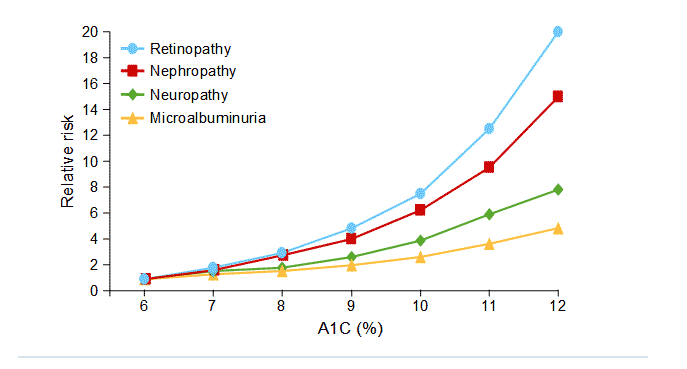
What was clear (and came up in other sessions) was that taking the HbA1c guideline of 48mmol/mol (or 6.5% in old money) definitely won't work for everybody.  Evidence suggests that an HbA1c at that level will reduce your risk of complications - but again that  doesn't make it easy to get to, or appropriate for everyone.

Relative risk of different complications vs HbA1c level

Julie Edge gave a great archery analogy - make 6.5% the middle of an archery target (i.e. what you aim for), sometimes you might hit it, other times you won't.  The further away you are, the more you need to make adjustments.

But making adjustments and setting the targets is where it gets tricky.  The target can't be 6.5% for everyone (and nor should it).  Making adjustments when you don't hit the 'bullseye' needs support and help.  Interestingly, even aiming for a target of 6.5% may not help you - studies show that if you aim for 6.5%, chances are you'll achieve 7%.

Aim for the left, you'll probably hit the right
What people need is individual support to understand what's appropriate for them and what's achievable based on their current circumstances.

In the afternoon, the NICE Guideline discussion started to a packed room (and an overflow room listening in).  Laura began with a stark statement - "Some of the NICE guidelines have made me feel like I've been put in a box where I don't belong" and I think that made a lot of people sit up and take notice.

Working through some of the new guidelines, Laura explained that clinic appointments with her consultant worked through her circumstances and looked at what external factors were impacting on her outcomes (such as HbA1c).  A visit to her GP was different - "You need to improve your control".  A question at the end of her talk asked for her views on individual targets for the guidelines - the answer was a simple one "Yes there should be individual targets, and NICE guidelines encourage it.  But how often is it actually done".

Brian Freer followed and spoke well about how targets could/should be set for individuals, and at the end there were a few questions/comments from the audience:
  • "If we say to a patient that their target HbA1c is 6.5% but we don't expect you to get there, then should be surprised if/when they don't?"
  • "If you pay GPs to hit specific targets, are they really going to set individual goals?"
  • "You can't treat diabetes by guidelines. You have to treat the individual in front of you."
There's a theme developing...

Partha took to the stage to talk about the practicalities of the Type 1 NICE guidelines.  He made some stark points that really should give food for thought.  He was keen to stress he wasn't criticising the guidelines but had some points he wanted to raise.

You could summarise his talk into a discussion of the language used in the guidelines.  
  • "People with diabetes should be offered an education course with proven benefit.... well we do offer it - it's just no-one goes.  Is 'offer' the right word?"
  • "NICE guidelines says people with Type 1 should have access to a minimum of four test strips per day.  Using four strips per day exists only in Narnia"
Partha rightly questioned the need for updated guidelines, asking if the last document hadn't made significant differences, why would the new one?  What I took away from what Partha said was that we know what the right things are, and the guidelines make that clear - they're grounded in evidence.

What needs to be better is the implementation of all this.  Writing the guidelines is a long process.  Making sure they contain proper guidance that will positively impact people with Type 1 (in this case) is no easy challenge.  But writing the guidance doesn't magically bring about change in how that guidance is translated to real world care.

Mike stood up at the end and spoke in response to Partha's session.  The one thing he said so passionately that resonated with the entire room was "I don't want you to tell me what's easy, I want to know what works.  If an HbA1c of 6.5% means I have fewer complications, I can understand how hard I have to work to get there.  How much 'better' is it and how much more effort is it to get from say 7% to 6.5%?  Then I can make that decision about what I think my target should be."

I think the theme of individual care has come across really strongly in many sessions in the conference already.  No-one I've heard thinks it's a bad idea - far from it.  There's a clear desire from healthcare professionals (and people with diabetes) to champion individual care.  We can't all fit into one box, we can't be given a one size fits all target.  We all have different support needs, we all have different requirements when it comes to how we engage with education.

The argument isn't about individual care.  The argument is about how we change the system to make sure that individual care is delivered to everyone with diabetes.

Wednesday, 2 March 2016

DPC16 - Impressions from Day 1

DPC Day 1

This is the standard ‘my first impressions’ blog about attending the Professional Conference.  I appreciate it’s probably a bit cliché, but hopefully it adds context to the rest of what you read about the conference.  Blogs on specific sessions will follow throughout the week (and probably into next week too).

No matter who you talk to, how much past experience you try and take on board, nothing can really prepare you for how BIG the Diabetes UK Professional Conference (DPC) is.

I felt like I’d had the benefit of a gentle lead into the chaos, having spent the day before the DPC at the Young Diabetologist & Endocrinologist Forum, running a couple of workshops with Kelly (@DiabeticQueen1) on what it’s really like to live with an insulin pump (I’ll save that for another time).  I’d had a day to get my bearings for the most part and I’d been through the session planner a week in advance so I had a good idea of what I wanted to see.

But DPC is BIG.  There’s over 3000 people at the conference, many of them great leaders in their fields, others desperate to hear them speak, even if it’s just for a short time.  Typically, there’s six sessions running concurrently with a few coffee breaks sprinkled in throughout the day in the huge exhibition room.  It sounds chaotic but it’s not.  It’s busy, but it’s an incredibly well-oiled machine.
Having hunted down our badges for the week, we piled into the main auditorium for the first round of lectures.  At this point it’s worth explaining how the day is split up – it sounds like overkill (and it’s a bit long to read here), but I think the context is important…

There’s roughly four big time blocks per day, each between 60 and 90 minutes long, each with an overarching theme.  There are six rooms that each run one of those time blocks concurrently.  And each time block contains two or three lectures.  That means in any given day, you’re likely to hear 10-12 individual talks across a variety of topics.  The 2016 Programme is here if you’re more of a visual person.

For the first day, I tried to split between things I had some interest in (it makes it easier to try and understand/write about), and things I felt were of a wider appeal.  Day 1 consisted of 14 individual talks:

Opening Plenary lecture session
  •           The Relative Effectiveness of Pumps over MDI and Structured Education (REPOSE) – Simon Heller
  •           Peptide Immunotherapy for Type 1 Diabetes – Colin Dayan
  •           Exercise for beta cell preservation in Type 1 diabetes: The Exercise for Type One Diabetes (EXTOD) trial – Rob Andrews and Parth Nardendran

Multidisciplinary approaches to managing admissions for DKA session
  •           A combined diabetes case manager and mental health approach for supporting people with multiple hyperglycaemic admissions – David Simmons
  •           The role of emotional wellbeing in DKA and one care pathway approach – Kirsty MacLennan
  •           Walking the tightrope of hyperglycaemia: education is not enough – Clare Shaban

Diabetes education: reaching the masses session
  •           Taking Control campaign – Bridget Turner
  •           Making the case for diabetes education – Charles Gostling, Helen Hopkinson, Alison White
  •           Getting people there – Vivien Coates, Anne Scott
  •           Adding options to the education menu – Sarah Newall, Rebecca Owen, Kingshuk Pal
  •           Addressing specific local barriers – Tahseen Chowdhury, Seonaid Morrison

What’s new in hypoglycaemia session
  •           Cardiovascular effects of hypoglycaemia – Simon Heller
  •           Evidence based pathway for the management of problematic hypoglycaemia – Pratik Choudhary

  • Mary MacKinnon Lecture

  •           West Hampshire Community Diabetes Service: re-commissioning community services and beyond – Kate Frayers


Fourteen talks across five broad subjects is a lot of information to take in.  I feel incredibly lucky to be here at the conference (and to have had the opportunity to speak for a few minutes within the Taking Control session) but it takes a lot of brain power to be on the go all the time.  Hopefully those of you following me (@BroomOwl) or the hashtag (#DPC16) on Twitter have got some sense of the huge amount of information being shared.  So back to the day…

The conference centre is big and you often find yourself rushing from one session into another, trying to grab a coffee on the way if you’re lucky enough.  The exhibition hall is where people tend to gravitate between sessions, though I’ll confess I’ve not actually taken a close look at anything there yet.

What really struck me was the mix of passion and knowledge on show, as well as the desire to make overwhelming change to the lives of people with diabetes.  That sounds a bit obvious really, but the sheer number of people devoting their time outside seeing patients to research, service changes and sharing best practice is really incredible.  It’s inspiring as a person with diabetes, I imagine as a healthcare professional it’s very motivating.

I’m writing this in the hotel bar at the end of the first day, reflecting back on what feels like a week’s worth of information I’ve had shoved into my head within the space of eight hours.  I’m trying to pick a favourite session, but it’s genuinely difficult.  I’ll freely admit some of them were very fast paced, and whilst I got the main messages from some, I couldn’t explain the research to you well enough.  Some (like REPOSE which I was a part of), were personally important to me, others, like the whole DKA session gave me something entirely new to think about.

Perhaps the one that struck the biggest chord with me was the education session.  REPOSE had shown in the morning that people using insulin pumps do no better than people on multiple daily injections (MDI) when proper high quality education is given.  The afternoon session showed that there were a huge group of committed individuals across the UK looking to deliver that message out to as many people as possible.  I’ll follow that up in a separate blog.


Thanks for reading my opening post, and thanks if you’re following along on Twitter.  Hopefully you’ll understand that a huge post on each lecture (or even session) is a bit impractical.  I’ll try and do one in detail and summarise some of the others along the way.

Tuesday, 30 June 2015

A little information can be a dangerous thing

Yesterday CrossFit caused what modern media would call a "Twitter storm".  Other people would call it a disagreement, a difference of opinion or simply a mistake.  Modern media loves hyperbole - me, not so much.

It started with this:


It's reasonable to say that this was certainly offensive to many people.  It's equally fair to say that what it's insinuating (Coca Cola causes diabetes) is also untrue.

I saw this shared a few times on Twitter and did so myself, highlighting to friends how inappropriate it was.  All the responses to that tweet were pointing out why the message was wrong, how insulting it could be and how people personally affected by diabetes had taken offence.

You'd expect CrossFit to realise the error of their ways, apologise and everyone could move on.  What they did instead was post a link to an article about how sugar was linked to diabetes.

At this stage it's worth pointing out a few facts, specifically that there are two types of diabetes.  Type 1 diabetes is an auto-immune condition and the cause isn't clearly known.  It typically presents in younger people but can do so in adults.  Type 2 diabetes is generally (but not always) brought on by being overweight and partaking in limited physical activity.  Gender, age, ethnicity and genetics also play a big part in determining if someone is more likely to get Type 2 diabetes.  

As you'd expect, a few people challenged Cross Fit about their link and as you can probably guess, CrossFit didn't really stop to think about what they were saying or how it was perceived.  Their next tweet said:


That's not true.  You can only have Type 1 diabetes or Type 2 diabetes.  You can't have both.  You can become more resistant to insulin over time if you have Type 1, but that doesn't mean you have Type 2 diabetes.

As you can imagine by now, this cycle of posting inaccurate information, only for it to be challenged by the knowledgeable diabetes online community continued.  One such tweet (since deleted by the CrossFit team) said this:


"and yet our point that diabetics shouldn't be drinking liquid sugar remains perfectly valid"

That's an incredibly dangerous and inaccurate thing to say.  It's also fairly irresponsible when you consider that over 293,000 people follow the CrossFit account (and some who aren't as well informed about diabetes are likely to believe it to be true).

For someone like me who has Type 1 diabetes, actually following that "advice" is potentially life threatening.  If I was having an episode of low blood sugar (hypoglycemia), something like Coca Cola would be absolutely necessary to stop me losing consciousness (and possibly my life).

It's easy to jump on the back of CrossFit (or at least whoever was in charge of their Twitter account yesterday) but I think the problem is more wide ranging than one errant social media account.  

The wider media perception of diabetes is that it's not necessarily all that serious, that everyone who has it does so through their own fault, and that by eating less sugar it's all entirely preventable.  For people living with the condition, it's both insulting and intimidating.  Attaching that level of stigma to a chronic illness is very irresponsible and can lead to people withdrawing, being scared to talk about their condition and not managing it correctly.

There's also some sort of implication that diabetes is fair game for jokes.  You don't see the same sort of things for other conditions like cancer (and rightly so I should add) because it's incredibly serious, life threatening and no-one's fault that they have it.  What people don't realise about diabetes is that all these things can apply equally.

At the start of 2015, Jamie Oliver apologised when being pictured next to a giant coke can with "Diabetes" written on the side in the Coca Cola font, stating that he was actually trying to highlight the lack of water in some American schools, where children were picking up sugar laden soft drinks  as there was no other choice.

As someone with diabetes, I don't expect everyone to know as much about it as I do or to understand how difficult it can be to live with.  Before I got diagnosed, I barely knew anything about it, but equally I didn't claim to know anything about it either.

As a person (diabetes or otherwise), I do expect those in a position to influence others (be it newspapers like the Daily Mail, or CrossFit twitter accounts) to report or comment on something serious after they've properly researched the full facts.  Passing off ill-informed opinions can have serious implications for millions of people and ultimately it's irresponsible to do anything other than be crystal clear with the truth.

The irony is that an active lifestyle is one of the best things you can do to help manage diabetes of either kind, and to help prevent Type 2 diabetes.  CrossFit seemed to be in the perfect position to use the facts to highlight how what they offer can benefit a lot of people.  Instead they chose to try and pull off something smug and fortunately it seemed to backfire.

Overnight (in the UK, during the day across the pond), it continued to rumble on.  There's something quite unsettling about watching an organisation who are clearly in the wrong continue to try and justify and defend their behaviour:


Firstly, as you can see above, "offending the sensitive" is apparently a small price to pay to ill-inform people.  For the record, I personally don't believe drinking excess amounts of anything is particularly good for you, not least Coca Cola.  But I also know that obesity is the link to Type 2 diabetes.  Excessive sugar consumption will most likely lead to obesity, in the same way that excessive consumption of anything calorific will do.  Eating sugar does not directly cause diabetes of any type.   Eating (or drinking) 'treat' foods (those higher in fat and sugar) should be done so in moderation.  Eating fresh fruit, vegetables, lean meat and some carbs is a balanced healthy diet.  But I say again, you can't get diabetes from eating sugar.


Next up, (just cut off at the top - sorry) is a triple whammy.  Firstly stating that any apology would be insincere, followed by a confirmation that making jokes about chronic illness is OK, and finished off, perhaps most staggeringly of all, by a tweet expressing disappointment about the "misinformation about diabetes and the role sugar plays in causing it".

If you've made it this far, the irony that CrossFit are the ones presenting misinformation is probably not lost on you.  Also EATING SUGAR DOESN'T GIVE YOU DIABETES.


CrossFit kept on pulling the trigger stating that if they have to insult "the sensitive" they will.  Well they don't have to insult anyone, 'sensitive' or otherwise.  They could just listen, understand and be more accurate in what they say.  Finally, they return to the scene of an earlier crime, stating that people with Type 1 diabetes can develop Type 2 diabetes.  No they can't.  Type 2 diabetes (as discussed way back at the beginning) essentially means your pancreas produces some insulin, even the tiniest amount.  Type 1 diabetes means your pancreas has no functioning beta cells (that produce insulin).  These two conditions are at odds - you can have one or the other, but not both.

At the time of writing this, I've not seen an actual apology from CrossFit for the way they misrepresented the facts.  They did post a few (subsequently deleted) tweets saying it should have been clear  they were only talking about Type 2 diabetes.  It wasn't clear, and it certainly wouldn't really have been any more accurate anyway.

They also posted this on Facebook:


When they say "the link between sugar and Type 2 diabetes is undeniable", they really should be talking about the link between obesity and Type 2 diabetes.

The also posted this on Twitter (highlighting that they absolutely haven't apologised):


I don't need an apology to make me feel better.  I know enough about diabetes to not need their validation or permission to do what I want.  I do want them to apologise for being lazy and irresponsible with their language that perpetuates the stigma of diabetes.

There's a reasonable chance you're reading this because you know me in some way, so you've probably read a lot of the science that distinguishes between Type 1 and Type 2 and nodded along.  Other people with a lot less experience of diabetes (like me 15 years ago!) simply do not know (and we shouldn't necessarily expect them to know) the difference, and are likely to be guided by the 'facts' that companies like CrossFit have misrepresented over the last 24 hours or so.

If you want facts about diabetes in this country, visit the Diabetes UK "Guide to Diabetes" page where you'll get accurate information.  Don't rely on companies with gimmicks to tell you the truth about something complicated.

There's a daily struggle to change that stigma that many people are subjected to that says having diabetes is your fault and you're to blame.  Some diabetes is preventable, but a lot of it (including all Type 1 diabetes) simply is not.  CrossFit haven't helped do anything to change that stigma and stereotyping and I think that's a real shame.

Apologies this has been long winded, but highlighting and disproving 'claims' like the ones CrossFit made today is really the only way that the perception will gradually begin to change and people with diabetes will stop being bullied, stigmatised, stereotyped and blamed about their condition.  We wouldn't put up with it for other long term illnesses, why should we stand by and accept it for diabetes?

CrossFit - #ImNotYourHomie

Friday, 10 October 2014

6489

So this is my final blog post anywhere before Sunday's Yorkshire Marathon attempt.

I say attempt because that's exactly what it is.  Despite all the training and hard work that's lead me up to this point, there's absolutely no guarantees of anything and I need to carry this determination over the start line and around York to get me to the end.

That's not to say I don't feel prepared because I think I am.  Definitely more so than I was two and a half years ago in London.  I've paid a lot more attention to my diet and training and I've focused on more than simply just logging miles.

I said recently that almost every day this year has been a lead up to this race.  Whilst I know I don't have anything to prove to anyone, I still feel like I owe myself something - that the first time I did a marathon wasn't really a true reflection of what I might be capable of.

I boldly said at the start of the year that I could knock an hour off my last time (5:30:41) and I still think that with some good conditions and a little bit of luck, that might be possible on Sunday. I think 4:45 is a more achievable time but I'm not going to put any pressure on myself to do anything until 18 or 19 miles in.

Experience tells me that the last 7-8 miles are the hardest and I'm hoping I can put myself in contention with something I can personally be proud of at that point.   If not, then maybe it just wasn't my day and whatever happens, I'll be glad to get round.

I read somewhere recently that running a marathon has become "normalised" to some degree.  Back in 1981 when the first London Marathon was staged, running 26.2 miles was a rare thing that few people outside of elite athletes even attempted.  My dad doing the 1989 marathon was what hooked me in from an early age.

Nowadays there are so many opportunities open to people that want to go that full distance (which I think is fantastic), but what I think it means is the effort that goes into preparing for a marathon gets lost.  Basically it's incredibly hard work for your average Joe like me. 

To give you some idea of what it takes to get to the start line, I've run 507.33 miles so far this year - roughly the distance from Sheffield to John and I've spent 86 hours, 16 minutes and 25 seconds training.  It's a huge commitment and it's very tiring.   But compare that to 2012 when I'd logged just under 195 miles (and just 36 hours running) it's a huge step forward.

Whilst running is mostly fun (and running in a big race with a big crowd is almost certainly the closest I'll ever get to being a rock star), it also has it's downsides.  It can be very painful, at distances over about 18 miles it can make you want to be horribly sick and you can ache in places you never knew existed.

Of course I have to manage diabetes alongside all that too which makes it a little more complicated.  I'm hoping I've had enough practice this year to have a clear strategy set out, and I'm hoping the jelly babies I'll be scoffing every few miles won't make me throw up (though you never can tell.

In short, I'm not taking anything for granted, but I'm hoping I can get round in a reasonable time and do so without injuring myself!

In 2012 I spent the day before the race watching The Hunger Games at the Odeon in Leicester Square.  This year I'll be at a networking day for Diabetes UK (conveniently held in York) meeting volunteers and other local group members, before having dinner and an early night.  It's good to have something to take my mind off it all and I'm hoping there'll be a lot to think about which will distract me whilst I'm running the next day.

Going to York is very much like going home, as I lived there for 10 years, and the start/finish will be at York University where I studied for four years.  I'm hoping it'll be a great weekend all round.

Finally, I just want to thank everyone who's supported me in one way or another.  I've received a lot of encouragement from friends and family and it's been great to see so many people generously donate to Diabetes UK.  I've raised £635 so far and I'm really hoping I can make it to £1000 before the end of the year.  I won't tell you all again, how much good that money will do (check any of my last blogs to see what I mean) but trust me, it really will make such a huge difference.  If you want to donate, then please visit http://www.justgiving.com/broomhead or text BROO81 10 to 7007 to donate £10.

I'll see you all on the other side with the verdict on how it went.

Thanks for reading.

Andy

Monday, 22 September 2014

Reasons to be cheerful

The Yorkshire Marathon is 20 days away now and I’m now fully focused on the last nine (NINE!) training runs before the big day.


I did my longest run yesterday – 22.2 miles – which is the furthest I’ve ever done in training and the second furthest I’ve ever done in my life.  The time of 4 hours 10 was a little outside what I’d hoped, but nothing too demoralising so I felt pretty pleased with it all things considered.  I didn’t push hard at all to be honest – didn’t tackle any of the major inclines on my route as I was trying to leave a bit of energy for the later, more gruelling miles.


I got to about 19 miles before I really felt like I was struggling but, that said, a lot of the last 3 miles was uphill which I took at a walking pace.  I’m also having to do these longer runs with a backpack carrying spare water as I can’t convince people to set up impromptu water stations for me around Sheffield.  Losing that bit of weight might make a difference.


I’ve decided that while a sub 4:30 marathon might still be a remote possibility for me, a lot of that will come down to conditions on the day.  You can train, plan and prepare as much as possible but sometimes things just won’t quite click and you’ll not get the performance you wanted.  Conversely, you can feel under-prepared and go out and have a great run.  I’m prepared to accept that unknown factor so I’ll just take it as it comes.  I feel confident I’ll beat my last time (5:30:41) and I’m quietly confident I can do sub-5.  Anything after that is a bonus.


This coming weekend will be interesting as I’m doing 20 miles on Saturday followed by another 6 on Sunday morning as part of the Great Yorkshire Run.  After that it’s some swift tapering before Race Day.


I’m also feeling pretty pleased about my weight for once as I’ve finally managed to get below 180lbs for the first time in about 5 years.  It’s fair to say that marathon training whilst dieting has played a major part in that, but I’m now looking to  just try and maintain this new weight.  It feels strange actively trying to find extra calories to eat (rather than avoid!) but I’m hoping it’ll build up my energy stores over the next few weeks and maybe make those last few miles a bit more bearable.


My diabetes seems to be behaving itself as well with all my post run blood glucose levels being in a ‘normal’ range.  I’m having to scoff most of a bag of jelly babies throughout the course of a long run but it seems to be paying off.  Hopefully that’s going to continue without incident.  It’s an added variable I have to take into account on each run and the longer I can keep it well controlled the better.


Finally it’s been a pleasing week from a fundraising perspective with people generously donating another £30 to take the total raised to £215 so far.  There’s still a long way to go to the £1000 target but it’s great to see the notifications come through about new donations – it really is an added incentive to get out and run.


I read something recently discussing how running a marathon had become ‘normalised’ because of the number of events and the number of people signing up for each one.  I think that is true to a large degree because it is a lot easier to find an event that it was 15-20 years ago.  But what that doesn’t do is normalise the amount of work that goes into preparing for running 26.2 miles.  It’s still an incredibly hard slog and the support that comes in from friends, colleagues and family makes a real difference.


As you probably know by now, I’m raising money for Diabetes UK so they can help to support the millions of people living with diabetes on a daily basis.  Diabetes is a chronic condition that directly affects more than 4 million people in the UK (and over 30,000 in my home city alone).   There’s also an estimated 700,000 people who may have undiagnosed diabetes at present, and seven million adults are currently at risk of developing type 2 diabetes.


The money I’m hoping to raise will pay for 20 qualified assessors to help people at risk understand what changes they can make to reduce their risk and be able to live a long and healthy life.


If you feel like you can spare a few pounds to help this incredibly worthwhile cause, please visit http://www.justgiving.com/broomhead or text BROO81 + your donation to 70070 (e.g. BROO81 5 to donate £5).


As always, thanks for reading.


Andy


Monday, 8 September 2014

Five weeks to go

I’m conscious I’ve not done an update for a while and with just under five weeks to go until the Yorkshire Marathon, I thought I let you know how I’ve been getting on.


I’ve logged just over 380 miles this year now and I’m on track to go over the 600 I’d planned for 2014 in total.  That’s quite encouraging in a sense because while I started the year pretty well, I had a huge dip around March/April after I’d done the Retford Half Marathon and it took quite a lot of motivation to get back out running at all, never mind training for a marathon.


I’m now very much at the business end of the training – three weeks of long runs and lots of miles, followed by two weeks of tapering (when I basically try not to undo all the hard work a fortnight before the big day!).  I logged 101 miles for August and I think September will be close to 120.


It was great to see the coverage of the Great North Run this weekend as I find it incredibly motivational to see all those people pushing themselves to their personal limits to get round the course.  Hopefully that’ll be what I can manage in a few weeks’ time.


Whilst running is obviously very much about overcoming physical barriers, it’s also crucial to be able to overcome the mental barriers too.  I’ve had my training plan set out for a few months now, but when it came to entering the last few long runs into my diary, I started thinking a lot more about what it means to run 18/20/22 miles just for training purposes, never mind the 26.2 miles for the actual race.  My wife has pointed out how physically and emotionally exhausted I was last time I tried this and she’s right – I was a complete wreck by the time I’d finished.  But at the same time, I’d like to think that no-one goes into a marathon thinking it’ll be anything but exhausting in every way. 


As a way of trying to promote a positive mind-set, I’ve been contrasting my first and second marathons:

 2012 London Marathon

Started training with one mile runs, having not run at all for over a year

Completely unknown territory – previous best distance was 13 miles about 15 year previously

Average mile times were about 11-12 minutes in training

Diet was mixed with no real information around the relationship between nutrition and running

Unsure how to deal with illness and injury – missed 5 or 6 training runs in the build up

Ran twice a week as pain meant any more wasn’t possible

Managing my diabetes whilst doing distance running was completely alien – lot of trial and error involved

2014 Yorkshire Marathon

Had logged over 700 miles in the run up to training

Know exactly what I’m getting into in terms of distance and the required mind-set

Average mile times are between 9.5-10.5 minutes and less than 11 minutes on hilly routes

More structured diet, eating the right foods at the right time

Able to handle niggles/aches/pain more effectively and better at preventing them

Run three times a week plus including non-impact training as well

Ready-made strategy to manage blood glucose levels whilst running and start/finish readings often almost identical


As you might gather from that, I feel like I’m in a lot better place physically which is very reassuring with my eye on Saturday morning’s 18 mile run.  I also think that mentally I’m a lot more clued up.  I know it’s going to hurt, I know I’m going to feel sick, that I’m going to have impossibly sore legs, and probably lose a toe nail or two along the way.  But ultimately I’m OK with that because it’s all temporary and I’ll live to tell the tale.  What I need to concentrate on is running my own race and not getting caught up in what other people are doing.  I’m not built to run a marathon in 3 or even 4 hours so putting myself down while reading about other people’s training isn’t going to help, and neither is trying to keep up with them on the day.  I’ve got to just zone out and do my best to ignore what everyone else does.


My training is currently focused on the end of September when I’ll do my 22 mile run on Saturday afternoon, and get up to do the Great Yorkshire Run (GYR) on the Sunday.  Thankfully I’m not looking to run any sort of fast time in the GYR and I’m just using it as a cool down run.  After that, my distances will drop to no more than 10 miles and I’ll be concentrating on keeping my legs fresh and injury free.


I feel like my diabetes has been incredibly stable over the last few weeks too which is good.  It often takes a while for me to get into a cycle where I can almost manage it without thinking and I feel like my current diet and exercise regime is really helping me at the moment.  I’m eating fresh, healthy food for every meal and I’m exercising regularly and that definitely shows in my blood glucose readings every day.  I’ve got an annual review coming up at the hospital in a couple of weeks so I’m hoping my consultant is going to be as pleased as I am.


As always, for those of you that made it this far, I’m going to finish with a little bit about the charity I’m running for this year – Diabetes UK.  There’s been a lot of press about charity recently and chances are unless you’ve been in outer space, you’ll be familiar with the Ice Bucket Challenge and the incredible amounts of money it’s raised for charities all around the world.  What you might not be so familiar with is how much charities like Diabetes UK rely on fundraising and donations to help the millions of people in the UK who either have diabetes, or are at risk of developing it.  As I may have mentioned before, almost 4 million people in the UK currently have diagnosed diabetes, with almost another 750,000 people who may have it but be undiagnosed.  Another 7 million adults are at risk of developing the condition in the future.


As I wrote last time, diabetes currently accounts for almost 10% of the prescribing costs of the NHS and this will only increase as more people get diagnosed.   Helping to educate those at risk to reduce the number of people with diabetes is critical, as is the ongoing support and education of those already diagnosed to reduce the chances of them developing serious long term complications such as blindness.  As if helping and educating all these people isn’t a big enough task in itself, Diabetes UK is a charity with a relatively limited budget.


To use another UK charity for comparison, Macmillan spent more than one-and-a-half times  the entire Diabetes UK’s 2013 annual income on their fundraising activities alone (£58.1m on fundraising vs £38m annual income).


Fundraising and donations are crucial to helping those with diabetes be able to live their lives and you can make a huge difference to millions of people by donating.   By running a full marathon, a half marathon and three 10km races, I’m hoping to raise £1,000 this year to make a difference to people with diabetes.  If you have anything you can spare, please visit http://www.justgiving.com/broomhead or text BROO81 + your donation to 70070 (e.g. BROO81 10 to donate £10).


Thank you.

Sunday, 10 August 2014

Rainswept

The most intense training week I've probably ever had is finally behind me...and I actually feel pretty good about it.

If you remember from last week, I was planning on 2, 3, 4 and 5 mile runs this week, using the shorter ones to try and have some actual speed and the longer ones to translate that into some pace over more miles.

Family and charity commitments over the next week or so meant I actually had to pull one of Week 4's runs forward into this week so I had an additional 6 mile effort in there too, making it 20 miles for two consecutive weeks which is something to be pretty proud of!

To say I've done 5 runs in 7 days (something I've never attempted before) I feel pretty good and my times have reflected that.   My average pace across the last 20 miles is 9:26 minute miles compared with an average of 10:13 for the previous week.

I know for most people, they aren't anything amazing to write home about (and I look at others on Twitter who are training for the same race and they're a lot faster).  The one thing about marathon running is that for 99% of people entering you're only really racing yourself - it doesn't matter how everyone else does so I'm trying not to pay too much attention to other people and just focus on doing what I'm doing.

I talked last time about how conditions are something you need to bear in mind when running and managing your diabetes.  This week the weather has given me a fair few challenges, varying between warm sunshine and monsoon rain.  Fortunately I've managed to take most of that in my stride (pun unintended).

The most difficult run this week was the 6 miler this morning (Sunday).  Having been out four times already meant I was pretty tired but I'd had one of those nights with my diabetes that meant it was all the more difficult to motivate myself to get going.  I'd replaced my cannula just before bed as the adhesive had lost its usefulness but this is something you should generally avoid because if you put the new one in wrong and you don't get insulin properly, it can be pretty catastrophic and you're unlikely to know during the night.

For some reason I still don't understand, the new one only lasted about 20 minutes so I was still up at nearly midnight putting a third cannula in (and sticking it down with surgical tape to be certain).  To make sure I was going to be OK, I set an alarm for 1:30am to get up and check my blood glucose (which was fortunately OK).  I then had a hypo at 5:30am so I was up again to eat and raise my blood before I set off to run.  That's a fairly good (but thankfully rare) example of a diabetes rollercoaster - highs and lows and the physical strain of dealing with everything in between too.

Thankfully I managed to get round in a pretty decent time and made it home in the rain before it properly bucketed it down.

Next week is relatively easy, two runs and some non-impact/strength work. I'll be doing 5 miles tomorrow (Monday) and then 12 miles on Thursday after work.  That definitely won't be fun as I'm not a huge fan of doing my long runs midweek, but needs must this time.  The distances are going to start getting bigger pretty quickly now so the next 6 weeks are crucial now.

I'll finish, as always, with a mention of the fantastic work that Diabetes UK do and why I'm raising money for them.  Living with diabetes isn't an easy thing to do a lot of the time.  Having a self managed chronic illness  takes a lot out you and knowing there's someone there who can support you is an incredible help.  Diabetes UK offer that help and support to millions of people like me who need it and to say it makes actually living life easier is a huge understatement.  If you can spare anything to help me reach my £1,000 target for 2014, then please visit http:www.justgiving.com/broomhead - I'm incredibly grateful for your support.

Thanks


Monday, 4 August 2014

Peas in a pod

So that’s week two out of the way and my first 20 mile week since late January/early Feb.  As usual, it had its ups and downs with a pretty good 5 miler followed up by a pretty atrocious one, all rounded off with an average 10 mile run at the weekend.


While I was out and about, it struck me how many similarities there are between running and having diabetes:


·         They’re both unpredictable.  Take my two 5 mile runs.  The first was excellent – one of the fastest I’ve done in months, and my 7thfastest time of the year.  I came back feeling really pleased and confident that I had finally started to get to a place where I could push on and start to make some serious progress.  The second of those runs a few days later was abysmal.  I’d prepared in the same way I usually do – checked my blood, had a couple of jelly babies to stop my blood going low while I was running, had a few puffs on my inhaler to help my breathing and did a few (albeit brief) stretches.  After 3 miles I was a wreck – with an aching back, pain in my left side and I couldn’t catch my breath (and worse still, my inhaler I carry with me had run out).  Now I’ve been running long enough to know things like that will happen without any obvious reason and having diabetes can be the same.  You can have one day where your blood glucose readings are pretty much ‘perfect’ and the next day, you’ll do exactly the same things, weigh your carbs out as usual and your blood glucose levels will be bouncing around between painfully high or sickeningly low.  Being able to accept that and try and again the next day is key.


·         They’re both affected by many things.   Obviously things like the terrain, route and weather will affect how you run.  Running uphill on uneven ground will definitely yield different results to running on a nice flat, even path.  Well it definitely will for me at least.  Diabetes is very similar.  Insulin absorption is affected by temperature (it absorbs faster when it’s warm) so you need to think about how your body will behave differently in the heat of summer compared to cooler days.  A lot of people with diabetes will tell you that they have more hypos in the summer.  Even the time of day has an effect on the amount of insulin you need.  Many people have different insulin to carb ratios at different times of the day and a lot of people also see a rise in blood glucose in the morning, which may mean they need more insulin first thing.  Foods with higher fat content will affect the rate at which carbohydrates are absorbed into the bloodstream which means you need to adjust the way in which you administer insulin.   Being aware of the things that are going to affect you is important.


·         They both require proper planning.   I foolishly underestimated the weather on Saturday morning as I set off for my 10 mile effort.  It was overcast and a bit breezy so I set off in a t-shirt with a litre of water, thinking I’d have some to spare by the time I got home.  After about 6 miles, the sun had broken through the clouds, it had got a lot muggier and I was rationing my water to make sure I had enough to get me through the last mile.  I got home cursing myself for not starting with an extra half a litre and a running vest.  A lot of my life is given over to planning how to manage diabetes.  I went to a wedding on Saturday night and stayed over in a nearby hotel.  Fortunately it was little over an hour away from home so I decided not to take my usual bag full of spares and supplies, but still made sure I had a couple of spare cannulas and my inserter with me just in case.  I’d refilled my pump with insulin after my run that morning so I knew I’d be OK for insulin (a full pump will last me at least 3 days).  Really I should have packed a spare vial, a couple of reservoirs for the pump, plus all the kit in case the pump failed and I had to revert to pens.  I took a chance that being relatively close to home meant I’d be able to sort it out fairly quickly if anything went seriously awry.  That said, I still forgot extra blood testing strips so had to ration them a bit.  Not great when my evening readings started to go high and I wanted to keep checking!  Prior planning will affect performance.


·         They’re both tiring.  This might be an obvious one in some sense but it’s definitely a big similarity.  Obviously running make you tired and running on a muggy summer’s morning makes you extra tired.  Thankfully my legs recovered pretty quickly after this 20 mile week.  It’ll get harder as the weekly miles increase (and I know I’ll start to feel the longer runs when they start!)  Having diabetes is quite frankly exhausting sometimes.  Not so much physically, but mentally it can take its toll.  A lot of the self-management becomes second nature after a while.  You keep your medication and supplies in the same place, you can almost test your blood without looking and inject or use a pump as a reflex.  But as I mentioned in another post I wrote for Diabetes UK, it can be difficult to switch off from diabetes.  You constantly have to consider whether you have enough insulin to get through the day, when the battery on your pump will run out, how many carbs are present in a biscuit that someone brings into work…. The list feels never ending, and having to manage all that information in your mind 24/7 takes its toll.  If you ask people with diabetes what they want more than anything, I’d wager the most popular answer to that question (besides “a cure”) would be “a day off”.  We all know what it’s like to be tired and being able to manage that as best we can is all we can do.


I could go on and on with that list, but I’ve rambled a fair bit already.  This week is supposed to be an “easy” week to let your body adapt to the training.  I’m mostly going to adhere to that philosophy but I might stick an extra run in so instead of doing 2, 4 and 5 miles, there’ll be an extra 3 miler in there to help me try and rediscover that confidence I had at the start of last week.  I can also use the shorter runs to focus on pace and the longer runs to practice holding  steady pace for longer distances.  It all depends what I can fit in really.


Finally, as always, a word about why I’m doing all this (besides the promise of a medal at the end of it all!)  I’m raising money for Diabetes UK who are the leading charity who care for and campaign on behalf of all people with diabetes in the UK.  As you may know, I’m involved in some of the work they do already by writing a monthly blog for their site as well as being chairman of the Sheffield Group of Diabetes UK.  The work the charity does benefit millions of people across the country who can struggle to manage their condition and have their voice heard when it comes to getting the appropriate level of healthcare and support.  I’ve had diabetes for 13 years and still rely a lot on the support they offer – these services are so valuable for people who have either type of diabetes, regardless of how long they’ve had it.


If you can spare anything at all, please help me try and raise £1000 ahead of the Yorkshire Marathon in October by visiting  http://www.justgiving.com/broomhead and donating whatever you can.


Thanks


Andy


Saturday, 7 December 2013

Peer Support

There should be little doubt that living with diabetes can sometimes be difficult to the point of making you feel overwhelmed.

Having a good support network is key to helping you manage the times where you feel like you're not sure where to turn or what to do for the best.  Many of us are fortunate enough to have a group of close friends or a supportive family to help us when we need it; to listen to our problems and offer a sympathetic ear.

Some people are a little less fortunate or may even feel worried or embarrassed about revealing a particular problem or concern to someone they have a close relationship with.  In these cases, Peer Support can be an effective tool for people with diabetes.

Peer Support is an incredibly valuable service that's run on a purely volunteer basis aimed at providing anyone affected by diabetes, whether it's you with the condition or you're a parent or carer for someone with diabetes.  All volunteers go through training provided by Diabetes UK to ensure they're able to listen to whatever you have to say and provided support, advice or guidance wherever possible.  Anyone can get in contact via phone or e-mail and you can read more about it on the Peer Support page

Recently I've become involved, along with another volunteer Louise, in a new strand of localised Peer Support that is being piloted by Diabetes UK.  The overall aim is to be able to offer the same Peer Support service described above, but also offer informal support in a more social environment on a group or face to face basis within our own local areas.

Louise and I are offering Peer Support through a number of different mediums (Twitter, Facebook, and via a shared blog) as well as looking to utilise the Diabetes UK forums if at all possible.  That support will be open to anyone who feels like they need to get something off their chest, just needs someone to listen or simply needs pointing in the right direction for some support or advice.

On a local level, we're hoping we can promote the service by getting local doctors and healthcare professionals on board and by asking our diabetes specialist teams to make sure everyone in hospital clinics knows what we have to offer.  As interest hopefully grows, we'll be looking to arrange informal meetings for people to get to know each other.

Our new Peer Support work hasn't been going very long but it's starting to gather momentum and the more we can spread the word, the more we'll be able to help people affected by diabetes with anything they might need.

Louise and I aren't experts with years of medical training, but we do have a wealth of experience in living with diabetes and know that sometimes, having someone who's able to listen will do you the world of good.

If you want to find out more about what we're hoping to achieve, please visit our Peer Support Blog which also details how to get in touch with us by e-mail.

You can also connect with us in the following ways:

Andy (Sheffield area)

Twitter:  @AndyPeerSupport
Facebook: https://www.facebook.com/pages/Diabetes-Peer-Support-Sheffield/534756433284902


Louise (South East)

Twitter:  @LouPeerSupport
Facebook: https://www.facebook.com/diabetespeersupport

If you've got something that's been troubling you then please consider using Peer Support as a means of unburdening yourself.  We use the hashtag #talktosomeone on Twitter so if you need help, support or advice then do Talk To Someone.


Important: All Peer Support volunteers have been through training and checks to ensure you're always discussing any issues in a safe environment.  Your details will be kept confidential at all times.

Wednesday, 13 November 2013

Divided and United

This blog was first published on the Diabetes UK Blog site in November 2013

Despite being a member of a "club" along with about 4 million other people in the UK, having diabetes is a very individual thing.  The intricacies of the treatment varies from person to person (think insulin to carb ratios) and some will have symptoms that others don't (e.g. hypo awareness).

How we each manage our own conditions, and everything else that comes with it, is a very personal thing to us.  The people we interact with and discuss our daily highs and lows (pun not intended) is also an individual thing.  Some choose to talk openly to the #doc (diabetic online community), others attend local meetings and some may only share with their nearest and dearest.

Despite the myriad individual things that set us all apart from other diabetics, I recently realised that there are a lot of things that do unite us.  I think it probably helps to remember when we're having a bad day that there's someone else who's been through the same things we have, and that should make us feel a little less alone in the universe.  What follows is a list of things that I think we've all done or experienced at some point in our diabetic journey (the list is a little Type 1 specific as I'm speaking from experience, but I've tried to include the Type 2 ones I've discussed with others)

  • Being told "you can't eat that" or "should you be having that?!"  
  • Testing your BG only to get a reading in the 20s that you can't possibly explain
  • ...and conversely, getting a low BG reading when you have no hypo symptoms
  • Writing down your insulin dose in a diary but forgetting to actually administer the dose (really hoping that's not just me!)
  • Waking up in the middle of the night and losing an hour of precious sleep to deal with a hypo
  • Hearing that you have the "naughty" type of diabetes (something I've heard said to Type 2s a few times!)
  • Concocting an elaborate excuse ahead of annual review time to explain a wayward HbA1c
  • Having a particularly bad day where you end up saying "sod it, I'm having chocolate"
  • Stacking insulin doses so you end up with low blood sugar
  • Having a BG reading that's either so high or so low that you do a double take on your meter
  • Wasting a test strip because you don't get quite enough blood on the end
  • Being slightly irritable and having someone tell you to test your BG because they think your sugars are too high/low
  • Getting blood on your clothes after a bolus injection or a cannula change
It's obviously not a comprehensive list but hopefully it does illustrate that whilst we have our own individual plans for dealing with our diabetes, there are some moments we all share.

It can be hard to feel like you're always in control of every aspect of your diabetic life and it can be quite easy to feel like you're the only person in the world who is struggling with something.  Hopefully you might recognise a few of the things from the list above and realise that while we're all individual, we're also all united by the same things that diabetes forces upon us every day.

Can you think of any I've missed?

World Diabetes Day

Tomorrow (Thursday 14th November 2013) is World Diabetes Day (WDD for the sake of my typing).  It's going to be the first time I've "celebrated" it and I've been thinking about what it really means to me.

The short answer is "I don't know".  I've been diabetic for 12 years now and truth be told, I've only known about WDD for a couple of years despite it having been running since 1991.  Those with curious minds can visit the International Diabetes Federation website to find out a bit more about it and the significance the date holds.

Obviously I'm all for anything that helps promote awareness of diabetes and the various difficulties it brings.  There's without doubt a certain stigma that comes with it as many people are unaware of the different "types" of diabetes and the different causes/effects of each.  Again, I'm not going to shove the information down your throat, but Diabetes UK have a pretty quick and effective guide to Type 1 and Type 2 diabetes if you're interested.

I've done a fair amount of work over the last 12-18 months to help fundraise and awareness on behalf of Diabetes UK (thanks to everyone who's supported me in those ventures) but I'm still unsure of the best way to "mark" the day, or whether I need to mark it at all.

I've got some great friends within the Diabetic Online Community (#doc) as well as some great relationships I've formed with people I've met via hospital courses or through my local Voluntary Group.  I'm sure tomorrow will be like many others in a lot of respects in that I'll experience a few highs and lows (physically, metaphorically and blood glucosely) and that I'll chat some of the same nonsense I always do.

After a little contemplation, I decided that I'll rock up to work in a blue shirt and tie (repping the IDF colours) and that I'll try and "live tweet" my day as a Type 1 diabetic.  I'll post my blood glucose readings, my meals, my carb calculations and some of the emotional responses that a "typical" day with diabetes can elicit.  (There's a lot of talk around the associated mental health problems people with diabetes can face that you may not be aware of).

If you want a snapshot into the world of a diabetic, or might know someone else who'd be interested, you can follow me on Twitter at @BroomOwl I'll do my best to tag my posts with #WDD and #DILOD (Day In the Life of a Diabetic) depending on character limits and all that.

I suppose tomorrow will be a chance to reflect and be thankful that whilst having diabetes can suck some of the time, I'm lucky to be alive in a time where modern medicine means I've got a pretty decent shot of living with it for years to come.

Thanks