Showing posts with label care. Show all posts

Tuesday, 16 June 2020

Week Thirteen - Perception


Another week, another post where the blank page has been open for 24 hours and half an idea is floating around in my head as I try to pin it down.

I think it vaguely ties in with what I said a couple of weeks ago about how it's sometimes hard to judge where you are in a relationship (short-hand for an interaction with someone else - not exclusively 'romantic') and how it can impact on self-esteem despite best efforts.

As most things often do, it starts with music.  Music is brilliant obviously - having that ability to conjure up a person, place or moment in time based on a few notes played in a certain order is something special.  Part of the problem of course is that it works both ways - for every moment you want to remember, there's usually something you're trying to forget (and obviously they're always the songs that stick in your head).  To steal from Jay-Z's Blueprint2 album title - it's a gift and a curse.

This starts with a track from The Streets' 2008 album 'Everything Is Borrowed' - namely "I Love You More (Than You Like Me)"
james acaster repertoire | Tumblr
'Perfect Sound Whatever' by James Acaster is a great read about music and mental health


Of course the thing with music that makes it so brilliant is that the interpretation becomes personal to us.  I can't ever understand what prompted Mike Skinner to write that song but I know that those 10 words - I think I love you more than you like me - have almost become a kind of shorthand for my perception of many of my relationships.

That's not to say it's actually true by any means of course, but that perception is sometimes difficult to disentangle yourself from.  I'd been trying to think about why that is and I think it's down to certainty - or more specifically, a lack of it.

Most of the time I'm fairly clear about what I'm thinking, even if actually articulating it is somewhat difficult (*cough* case in point *cough*) but knowing what someone else is thinking or feeling is a lot less clear and is often where our old friends Worry and Anxiety pop round uninvited and put their feet up on the sofa.

Objectively there's nothing to worry about of course - those relationships you've had for years have stood for that long because they're built on solid foundations.  Nothing to worry about right?
Well Yes, But Actually No | Know Your Meme
I love this one


"What if they didn't understand what I meant when....?"
"What if I upset them when...?"
"What if they're mad because...?"
"What if they don't want to be friends anymore...?"

I had my eyes opened at StressControl last year when I found out that not everybody thinks these things and worries about them like I do.  If you're one of those people, then kudos to you - but it partly felt like my reality was being torn down and rebuilt.  Again, objectively of course people don't all think like that because it makes very little logical sense.  But it's hard to free yourself from that when it's been your perception for so long.

Under the old regime there were a few tried and tested options when those questions started floating around:
  1. Seek any kind of constant reassurance (explicitly or implicitly) that the last thing I'd said hadn't been misinterpreted or that you'd not upset the status quo
  2. Qualify what (I thought) I'd done wrong in a painstaking level of detail that would make War & Peace look like a short story
  3. Assume I'm burdensome and a distraction that people would happily do without (not in that way - chill)
  4. Shut down - don't make the effort because it can't or won't be reciprocated in the way I expect - better to not bother than show vulnerability


Sorry I Annoyed You With My Friendship - Gif | Annoyed, Friendship
Point number 3


Point number 4


Sorry - a lot of relevant memes this week...

And so, via a slightly circuitous route, we come back to Mike Skinner and the woes he and I share - "I think I love you more than you like me".  The last couple of points on that list above are the kinds of things I associate that line with - being at the extreme of one feeling while perceiving that everyone else is at the far end of another.

That perception genuinely feels hard to get over sometimes, though I've learned that often it's the arbitrary expectations that come with the perception that compound those difficulties.  Relationships can't be quantified or measured - they're things we know, feel and trust in.  

Worry and anxiety can make us question those things we know to be true, and have faith in and so, like with most things, it's the same few tricks that help us through.  What would we tell a friend feeling that way?  What is the likelihood that the thing we're obsessing over is actually happening?  How do we make mental space to be able to evaluate what we're thinking and experiencing in a rational way?   If in doubt, play the greatest hits right?

I envy the people that have that in-built way of just knowing this stuff is all OK without it being a large number of conscious thoughts.  Maybe you're all sociopaths or something?   Sorry - what I meant by that was..... please don't be mad at me.... are you upset....? Etc etc forever and ever...

(Oh - in diabetes news, I've had four consecutive days with bloods all under 10mmol so I guess I'm cured or something... - come for the sadness, stay for the diabetes)

Stay safe. Love you (more than you like me) x

Tuesday, 6 September 2016

Food Glorious Food?

I don’t have a good relationship with food.   I have to work harder at eating more than I do almost anything else.  I know that’s true for many  people with type 1 diabetes, and why wouldn’t it be? 

It’s a mental calculation every time we even think about putting something containing carbs in our mouths.  What’s my blood glucose now?  When did I last take insulin?  Do I need to correct?  How many carbs does this have?  Is it going to spike my levels or take a while to absorb?  And after all that, you either have to stick a needle in you or fish out your pump and dose appropriately.   That’s not a normal relationship by any standards.

My experience with food feels more complicated than that (if it’s possible!)  Four years ago, I weighed 215lbs (almost 98kg or nearly 15.5 stone).  I’d let my weight creep up and ignored what I was eating as long as I could get decent blood glucose readings.  This was less than 6 months after I’d somehow run the London marathon (weighing a lot less).  My reflection in the mirror finally persuaded me to do something about it and in three months I was down to 182lbs (83kg or 13 stone).

I’d always thought that losing weight was the hardest thing to do when you’re dieting, but actually maintaining any kind of progress really took it out of me and eight months later I was almost back where I started, feeling totally demoralised.  And so I did nothing about it for about 12 months.  Along with all the complexities that diabetes adds to eating, I started to view food as an enemy.  But of course the thing many of us reach for when we feel a bit low is food (because it’s delicious) and if you’re in a position where food is your best friend and nemesis at the same time, your relationship with it becomes more complicated.

Finally, something changed – I can’t remember what it was.  Another unflattering glimpse of my reflection most likely, coupled with a desire to change.  I’d entered another marathon and was determined I could run faster than my exploits over two years before.  I decided that actually losing a lot of weight would help me more than anything else.  Not lugging extra kilos of body fat around makes a big difference.  I embarked on a diet with a really strict calorie intake and a lot of exercise, and it worked!  I lost 45lbs (20kg or over 3 stone) by the end of the year.  It was hard work, but I actually felt good about myself for the first time in a long time.  I was at my lowest weight since I’d been diagnosed over 12 years previously, my blood glucose control was good (and I was running faster than ever too).

Now came the hard part – sustaining weight loss.  I’d tried once before and hadn’t managed it and I was determined to do better this time around.  I decided that I was probably at too low a weight to make sustaining it sensible in the long term.  I was eating around 1400 calories a day, running 20-30 miles a week plus other ad-hoc exercise.  I allowed myself a bit of a rise to keep some semblance of quality of life, but focused on what I was eating (and portion size too).

And it kind of worked for quite a long time.  Putting aside blips for holidays and Christmas, I managed a fairly steady weight for almost 18 months, eating pretty well, exercising regularly, and actually feeling pretty pleased (and dare I say, happy with my own body image).

Recently it fell apart again.  I had a running injury that stopped me exercising as much as I used to, which in turn pushed me back towards my comforter-in-chief… food.  A lot less exercise and a lot more food pushed my weight up at the start of this year to a point where I avoided the bathroom scales because I knew I’d hate the reading it gave me.  That reminded me of how I was with my diabetes about six years after diagnosis… I stopped testing because I didn’t feel in control of the results and I put it all out of my mind.

I know from experience that nothing good comes from that denial.  I felt (feel?) guilty about what I eat if it’s full of calories, but eating something like that gives me such a rush it’s hard to stay on track.  It’s almost like an addiction in some senses, and sticking to a plan of eating healthily requires an incredible amount of willpower.  Trying to convince yourself you don’t need one more hit of fat, sugar or salt takes a lot of effort.

My weight is currently back on the way down, and that feeling of control has returned (with my weight, and diabetes in general).  I feel like I can only operate at extremes though – full on culinary hedonism, or the strictest diet I can imagine.  Having a metabolism that seems to not need much fuel to keep the lights on doesn’t help either.   But even having lost 11lbs in the last month, I still look at my reflection and think I could probably lose a couple more…

I don’t think it’s easy to interact with food when you have diabetes.  I don’t know how typical my experiences are when it comes to the frustrations of balancing my intake with how I see myself.  I think as a community we talk a lot about managing the highs and lows of blood glucose (and the everyday aspects of diabetes), but we talk less about how food makes us feel… Maybe it’s because most of us don’t need to.  Or we don’t know how to.  I might be an outlier when it comes to managing food, but I suspect I’m not.

I’ve delayed writing this blog for a long time – mostly because I wasn’t sure I had the right words to express how it affects me.  That said, ‘guilt’, ‘denial’ and ‘frustration’ are words that are all too familiar when it comes to diabetes so perhaps they were there all along.

This blog also appears on the Diabetes UK blog site - you can read my most recent posts there by viewing my bio on their site

Friday, 4 March 2016

It's not the end, its a new beginning

As we started with a cliched "this is what it's like" post, we end with this "this is how it was" entry.  Except that it isn't the end - at least it better not be.  (I've got a few more blogs up my sleeve for a start).

The last three days of #DPC16 (I'm finding it difficult to stop typing that hashtag - muscle memory at its finest) and the first lead in day of #YDEF16 have been exactly how you'd imagine. Whirlwind, busy, chaotic, tiring and complicated... but also fun, eye opening, insightful, and inspiring.

Pretty much everyone I've spoken to on the last day has asked me the same thing; "How's it been?"  I think my answer's always been the same - incredible.  I probably ran out of proper superlatives at the end of the first day and just settled on that one.

I said at the very start that it's hard to describe the general buzz of the conference and I'm not sure I'm any closer to being able to articulate it now.  I don't suppose that matters too much.  What I think does matter is the messages that come out of the conference.  If you've followed along with any of my tweets, hopefully you've had a sense of both the content of the individual sessions as well as the overarching messages that I think have been present.

If not, I'm going to try and present that a bit more clearly over the next few paragraphs...

I wrote yesterday about how a lot of sessions had references to individual care, some more pointedly than others.  That really feels like the essence of a lot of what I've heard over the last three days.
  • Education needs to be individual, as the current offering doesn't suit everyone  
  • Targets for people with diabetes need to be individual because what's achievable is different for everyone  
  • Type 2 Prevention is potentially individual if we can identify those with specific factors making them more susceptible to the condition
  • Transition clinics for younger people with diabetes need to have an individual approach because there are so many individual factors to consider...

People with diabetes aren't numbers.  My diabetes isn't defined by an HbA1c score of 6.6%, cholesterol of 3.2, BMI of 28 any more than the conference is defined by being 3 days long, having 3000 visitors and containing over 100 talks.  You don't get a qualitative understanding by looking at numbers - context is hugely important.

We as people with diabetes know that how our diabetes behaves.  We know that our diabetes is different to other people's.  We know that our care has to be different to other people's because we are all individuals.  The message that care has to be provided on an individual basis came out again and again, and it was very encouraging to see.

There was a clear sense that it's time to stop talking, and start doing.  I think that comes with some caveats though.  "Doing" something isn't always easy - and I think that's where a lot of us feel a sense of frustration, people with diabetes and healthcare professionals alike.   But I think that tide is changing.

I've been fortunate to sit in on some sessions where clinical teams are doing something.  Whether that's redesigning transition services for young people, putting together an integrated care model for repeat DKA admissions, or building a new way of delivering diabetes services for people across an entire CCG.  There are groups of people across the entire UK saying "I know what needs to be done, just let me do it".

Change can be a slow process.  Within an organisation like the NHS it can feel glacial sometimes.  But it's coming - you can sense it.  To me, it feels like there are so many people, doing so much to change care within diabetes that it's going to be difficult to hold it back.  You'll get swept up in it one way or another and have to decide whether you want to ride the wave or drown in it.

So where am I going with all this?  The title of this post alludes to the start of the next chapter for all of us.  The conference has been an incredible experience for me, as I hope it has for every single person there this week.  But what do we do now it's over?  Can we go back to doing what we've been doing?  Was that just three days of information and "oh that's interesting" seminars, or was it actually the start of something?

I walked out of the conference centre this afternoon with a range of emotions.  But the one that I hope to carry forward most of all is that sense of inspiration to do something.  I've been fortunate to meet a HUGE number of people over the last three days, clinical and #doc folk alike.  Every one of them talks about making things better, about changing what isn't working, about doing something... It feels like it's my duty to carry that on outside of the conference walls.

I think if even half the people at the conference leave with that same sense of inspiration and empowerment, the changes we've all longed for in diabetes care will be with us sooner than we all thought.  It's the end of the conference, but it's the start of something new.


Thanks to Diabetes UK for the opportunity to attend the conference, to those who I met, however briefly, to those who stood at lecterns and spoke passionately about what they've already done and what they still strive for, and to those who followed along virtually... thank you.

Thursday, 3 March 2016

Individual Care

This post is a bit of a mashup of a few different sessions that I attended on Day 2.  For the sake of consistency, today for me consisted of:

Janet Kinson Lecture

  • It's education Jim but not as we know it - Helen Rogers

Debate: Prevention of diabetes: Popping a Pill or Running a Mile
  • Popping a pill - Kamlesh Khunti
  • Running a mile - Naresh Kanumilli

Service redesign and attention to detail: can it improve outcomes in children and young people?
  • Improving paediatric outcomes: the Diabeter Experience - HenkVeeze
  • Target setting: what's new in the NICE guidelines? - Julie Edge
  • Blood glucose monitoring: Making the most of downloads - Iain Cranston

Quality in Care (QiC) Diabetes
  • My Diabetes My Way - Scott Cunningham
  • Sugarbuddies - Sarah Woodward, Kelly Carden

Individualising targets in diabetes: NICE or not NICE
  • Setting the scene: a patient's perspective - Laura Cleverly
  • Which target for which patient - Brian Frier
  • NICE guidelines: Type 2 diabetes - David Millar-Jones
  • NICE guidelines: Type 1 diabetes: a utopian fantasy? - Partha Kar

There was a lot of variation in the sessions I attended, and a great many highlights (including Kamlesh Khunti arguing against some of his own research in the Prevention debate, and seeing some of the people I class as friends deliver some great talks).

But what's becoming more and more apparent the more talks I sit in are a few key themes that are common:
  • Education plays a hugely important role in helping people with diabetes
  • Diabetes is an individual condition and care has to be individual (linked to education above)
  • Changes to care don't neatly adhere to a one size fits all strategy
What I'm going to try and do is bring in elements of both the Service Redesign and NICE guideline sessions to (hopefully) get across some of the ideas that make diabetes care challenging, both for people with diabetes, and for those delivering care.

The session on NICE guidelines in service redesign highlighted one very simple point - nothing is really that new.  The guidelines today and the guidelines from 1993 are markedly similar, though that doesn't necessarily make it easier for families to meet those guidelines.

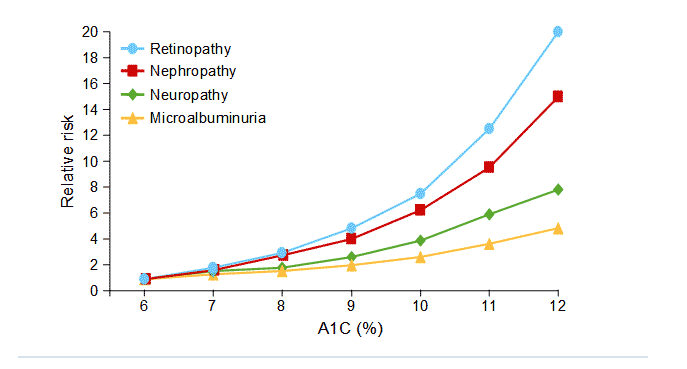
What was clear (and came up in other sessions) was that taking the HbA1c guideline of 48mmol/mol (or 6.5% in old money) definitely won't work for everybody.  Evidence suggests that an HbA1c at that level will reduce your risk of complications - but again that  doesn't make it easy to get to, or appropriate for everyone.

Relative risk of different complications vs HbA1c level

Julie Edge gave a great archery analogy - make 6.5% the middle of an archery target (i.e. what you aim for), sometimes you might hit it, other times you won't.  The further away you are, the more you need to make adjustments.

But making adjustments and setting the targets is where it gets tricky.  The target can't be 6.5% for everyone (and nor should it).  Making adjustments when you don't hit the 'bullseye' needs support and help.  Interestingly, even aiming for a target of 6.5% may not help you - studies show that if you aim for 6.5%, chances are you'll achieve 7%.

Aim for the left, you'll probably hit the right
What people need is individual support to understand what's appropriate for them and what's achievable based on their current circumstances.

In the afternoon, the NICE Guideline discussion started to a packed room (and an overflow room listening in).  Laura began with a stark statement - "Some of the NICE guidelines have made me feel like I've been put in a box where I don't belong" and I think that made a lot of people sit up and take notice.

Working through some of the new guidelines, Laura explained that clinic appointments with her consultant worked through her circumstances and looked at what external factors were impacting on her outcomes (such as HbA1c).  A visit to her GP was different - "You need to improve your control".  A question at the end of her talk asked for her views on individual targets for the guidelines - the answer was a simple one "Yes there should be individual targets, and NICE guidelines encourage it.  But how often is it actually done".

Brian Freer followed and spoke well about how targets could/should be set for individuals, and at the end there were a few questions/comments from the audience:
  • "If we say to a patient that their target HbA1c is 6.5% but we don't expect you to get there, then should be surprised if/when they don't?"
  • "If you pay GPs to hit specific targets, are they really going to set individual goals?"
  • "You can't treat diabetes by guidelines. You have to treat the individual in front of you."
There's a theme developing...

Partha took to the stage to talk about the practicalities of the Type 1 NICE guidelines.  He made some stark points that really should give food for thought.  He was keen to stress he wasn't criticising the guidelines but had some points he wanted to raise.

You could summarise his talk into a discussion of the language used in the guidelines.  
  • "People with diabetes should be offered an education course with proven benefit.... well we do offer it - it's just no-one goes.  Is 'offer' the right word?"
  • "NICE guidelines says people with Type 1 should have access to a minimum of four test strips per day.  Using four strips per day exists only in Narnia"
Partha rightly questioned the need for updated guidelines, asking if the last document hadn't made significant differences, why would the new one?  What I took away from what Partha said was that we know what the right things are, and the guidelines make that clear - they're grounded in evidence.

What needs to be better is the implementation of all this.  Writing the guidelines is a long process.  Making sure they contain proper guidance that will positively impact people with Type 1 (in this case) is no easy challenge.  But writing the guidance doesn't magically bring about change in how that guidance is translated to real world care.

Mike stood up at the end and spoke in response to Partha's session.  The one thing he said so passionately that resonated with the entire room was "I don't want you to tell me what's easy, I want to know what works.  If an HbA1c of 6.5% means I have fewer complications, I can understand how hard I have to work to get there.  How much 'better' is it and how much more effort is it to get from say 7% to 6.5%?  Then I can make that decision about what I think my target should be."

I think the theme of individual care has come across really strongly in many sessions in the conference already.  No-one I've heard thinks it's a bad idea - far from it.  There's a clear desire from healthcare professionals (and people with diabetes) to champion individual care.  We can't all fit into one box, we can't be given a one size fits all target.  We all have different support needs, we all have different requirements when it comes to how we engage with education.

The argument isn't about individual care.  The argument is about how we change the system to make sure that individual care is delivered to everyone with diabetes.