Showing posts with label experience. Show all posts

Tuesday, 9 June 2020

Week Twelve - Paths not taken (or things I wish I'd known)

I drew a blank yesterday when I sat down to write - there was something there but I couldn't quite see it.  It vaguely came to me as I stared at the ceiling at something-past-midnight so let's go.

I should preface this by saying that it's Diabetes Week (8th to 14th June 2020) and so while this won't entirely depart from the mental well-being stuff I've talked about for the last three months, I was reflecting on my experiences specifically with diabetes more than usual last night.

I was trying to remember how old I was when I got got diagnosed with type 1 diabetes.  I always start by telling myself it was the October of my graduate year at university as I remember it being a fairly isolating experience in many ways.  But that's not true.  The date I mean - it was isolating in a lot of ways.  I remember trying to explain it all to a couple of my course-mates (and fellow 5-a-side colleagues) and how lower GI stuff like Shreddies would help.  "Shreddies - keeps diabetes locked up til lunch" still makes me smile.  But that must have been the start of my third year which was October 2001.

And that means next year will be 20 years with type 1 - half my life.  After that point it'll be something that'll be the bigger part of my experiences, not the smaller part.  Those 20 years without diabetes would always be a static thing, but soon that block of time will become a decreasing minority.
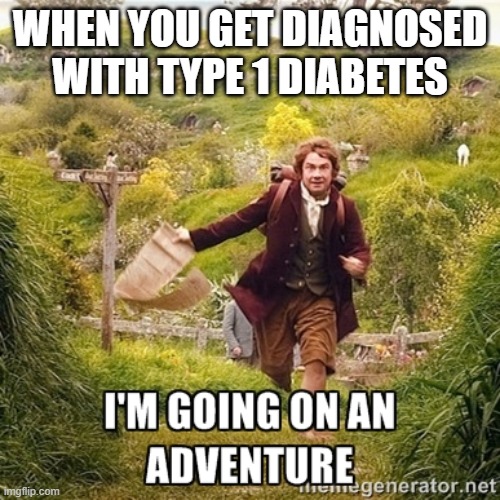
Memes for all occasions

Looking back at the start of this adventure I was woefully ill-placed to deal with it - not that there's ever really a good time to get diagnosed with a chronic condition but still...  A few ridiculous things really stand out from those first few months.  I remember being told to make sure I'd eaten before playing football at university so I'd cram all sorts in before a match and wonder why I was sky high afterwards.  I started off on mixed insulin so there wasn't really a concept (that I'd be told about at least) of correction doses so I just lived with it.

When I switched to basal/bolus a year or so later, that felt like a little more freedom, but I was still walking around with way too little knowledge in my head.  That's diabetes knowledge for those giggling at the back...  While I finally had the tools to finesse my own self-management, I didn't have the understanding.  One unit for 10g of carbs seemed to work, but I'm sure it took years for me to ask what would happen if I did insulin without food and finally understand if my levels were high I could just do insulin to fix it.  Seems so obvious now, but it was alien to me for so long.

And (as I gratuitously wield my crowbar) it got me thinking about other paths I'd not taken because of things I didn't know or was scared of finding out.  Opportunities I didn't take, places I didn't go, girls I didn't ask out, invitations I turned down... all because I was unsure of myself or scared.

Justin Whang 🐙 on Twitter: "Crazy how the "you posted cringe ...

I think what it made me realise (at nearly 1am...) is that the stress and anxiety that I've really only consciously started to be aware of has actually been around for a really long time.  Looking back, some "coping" mechanisms have been fairly common over the years (however cringe-worthy they were and how hard they are to let go of), some of the anxiety symptoms probably date back over 25 years.

So I think there are a lot of things I wish I'd known.  All the stuff I've accumulated over nearly 20 (TWENTY) years of living with diabetes would obviously have been hugely beneficial way back in 2001.  But I've been struck again by how much the mental aspects have been so important. Not just in terms of missing out on lived experience, self-confidence or self-esteem, but that overlap with managing the physical bits.

I had a conversation with someone recently about how easy it feels now to instinctively know what my insulin doses should be, and that the textbook answers don't reflect what I intrinsically know to be true about my own care.  But whilst that trial and error, and learning from those mistakes has been tough at times, it feels easy in comparison to understanding and managing things that aren't tangible or don't manifest themselves as physical problems to solve.

I don't know... it makes sense to me, and if you can relate too, that's good.  Happy diabetes week.  Until next time

Stay safe x

Tuesday, 16 February 2016

Libre-ating?

No, you haven’t clicked on an old link, or got here in a TARDIS, this is really a FreeStyle Libre review written in 2016.

I’ve finished my first 14 day stint with a sensor and I’m thinking about what I’ve got from having it.  This is old hat to a lot of people so you can skip the TL;DR stuff if you want – I won’t be offended.


The general reaction from anyone in the Diabetes Online Community regarding the Libre is “Oh how are you finding it?” – a fair question to ask, but not necessarily an easy one to answer.  Before I plugged myself in for the first time, I wrote about why I’d waited so long and what I was really hoping to get out of using the almost-CGM system.

So how did I find it?

Well putting the sensor on in the first place took a while.  I don’t think I’ve ever seen a more intimidating set of packaging in my life so it took a fair amount of courage/encouragement/mocking before I pushed the thing in.  Yes OK it didn’t hurt, but it look like it would so I stand by my reticence.    I’d plugged it in a little before bed so I’d have an overnight set of info to look at in the morning.

I’d set the boundaries on the reader to be between 4.8 and 7.8mmol.  I’ve no idea what other people do, but it seemed like a sensible enough range to me as that’s where I’d like most of my readings to be.

I think my overall experiences of the Libre in the first and second weeks were quite contrasting.   The first week felt positive – I had more information that I could understand and act on.  I don’t think the benefit of the directional information can be understated but it is equally important to fully understand what that information means, and how accurate it is (compared to a finger-prick test).  I was wary of effectively chucking all my old testing kit in a cupboard and solely relying on something new.  I tested almost as much as normal for the first 3 or 4 days before I got comfortable with it.

About as close as you're likely to get

The second week wasn’t as encouraging.  I got to a point where no matter what I did, the Libre was showing me as “Lo”, or under 3mmol when my finger-prick tests showed something entirely different.   The thing with diabetes is that more often than not, you can feel if your BG is too high or too low and often you test to see how high or low it is so you can treat accordingly.  Suddenly seeing “Lo” on a reader (BG < 2.2mmol) when you feel fine is quite disconcerting.  One of the biggest discrepancies I saw was the Libre reading 3.5mmol and my BG meter showing 8.9mmol.  I know there’s an inherent lag of around 10-15 minutes, but even that didn’t explain the constant low readings.

The arrow is deceiving, as you can see from the constant flat red line...

After about 10 days, I’d pretty much given up on relying on the Libre readings in any way (though I carried on scanning it to see how it was behaving).  A day or so before the sensor died, it had got itself back in order to a degree – constantly reading about 1.5mmol lower than a finger-prick test at any given time.  (It’s worth noting that this point that when I phoned Abbott, they agreed to ship me a replacement sensor as obviously those sorts of deviations aren’t good).

So what did I learn from this first foray into 24/7 data?

Well firstly, considering the three things I wanted to understand more about, I definitely noticed a dip mid-morning and having observed it for a few days, I tweaked my basal settings slightly and noticed the effect of that lessen somewhat.

Mid morning dip at about 10am

Regarding exercise, the Libre confirmed pretty much what I suspected, in that the approach I have at the moment (temp basal, few jelly babies etc) seems to work really well for me, with no noticeable spikes or dips.  Being able to keep that stable BG over distances up to around 10 miles is encouraging.  

Short spike before running, in range (and rising) at the end

Finally the occasional evening/overnight spike… it’s definitely there!  Work to reduce its frequency is ongoing.

Blerg

Secondly, I was amazed at how much having the sensor can influence your behaviour – whether you want it to or not.  I’ve read blogs over the last 12 months likening having a Libre to being like a game (think Flappy Bird) where up and downs within the blue band are OK, but do what you can to keep it within those boundaries.  Even after about 24 hours use, I can see how it gets that addictive and I was modifying my approach to self-management to try and keep a flatter line.  I’m more likely to bolus 5-10 minutes before eating now as a result of the Libre.  I’m also more likely to try and ‘nudge’ my BG in the right direction if I see it falling or rising quickly.

Cured.  Sort of.

The flip side of that is that diabetes with a Libre is a full time job.  More information seems to breed more action, which in turn breeds even more information.  If moving from pens to a pump is more of a constant reminder of living with diabetes, then throwing a Libre into the mix is basically signing your entire existence over to it.  I also think that the abundance of information is meaningless if you aren’t understanding and reacting to it properly.  Stories of people treating high BG with temp basals, or constantly fiddling with those basal settings every few hours of every day to try maintain a flat line isn’t (in my humble opinion) helping.  I think if you’ve got access to the information you need to be able to look at it objectively and make longer term changes.  I think information overload can easily be a contributing factor to diabetes burnout.

Obviously, the readings from the Libre are great when you can trust it.  Once you can’t, it becomes meaningless.  I don’t know how often other people finger prick test alongside scanning, but I felt like I needed that reassurance that the daily graph was worth looking at.  Towards the end of the sensor, I felt very demoralised by the whole process if I’m honest.  I felt like I was suddenly second guessing my every move, faced with a lot of information and decisions that I couldn’t make sense of.  I’ve had type 1 diabetes for 13 years and I haven’t been in a position where mentally, I felt like I did last week in about 10 years.

Finger-prick results never read below 4mmol...

Finally (you’ll be relieved to read), I was surprised by the little differences the Libre made.  I was really conscious of not laying on the sensor while I was sleeping.  I was very conscious of knocking it while I was walking or showering, and even getting dressed became quite a cautious activity.  I’ve no doubt that’s my own personal risk aversion, and not the experience of the majority, but it was definitely a noticeable behaviour change.

So where do I go from here?  Well I’ve got one more sensor at home, and a replacement on the way, so the experiment will continue.  I’m going to wait a week or so before going again (so it coincides with being away for a week, where I think the convenience will be most beneficial).  I definitely think an accurate sensor could play a very positive role in my life with diabetes, and probably lead to improved HbA1c results.  

From the first week, where it worked properly

I suspect that more frequent use would mean those behavioural changes become more normal (or at least less noticeable).   I don’t want my life to be 50 scans a day, along with constant small insulin doses or 5g carb snacks.  That’s not living to me, that’s just existing.  I want the ability to test at convenient times, get information I can trust, and learn how I can make simple adjustments, to remove the variability in my BG as much as is reasonably possible.


So is the Libre for you?  I can’t tell you (and neither can anyone else).  Like a pump, it’s a personal decision that you have to investigate for yourself.  I think it’s worth investing £130 (if you can spare it), to get a reader and two sensors so you’ve got enough time to make an informed decision.  If you’ve made it this far through the post, hopefully you’ve got some things to consider for yourself, but what works for me might not work for you (and vice versa).  However you choose to manage your diabetes is an entirely personal thing, and don’t let that change.