Wednesday, 2 March 2016

Taking education to the masses

I’d had my eye on the Education session on Day 1 with equal excitement and trepidation.  The education campaign is one I feel personally connected to.  I felt like the DAFNE course I did has made a huge difference to how I manage my own diabetes, and so hearing a number of professional views on the subject was something I was looking forward to.

Equally, I’d been asked to give a short view of my experiences of education to the assembled professionals, so I was a little nervous about how that was going to go.

If you’ve not had a look at the Diabetes UK Taking Control campaign yet, I’d urge you to start there.  The campaign launched towards the end of last year, and is aimed at making sure everyone is given the chance to learn about their diabetes.  I think we’re at a point now where the evidence for education is no longer in question, we’re now looking at how best to get that education out to as many people.

The session was split down into five talks:
  •           Taking Control campaign – Bridget Turner
  •           Making the case for diabetes education – Charles Gostling, Helen Hopkinson, Alison White
  •           Getting people there – Vivien Coates, Anne Scott
  •           Adding options to the education menu – Sarah Newall, Rebecca Owen, Kingshuk Pal
  •           Addressing specific local barriers – Tahseen Chowdhury, Seonaid Morrison

Bridget set the scene, explaining why Diabetes UK are championing education and how using an adapted House of Care can be used as a model to deliver education to more people.

Bridget Turner (Director of Policy and Care Improvement at Diabetes UK),
discussing the adapted House of Care model for education

I gave my own (short) view on my personal experience of DAFNE, and why I think education is important.  I won’t dwell on my own personal views too much here, but I generally believe that education helps people become more active in their own healthcare and that in turn helps them achieve better outcomes.  I’ll save that for a separate post outside of the conference.

The stage was set for the other examples from the rest of the speakers.  Charles Gostling started off talking about how they deliver education to people in South London.  He made a great reference to the latest National Diabetes Audit (NDA) data, saying that without clear data, we don’t know where we do things well.  I think that’s a point that can’t be stressed enough.  Without getting side-tracked into a debate on NDA submissions, I think it’s really important to understand your starting position and data is the way you do that.

We know diabetes education referrals are generally low, the take up rates even lower.  Two key messages Charles got across were simple (but important ones).  Firstly, find out why people don’t take up the offer of education.  Secondly, share local success stories.  If someone is doing something well, make sure it’s publicised across your local area so others can learn from it.

Helen Hopkinson then moved onto how the education offering was redesigned, talking through the journey they went on to get to DAFNE (‘because it’s evidence based and we know it works’).  She made a great point that redesigning your education offering can be cost free but when looking at how to do that, you need to engage all your stakeholders.

Why choose DAFNE?
That second aspect sounds so fundamental, that it almost beggars belief that you’d have to say it at all.  It’s a pretty short-sighted approach to try and design something one group of people, that’s paid for by another, provided by a third and ‘marketed’ by a fourth without including them all in the process.  You wouldn’t expect it for iPhones, so why should diabetes education be any different?  It was eye opening in its simplicity.

“Getting People There” looked at reasons why people with diabetes choose not to attend courses (“I learned from other sources”, “more important things to do”, “don’t see the point”).  Some of these struck a chord with me.  I started out with the view that I didn’t need education, but now I’m a big advocate for it.  I think we need to do more to sell the benefits of people who could be persuaded to go if they knew what they’d get from it.  Others need a different model of support – as with everything related to diabetes, one size doesn’t fit all.

As we moved to the discussion on “Adding options to the education menu”, we saw some interesting and innovative ways Lambeth were engaging with different groups within their area.  As with the other parts of the session, there’s some blindingly obvious bits in there too.  If you’ve got an education offering, tell people about it.  Spread the word as much as you can, use community centres, library groups, church meetings – anyone you can – to widen the circle of people who know you have something for them.

One of the most interesting things that came up was the concept of taster sessions.  These are short (90 mins) sessions that act as an introduction to the larger scale education courses on offer.  They’re typically targeted at groups or populations that are historically harder to reach (the example they gave was the Sri Lankan community in Lambeth), or those where Did Not Attend (DNA) rates are higher.   With all the taster sessions, people were ‘followed’ to see how many attended a full course later.  That stood at about 10% for the first year, but it’s hoped to be higher for 2016.

The last bit I’d like to talk about was HeLP Diabetes – an online learning option for people with Type 2 diabetes.  I think it’s important to cover as a lot of people want more online support and if we return to this ground breaking idea of providing what people want, this ticks the boxes.
Around 50% of visitors to the HeLP Diabetes site come outside ‘regular’ working hours, when it’d obviously harder to provide traditional education like DESMOND.  Interestingly, despite some of the upsides to the online delivery (24/7 access, anonymity etc), it still faced some of the more traditional barriers, such as spreading the word about its availability.

I’m a huge advocate of education because I’ve got a deeply personal experience about how it transformed my ability to be in control of my diabetes.  I think the case for things like DAFNE is huge (given its evidence base), and I think that by selling the benefits of the education, we can convince those who have the time, but no inclination, to attend a course and hopefully go on a similar journey to the one I went one.

That said, it’s naïve to think there’s only one way to persist, and if we want to give the benefits of education to as many people as possible, we need to consider how best we offer that education to meet the needs of the many.  “Education is about interaction with others, whether that’s other people with diabetes, healthcare professionals, of your friends and family” – I think many of us who’ve been on a course, or have used social media to help us with our diabetes would agree with that.

The last word should go to Seonaid Morrison from Argyll & Bute on the West Coast of Scotland.  She gave an incredible talk (without slides after a technical problem), on how she crosses a huge geographical area to try and bring education to as many people as possible…


“When you provide education to people, you see the change in them. That's what gets me up and out of bed in a morning”.

DPC16 - Impressions from Day 1

DPC Day 1

This is the standard ‘my first impressions’ blog about attending the Professional Conference.  I appreciate it’s probably a bit cliché, but hopefully it adds context to the rest of what you read about the conference.  Blogs on specific sessions will follow throughout the week (and probably into next week too).

No matter who you talk to, how much past experience you try and take on board, nothing can really prepare you for how BIG the Diabetes UK Professional Conference (DPC) is.

I felt like I’d had the benefit of a gentle lead into the chaos, having spent the day before the DPC at the Young Diabetologist & Endocrinologist Forum, running a couple of workshops with Kelly (@DiabeticQueen1) on what it’s really like to live with an insulin pump (I’ll save that for another time).  I’d had a day to get my bearings for the most part and I’d been through the session planner a week in advance so I had a good idea of what I wanted to see.

But DPC is BIG.  There’s over 3000 people at the conference, many of them great leaders in their fields, others desperate to hear them speak, even if it’s just for a short time.  Typically, there’s six sessions running concurrently with a few coffee breaks sprinkled in throughout the day in the huge exhibition room.  It sounds chaotic but it’s not.  It’s busy, but it’s an incredibly well-oiled machine.
Having hunted down our badges for the week, we piled into the main auditorium for the first round of lectures.  At this point it’s worth explaining how the day is split up – it sounds like overkill (and it’s a bit long to read here), but I think the context is important…

There’s roughly four big time blocks per day, each between 60 and 90 minutes long, each with an overarching theme.  There are six rooms that each run one of those time blocks concurrently.  And each time block contains two or three lectures.  That means in any given day, you’re likely to hear 10-12 individual talks across a variety of topics.  The 2016 Programme is here if you’re more of a visual person.

For the first day, I tried to split between things I had some interest in (it makes it easier to try and understand/write about), and things I felt were of a wider appeal.  Day 1 consisted of 14 individual talks:

Opening Plenary lecture session
  •           The Relative Effectiveness of Pumps over MDI and Structured Education (REPOSE) – Simon Heller
  •           Peptide Immunotherapy for Type 1 Diabetes – Colin Dayan
  •           Exercise for beta cell preservation in Type 1 diabetes: The Exercise for Type One Diabetes (EXTOD) trial – Rob Andrews and Parth Nardendran

Multidisciplinary approaches to managing admissions for DKA session
  •           A combined diabetes case manager and mental health approach for supporting people with multiple hyperglycaemic admissions – David Simmons
  •           The role of emotional wellbeing in DKA and one care pathway approach – Kirsty MacLennan
  •           Walking the tightrope of hyperglycaemia: education is not enough – Clare Shaban

Diabetes education: reaching the masses session
  •           Taking Control campaign – Bridget Turner
  •           Making the case for diabetes education – Charles Gostling, Helen Hopkinson, Alison White
  •           Getting people there – Vivien Coates, Anne Scott
  •           Adding options to the education menu – Sarah Newall, Rebecca Owen, Kingshuk Pal
  •           Addressing specific local barriers – Tahseen Chowdhury, Seonaid Morrison

What’s new in hypoglycaemia session
  •           Cardiovascular effects of hypoglycaemia – Simon Heller
  •           Evidence based pathway for the management of problematic hypoglycaemia – Pratik Choudhary

  • Mary MacKinnon Lecture

  •           West Hampshire Community Diabetes Service: re-commissioning community services and beyond – Kate Frayers


Fourteen talks across five broad subjects is a lot of information to take in.  I feel incredibly lucky to be here at the conference (and to have had the opportunity to speak for a few minutes within the Taking Control session) but it takes a lot of brain power to be on the go all the time.  Hopefully those of you following me (@BroomOwl) or the hashtag (#DPC16) on Twitter have got some sense of the huge amount of information being shared.  So back to the day…

The conference centre is big and you often find yourself rushing from one session into another, trying to grab a coffee on the way if you’re lucky enough.  The exhibition hall is where people tend to gravitate between sessions, though I’ll confess I’ve not actually taken a close look at anything there yet.

What really struck me was the mix of passion and knowledge on show, as well as the desire to make overwhelming change to the lives of people with diabetes.  That sounds a bit obvious really, but the sheer number of people devoting their time outside seeing patients to research, service changes and sharing best practice is really incredible.  It’s inspiring as a person with diabetes, I imagine as a healthcare professional it’s very motivating.

I’m writing this in the hotel bar at the end of the first day, reflecting back on what feels like a week’s worth of information I’ve had shoved into my head within the space of eight hours.  I’m trying to pick a favourite session, but it’s genuinely difficult.  I’ll freely admit some of them were very fast paced, and whilst I got the main messages from some, I couldn’t explain the research to you well enough.  Some (like REPOSE which I was a part of), were personally important to me, others, like the whole DKA session gave me something entirely new to think about.

Perhaps the one that struck the biggest chord with me was the education session.  REPOSE had shown in the morning that people using insulin pumps do no better than people on multiple daily injections (MDI) when proper high quality education is given.  The afternoon session showed that there were a huge group of committed individuals across the UK looking to deliver that message out to as many people as possible.  I’ll follow that up in a separate blog.


Thanks for reading my opening post, and thanks if you’re following along on Twitter.  Hopefully you’ll understand that a huge post on each lecture (or even session) is a bit impractical.  I’ll try and do one in detail and summarise some of the others along the way.

Tuesday, 16 February 2016

Libre-ating?

No, you haven’t clicked on an old link, or got here in a TARDIS, this is really a FreeStyle Libre review written in 2016.

I’ve finished my first 14 day stint with a sensor and I’m thinking about what I’ve got from having it.  This is old hat to a lot of people so you can skip the TL;DR stuff if you want – I won’t be offended.


The general reaction from anyone in the Diabetes Online Community regarding the Libre is “Oh how are you finding it?” – a fair question to ask, but not necessarily an easy one to answer.  Before I plugged myself in for the first time, I wrote about why I’d waited so long and what I was really hoping to get out of using the almost-CGM system.

So how did I find it?

Well putting the sensor on in the first place took a while.  I don’t think I’ve ever seen a more intimidating set of packaging in my life so it took a fair amount of courage/encouragement/mocking before I pushed the thing in.  Yes OK it didn’t hurt, but it look like it would so I stand by my reticence.    I’d plugged it in a little before bed so I’d have an overnight set of info to look at in the morning.

I’d set the boundaries on the reader to be between 4.8 and 7.8mmol.  I’ve no idea what other people do, but it seemed like a sensible enough range to me as that’s where I’d like most of my readings to be.

I think my overall experiences of the Libre in the first and second weeks were quite contrasting.   The first week felt positive – I had more information that I could understand and act on.  I don’t think the benefit of the directional information can be understated but it is equally important to fully understand what that information means, and how accurate it is (compared to a finger-prick test).  I was wary of effectively chucking all my old testing kit in a cupboard and solely relying on something new.  I tested almost as much as normal for the first 3 or 4 days before I got comfortable with it.

About as close as you're likely to get

The second week wasn’t as encouraging.  I got to a point where no matter what I did, the Libre was showing me as “Lo”, or under 3mmol when my finger-prick tests showed something entirely different.   The thing with diabetes is that more often than not, you can feel if your BG is too high or too low and often you test to see how high or low it is so you can treat accordingly.  Suddenly seeing “Lo” on a reader (BG < 2.2mmol) when you feel fine is quite disconcerting.  One of the biggest discrepancies I saw was the Libre reading 3.5mmol and my BG meter showing 8.9mmol.  I know there’s an inherent lag of around 10-15 minutes, but even that didn’t explain the constant low readings.

The arrow is deceiving, as you can see from the constant flat red line...

After about 10 days, I’d pretty much given up on relying on the Libre readings in any way (though I carried on scanning it to see how it was behaving).  A day or so before the sensor died, it had got itself back in order to a degree – constantly reading about 1.5mmol lower than a finger-prick test at any given time.  (It’s worth noting that this point that when I phoned Abbott, they agreed to ship me a replacement sensor as obviously those sorts of deviations aren’t good).

So what did I learn from this first foray into 24/7 data?

Well firstly, considering the three things I wanted to understand more about, I definitely noticed a dip mid-morning and having observed it for a few days, I tweaked my basal settings slightly and noticed the effect of that lessen somewhat.

Mid morning dip at about 10am

Regarding exercise, the Libre confirmed pretty much what I suspected, in that the approach I have at the moment (temp basal, few jelly babies etc) seems to work really well for me, with no noticeable spikes or dips.  Being able to keep that stable BG over distances up to around 10 miles is encouraging.  

Short spike before running, in range (and rising) at the end

Finally the occasional evening/overnight spike… it’s definitely there!  Work to reduce its frequency is ongoing.

Blerg

Secondly, I was amazed at how much having the sensor can influence your behaviour – whether you want it to or not.  I’ve read blogs over the last 12 months likening having a Libre to being like a game (think Flappy Bird) where up and downs within the blue band are OK, but do what you can to keep it within those boundaries.  Even after about 24 hours use, I can see how it gets that addictive and I was modifying my approach to self-management to try and keep a flatter line.  I’m more likely to bolus 5-10 minutes before eating now as a result of the Libre.  I’m also more likely to try and ‘nudge’ my BG in the right direction if I see it falling or rising quickly.

Cured.  Sort of.

The flip side of that is that diabetes with a Libre is a full time job.  More information seems to breed more action, which in turn breeds even more information.  If moving from pens to a pump is more of a constant reminder of living with diabetes, then throwing a Libre into the mix is basically signing your entire existence over to it.  I also think that the abundance of information is meaningless if you aren’t understanding and reacting to it properly.  Stories of people treating high BG with temp basals, or constantly fiddling with those basal settings every few hours of every day to try maintain a flat line isn’t (in my humble opinion) helping.  I think if you’ve got access to the information you need to be able to look at it objectively and make longer term changes.  I think information overload can easily be a contributing factor to diabetes burnout.

Obviously, the readings from the Libre are great when you can trust it.  Once you can’t, it becomes meaningless.  I don’t know how often other people finger prick test alongside scanning, but I felt like I needed that reassurance that the daily graph was worth looking at.  Towards the end of the sensor, I felt very demoralised by the whole process if I’m honest.  I felt like I was suddenly second guessing my every move, faced with a lot of information and decisions that I couldn’t make sense of.  I’ve had type 1 diabetes for 13 years and I haven’t been in a position where mentally, I felt like I did last week in about 10 years.

Finger-prick results never read below 4mmol...

Finally (you’ll be relieved to read), I was surprised by the little differences the Libre made.  I was really conscious of not laying on the sensor while I was sleeping.  I was very conscious of knocking it while I was walking or showering, and even getting dressed became quite a cautious activity.  I’ve no doubt that’s my own personal risk aversion, and not the experience of the majority, but it was definitely a noticeable behaviour change.

So where do I go from here?  Well I’ve got one more sensor at home, and a replacement on the way, so the experiment will continue.  I’m going to wait a week or so before going again (so it coincides with being away for a week, where I think the convenience will be most beneficial).  I definitely think an accurate sensor could play a very positive role in my life with diabetes, and probably lead to improved HbA1c results.  

From the first week, where it worked properly

I suspect that more frequent use would mean those behavioural changes become more normal (or at least less noticeable).   I don’t want my life to be 50 scans a day, along with constant small insulin doses or 5g carb snacks.  That’s not living to me, that’s just existing.  I want the ability to test at convenient times, get information I can trust, and learn how I can make simple adjustments, to remove the variability in my BG as much as is reasonably possible.


So is the Libre for you?  I can’t tell you (and neither can anyone else).  Like a pump, it’s a personal decision that you have to investigate for yourself.  I think it’s worth investing £130 (if you can spare it), to get a reader and two sensors so you’ve got enough time to make an informed decision.  If you’ve made it this far through the post, hopefully you’ve got some things to consider for yourself, but what works for me might not work for you (and vice versa).  However you choose to manage your diabetes is an entirely personal thing, and don’t let that change.

Sunday, 31 January 2016

Libre Intentions

This will be quick - I've got to get a munchkin ready for a party in 30 minutes...

My first Freestyle Libre arrived in the post on Friday.  It's currently sat in its partially opened boxes on my sofa.  I'll probably take the plunge this evening - but right now, I'm filled with a sense of apprehension.

Not just because of the intimidating packaging (and thanks to those of you who've reassured me), but more because I'm not sure why I've got one.

There's no doubt it's popular among the online community - I've seen plenty of tweets and blogs about the virtues of it's quasi-CGM ability, and I've met a few people in real life who are incredibly complimentary about it too.

But I know my control is actually pretty good overall.  And I know I have the moderately addictive personality that could mean I can't just use two sensors and revert to conventional testing.  I've held off for so long because I want to make sure I'm going to use if for the right reasons for me.

Regardless of all the basal testing I've done, I know that at some point between 10 and 11am, my BG takes a dip.  Not always a huge one, but something strange happens around then and I'm hoping I can start to visualise what that is.

I also do a lot of exercise, and whilst I've worked hard to be able to manage my diabetes and run as much as I do, I've got a genuine curiosity about what happens to my BG whilst I exercise.  Again, the Libre should help me out there.

Lastly, I'll have some evenings where I eat late, and things don't behave in the way the usually do.  Last night was a prime example, where, despite meticulous carb counting and appropriate insulin delivery, I woke up around 16.5.  Not much cop is it?  Hopefully I can understand how that happens, so I can learn what to do about it in the future.

What I don't want to do is become someone who chases flat lines on a graph with temporary basal rates and huge doses of insulin.  I know from DAFNE that a more patient and informed approach is more likely to give better results and understanding in the longer term.

As you may know, I got to listen in on a few sessions at the Association of Children's Diabetes Clinicians conference on Friday, and two talks there really captured my attention.

Firstly, Dr Peter Adolfsson talk about how, in his native Sweden, patients (particularly paediatric patients) are introduced to continuous glucose monitoring before they start pump therapy.  Indeed it turns out, not all patients want or need pump therapy once they've understood how the glucose reacts to different situations.  This gave me hope I was making the right decision with a Libre.

The second talk was from Prof. Kath Barnard, who spoke brilliantly (and candidly) about the lack of psychosocial support for people using diabetes technology like CGM, and how many that self fund, do so and ignore a lot of the information they receive (e.g. cancelling/ignoring alarms from devices).  This made me feel more cautious with the Libre.

Am I getting myself into something I fully understand that will give me the information I want, without changing my existing attitude and approach to managing diabetes?  In short, I don't know.  But there's probably only one way to find out...

Tuesday, 26 January 2016

Oppo Ice Cream - REVIEW

(Disclaimer - Oppo sent me three vouchers, each for a free 500ml tub of their ice cream.  I've not been paid to write this and Oppo have had no editorial rights over the content.  All views expressed are my own.)

I think ice cream is one of those almost universally loved treats.  Whether you're a kid at the seaside or you've ended up with a scoop of something decadent on the side of a restaurant dessert, ice cream is essentially awesome.

Before Christmas, Oppo got in touch and asked me if I fancied reviewing their three new low calorie, low carb ice creams.  Given my almost constant state of dieting, that's a hard thing to pass up.  During some initial conversations I was told the Oppo flavours were 'diabetes friendly' too.

Normally I'd be wary of such a claim.  Many of us (rightly) associate 'diabetic ice cream' with the addition of a bunch of polyols that have unpleasant laxative effects if consumed in any great quantity.  You'll be pleased to hear that Oppo has none of those unpleasant things added to it.   The lower carb/calorie content comes from switching out cream and cane sugar for whole milk, Stevia and coconut oil.

The premise is that Oppo have taken 3 flavours and boosted them with an added touch to each one.  There's Vanilla & Baobab, Salted Caramel & Lucuma and Mint Choc swirl with Spirulina.

Mint Choc
Vanilla
Salted Caramel

And here's the nutritional info from the back of each tub.  I've tried to get as much of the ingredients in as possible too:

Salted Caramel
Mint Choc
Vanilla

As you can hopefully see, each two-scoop portion for each flavour is around 85 calories each, with around 9g of carbs per portion too.  Pretty good in my opinion.

Now reviewing ice cream is a tricky business as flavour is an incredibly subjective thing but here we go:

I'll admit I was a little sceptical of the Mint Choc Swirl with Spirulina when I saw the three flavours that were available.  Mint Chocolate is one of my all time faves, and I've had mixed experiences with Spirulina when using it in juices/shakes.

I'm relieved to be able to tell you that this is my favourite of the three and that the addition of Spirulina hasn't been at the expense of the mint-chocolatey goodness.  The Mint Choc is also the softest of the three in my experience and there's no trouble scooping straight from the freezer

Mint Choc yum!
Next up - Salted Caramel.  I think this is the sweetest of the three and the salted caramel flavour comes through well.  I'll confess now that I'm not sure what lucuma tastes like and it's presence in this ice cream must be subtle as I can't detect the taste of something unfamiliar.  It's definitely nice though!

Salted Caramel
Lastly, the Vanilla.  Good old vanilla right?  Well that's what I think anyway.  It's a dependable friend is vanilla - not necessarily going to rock your world, but you always know what you're getting.  What I especially liked about this was the abundance of vanilla flecks as soon as you lifted the lid on the tub.  Again, I'm not sure what baobab tastes like, but you can detect something beyond the vanilla in this one and I think the two complement each other nicely.

Vanilla - hopefully the flecks come through!

One observation I've got about the latter two is that they're solid ice creams - literally.  If you've ever experienced trying to eat something like Ben & Jerry's Cookie Dough straight from the freezer, you'll know what I mean.  Whilst the Mint Choc is soft enough to scoop straight from the freezer, I found better results with both Vanilla and Salted Caramel if I got them out a few minutes before I wanted to eat them.  That's not a criticism (in my experience, those 'harder' ice creams tend to be better), but just a public service announcement.

In the interests of fairness, I opened up the review process to both my wife and (five year old) daughter.  Whilst kids need no encouragement to tuck into ice cream, Mrs Hoverboards is a little less easy to please (particularly when it comes to added ingredients like baobab, lucuma and spirulina) so I thought the opinions of both of them might add some context.

My daughter's views can be accurately summed up with the sentence "can I have some more?!" - nothing too unexpected there I suppose.

Mrs Hoverboards was equally complementary too.  "It tastes like actual ice cream" was her immediate feedback.  And she's right.  That doesn't sound like a big deal, but I think if you're making a new product in a market where everyone has a lot of preconceptions about what ice cream is, to have something that ticks the boxes on flavour and texture is a good thing.

So, the conclusion - would I go out and buy it?  That's a tough one I think.  Oppo is branded as luxury ice cream, and it definitely comes with a luxury price tag (around £5.49 per 500ml tub).  It's not necessarily easy to get hold of either.  I had to visit 2 stores to pick up all three flavours, and when you live a 25 minute drive from one of them, you certainly feel like you're working for your luxury.  (You can find your nearest stockists via the "Stockists" link on the Oppo website).

I think if you're a regular purchaser of other luxury brands like Haagen Dazs or Ben & Jerry's, you should definitely give this a look in.  Per 100ml Oppo has about 80 calories, compared with 225 cals in Haagen Dazs Vanilla (and even 150 in WeightWatchers Vanilla).  It has significantly less fat that the Haagen Dazs alternative (and about 10% less fat than the WeightWatchers Vanilla too).

Let's be honest, spending over a fiver on a tub of ice cream is an extravagance - there's no other way to say it.  But if you're prepared to spend the cash, you could definitely do a lot worse than spend it here.

I rarely have ice cream in because I know I'm easily tempted to eat a lot of it and I know it'll make a big dent in my daily calorie allowance.  With Oppo I've been able to eat it without compromising what else I'm eating, and I've done that as part of a reduced calorie diet.  That ticks the boxes for me personally speaking.

At the time of writing, a £1 off coupon was available from Oppo's website if you hit the homepage.  If there's a stockist near you - give it a go and see what you think.  It's a lot to do with personal taste at the end of the day

Ultimately, for me,  I think it tastes good, one serving has fewer calories than a slice of bread and it's low fat.  Would I spend a fiver on it?  Occasionally, I think I would (that Mint Choc is very nice).  But I'd probably struggle to justify the cost if I went through it at any great rate.

Sunday, 24 January 2016

Dario Smart Meter - REVIEW

Disclaimer - I received a free Dario Smart Meter (along with 50 test strips) to use and review.  Dario have not paid me for my opinion, nor have they had editorial rights over any of  the content below.  All views expressed here are my own.

A couple of weeks ago, Dario got in touch and asked me if I'd be interested in reviewing their new Smart Meter.  It's a device that effectively turns your smart phone into a blood glucose tester.

Now if you're anything like me, you rarely go anywhere without your phone and BG testing kit so the idea of being able to combine the two (to a large extent) sounds appealing.  Plus I think we're all allowed to get a little excited about new diabetes tech right?  It's one of the few perks of putting up with Type 1 in my opinion.

So just over a week ago, I got my hands on the kit and here's how I think it performs...

The first thing to say is that it comes very well presented, as you can see below.

Dario Smart Meter box

I may have been a bit heavy handed opening the box, but I have a tendency to be like a kid at Christmas sometimes.

I think the meter is supposed to be in the orange section below - my bad

Test strips.  The box contains 2 x 25 strip cartridges 

The meter itself feels chunky, though I mean that in a good way.  It feels like it can stand up to being carried around in your pocket or bag without falling apart.  Mine has been carted pretty much everywhere with me over the last 10 days, and apart from being covered in fingerprints, it still looks brand new.

Out of the box

The device is split into 3 main components.  The orange section to the left houses the lancet.  You pull back on the black slider to prime it, then hit the orange button on top to inflict the pain that we're all familiar with.  The orange cap is secure without being too difficult to remove and there's a slider inside to allow you to vary the needle depth as is common to every lancet device I've ever seen.  I left mine on the default lowest setting and it's performed well even on my hardened fingertips.

The white section to the right houses a test strip cartridge.  Slotting the cartridges in is pretty straight forward and each one contains 25 strips.  It can be a little fiddly to get an individual strip out at first but once you've used a few it does get easier.

Meter with the cartridge cap removed

The final section is underneath and this is where the actual meter is hidden.  It's accessed by moving the orange slider.  The meter appears with a satisfying click and is easily removed.

As if by magic, the meter appears!

This surprisingly small component attaches to your phones via the headphone port - pretty nifty so far!

The Smart Meter device

At this point I should apologise for the rest of the photos as it becomes somewhat difficult to take a picture of your smartphone with your smartphone...

All put together

Now the only other thing you need to get going is the Dario app.  You can download it from the App Store for iPhones and it's available on Google Play for Android devices.  There's a QR code included in the box that you can scan to get a link to the app directly.

The app is free (as you might expect) but it's worth calling out at this point that one of the terms and conditions grants Dario the right to use your (anonymised) BG data for commercial purposes as well as for the usual things about improving the product.  That's personally not a huge deal for me, but I know a lot of other people differ from me so it's worth adding this in here.

The app walks you through what you need to do to get a result.  Once you've clicked the meter in, it prompts you to add a test strip, and then for a drop of blood (though I suspect many of us are way too familiar with the process already!)  You can see the app calculating the result which is pleasing - I find it reassuring to be able to see it working.

When you get a result, you get the option to add any additional info to the reading (carbs, insulin, activity) before you save it.  It also date/time stamps the info and there's location tagging if you have this switched on on your phone.  The results are colour-coded for at-a-glance reassurance (though those with red/green colour blindness may not benefit from this).  It's worth noting at this point that I didn't use those features so I can't comment on them, though I think if you keep track of that information in general, this is a useful addition.

Add carbs, insulin doses, activity or even tags

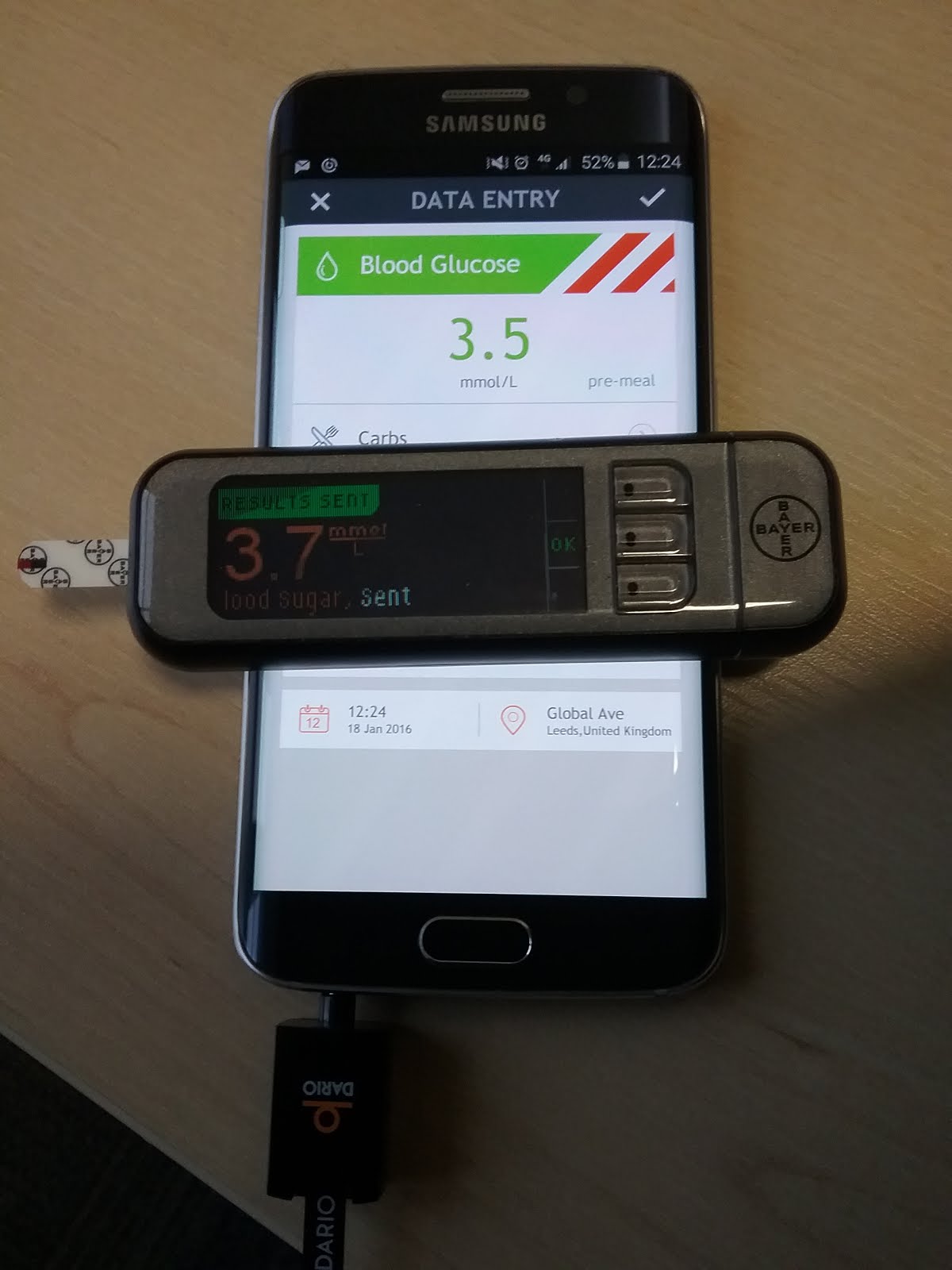
So how accurate is it?  Well Dario say it's compliant with the upcoming rules that all meters will have to adhere to from May 2016.  You can read a copy of that report in this link (opens in new tab/window).  I compare it to my own Bayer Contour Next a few times to get some sense of what it was doing.  I think the key thing with any meter is to feel like you trust it and that when you're acting on the info (treating a hypo or correcting a higher reading), you're doing so in confidence.  (again, apologies for the dodgy quality - real world examples and all that)...

Dario 4.1, Bayer 4.4
Dario 3.5, Bayer 3.7
Dario 3.5, Bayer 4.0
Overall I was pretty happy with how it performed and it was close enough to let me feel comfortable without having to constantly check on my regular meter.  I was happy to go out for the day and leave my Bayer behind and felt that I knew whatever I saw would be a fair reflection.

Two other features of the app are that it easily gives you an at a glance view of your recent history and the standard deviation of those results.


It also shows hypos and hypers so you can get an indication if the average is skewed by a lot of high or low readings.  I know other meters/software offer this too (my Bayer shows number in range, above and below after a few clicks), but I do like that it's all available immediately.

The last feature I wanted to mention is the estimated HbA1c reading:


You can see here from 30 measurements over the time I'd had the device, it estimated my HbA1c as 6% (which I'd be pleased with if it was true!)  I'm not sure how accurate that is but I like the dashboard feature so I can see how I've been doing overall.  I'm not sure if you can edit the "ranges" as I think it's reasonable that these may need to be personalised for individual targets.  There may be more infor on how to do that, but it wasn't immediately apparent to me after playing about in the menus for a little bit.  I'm sure someone will be able to tell me how that's done.

So... how does it fair in the real world?

Overall, I think it has a lot going for it.  It's definitely portable, and fits easily in my pocket alongside my phone and my pump.  I'm happy that it's accurate and I think the information presented in the dashboards in the app is really helpful.  You can use the Dario app without the meter and if you're interested in having that information at your fingertips, you might want to get the app anyway.  I think the design is pretty ingenious, and fitting a meter, lancet and test strips into something relatively small (about the size of the Bayer meter itself) is a feat of engineering.

On the other hand, only having 25 strips at a time may put people off.  I'm used to carrying 50 and I know roughly how long they last me.  It'd be an adjustment to carry half as many and I'd possibly worry about running out when I wasn't expecting it.  I'd be interested to see how the lancet part of the device stands up to prolonged use.  At the moment it does very well but I'd be concerned that the mechanism could end up being compromised by lint and general bits and pieces that are in people's pockets.

Whilst I also definitely do love the portability factor of it all, I do also wonder about how well people may be able to 'construct' it in the midst of a hypo.  It's not overly fiddly by any means, but compare having to get the constituent pieces, unlock you phone and get a reading to using a conventional meter then it's fair to say it does take longer and is a bit more involved.

Finally, from a purely personal point of view, in the testing case with my Bayer meter, I carry around a spare pump battery, some paracetamol and I use the spare pouch to bin the used test strips.   Adjusting that kind of behaviour for me has been interesting, and I've ended up with used strips in my pocket on more than one occasion.  I also don't believe it links to Diasend in the same way my existing meter does.

So - would I have one full time?  I think I could be persuaded but I'd want to run it alongside my existing Bayer device.  The Dario doesn't talk to my insulin pump and on more than one occasion I tried to use the Bolus Wizard and found I had to enter the info manually.  You can't test if you have headphones in (I spend a lot of time on conference calls using headphones) so there's that practicality to consider too.

But I do really like the fact that it's portable and a little more discrete than my existing meter.  I think having the choice when I go out to slip something in my pocket, or bring the bigger kit in a bag (or my wife's bag...) would be good.  I've really enjoyed having it around and when you consider the whole package is pretty small, and the info from the app is really useful in my opinion.  I don't think it could replace what I use today, but I think it does an excellent job of complimenting it, and makes living with diabetes a bit easier which is certainly no bad thing in my opinion.

If you're interested in finding out more about the Dario Smart Meter, you can head over to the Dario website where you can also see if your device is supported.  This link is for the Dario shop if you're interested in buying one for yourself.  Check with your diabetes team/GP/local CCG to see if any of it is available on prescription in your area first though.  The meter is £19.95 (inc 25 strips) and then it's £14.95 for 50 strips after that.  If you're self funding, it could start to add up so do take that into account.

Wednesday, 2 December 2015

Diabetes and Resilience - a child's explanation

As part of the fundraising and awareness work I do for the Sheffield Group of Diabetes UK I asked my daughter's primary school whether they'd be interested in getting all the kids to wear blue and make a donation for World Diabetes Day last month.

Each term the school has a "mindset" which they use to promote positive behaviour to children through a variety of different ways.  This term's mindset is resilience.   So whilst they'd already got Children in Need plans on that Friday, they asked me if I'd like to come in to an assembly and talk about how resilience is important when you have diabetes.

Now over the years, I've become pretty handy at talking about diabetes within my peer group, and especially when talking to other people with diabetes.  But talking to 200 odd children is a different proposition.  Most of the time, I'm using words and phrases like 'bolus', 'carb counting', 'peer support', 'care outcomes', 'HbA1c' and many others.  These are things you say when you've become used to the diabetes lingo that is common place for many of us.  

So how do you talk about diabetes to a large group with no prior understanding, and an age range of 4 to 11...  The answer is probably "I don't know", but that makes for a short blog.  So here's (roughly) what I said - you'll note some scientific license has been applied to a few parts.  That's not ignorance on my part, but a necessary modification for my audience.

Hopefully they found it useful in some way...

I'm going to talk about three things this morning.  Firstly I'm going to tell you a bit about what diabetes is.  Then I'll tell you what I think of when I hear the word 'resilience' and lastly, I'll talk about why resilience is important to diabetes.

So what is diabetes?  Well it's a special kind of illness that you have all the time, but you can't see.  And once you've got it, you have it forever, because there isn't a cure for it.  But it's not something you can catch off another person, so there's no need to worry about that.

When you all have something to eat, your bodies produce something called insulin inside.  That helps all the energy from your food get out of your blood and into your muscles so you can play at lunch time, and do your school work.

If you have Type 1 diabetes like me, then your body doesn't produce any insulin at all and so you have to inject it yourself.  And that's what I have to do.  Normally, you'd give yourself an injection every time you eat something, plus an extra one in the morning, and an extra one before bed.  So you could have to give yourself 5 or 6 injections each day.

You also have to give yourself little blood tests each day.  You get a little drop of blood from your finger and test it with a special machine that tells you if you've had the right amount of insulin.

There's also a different kind of diabetes called Type 2 diabetes.  People with Type 2 diabetes don't have to inject themselves, but usually do have to take a different kind of medicine every day in some little tablets.

When you have diabetes, it's really important to eat healthily.  It's OK to have treats like cake or chocolate sometimes, but it's important to make sure you have lots of fruit and vegetables every day.

Now I'd like to tell you what I think of when I hear the word 'resilience'.  I often think it's about how you cope with change.  Being resilient means that you have to learn to do things differently, keep going and not give up.  It can also mean having to do things when you don't think you can.  And that's why when you have diabetes, being resilient is really important.

When you get diabetes, you have to learn to do things differently.  Before, you might have gone out and have something to eat with your friends.  But when you have diabetes you have to remember to take your insulin with you, and your special machine  you use for your blood tests.  You also have to think more carefully about what you eat and how much insulin you have to inject.

You have to keep going and not give up.  Even if you're finding it difficult to keep injecting yourself, you have to be resilient and keep going.  If you don't inject yourself, you could get very poorly very quickly, and so that mindset of resilience in important.

And you have to do things even when you think you can't.  Sometimes, you don't want to get a drop of blood from your finger because you know it's going to hurt.  But you do it anyway because it's important you do the test to know how much insulin to have.

It isn't always easy having diabetes, but being resilient helps a lot.