November 14th is World Diabetes Day. I'd been thinking about this post from March 2016 a bit recently and wanted to offer a different perspective when talking about the hard facts of living with a chronic condition. I've lived with Type 1 diabetes for a little of 15 years and every day throws up new challenges and new things to learn.
Diabetes is sitting in your kitchen alone at 2am, eating because you've woken up shaking as your body alerts you to another episode of hypoglycaemia (low blood glucose).
Diabetes is lonely.
Diabetes is feeling like every snack and every meal is a challenge to be overcome. Counting carb values, measuring blood glucose, calculating insulin doses and sometimes just hoping for the best.
Diabetes is relentless.
Diabetes is sticking yourself with a needle about 50 times a week, whether it's finger-prick tests for glucose levels, or a cannula in your stomach to deliver insulin.
Diabetes is invasive.
Diabetes is desperately searching for a shop that sells batteries, because your insulin pump is almost our of power and without it you'll almost certainly be hospitalised inside 12 hours.
Diabetes is frantic.
Diabetes is trips to your GP, to eye screening appointments, to hospital clinics, and to pharmacies.
Diabetes is clinical.
Diabetes is that unquenchable thirst, stiff joints, that shattered feeling and the blurred vision that can only mean your blood glucose is way too high.
Diabetes is tiring.
Diabetes is doing the same thing two days in a row and getting hugely different results for reasons you can't possibly figure out.
Diabetes is frustrating.
Diabetes is being reminded of your own mortality whenever you go for a check up. Your eyesight, kidneys function, feet, and overall sensation are all things you fight to protect and preserve on a daily basis.
Diabetes is serious.
Diabetes is being stereotyped by media more concerned with headlines and sensationalism that science and fact. It's being the punchline to jokes that simply aren't funny.
Diabetes is misunderstood.
Diabetes is planning and packing a bag full of supplies (and spares) for even one night away from home, let alone a proper holiday.
Diabetes is not for the spontaneous.
Diabetes is being susceptible to your environment - knowing that the temperature, time of day, or your level of exertion (to name just three) can affect your blood glucose.
Diabetes is all encompassing.
Diabetes is treating yourself to a takeaway on a Friday night and hoping you get your insulin dose correct otherwise you'll be paying for it in the middle of the night.
Diabetes is hard.
Diabetes is a huge strain on your mental well-being - and with all these things to contend with every minute of every day, it's hardly a surprise.
Diabetes is exhausting.
Diabetes is having friends to rely on who help you through the tough days, and celebrate the successes with you.
Diabetes is a community.
Diabetes is celebrating small wins - like waking up with a 'normal' blood glucose reading which never seems to happen as often as it should.
Diabetes is a success (sometimes!)
Diabetes is an individual condition and doesn't affect everyone in exactly the same way. What works for some doesn't work for others.
Diabetes is like this (for me).
This isn't to suggest that it's doom and gloom the entire time because it really isn't. I can eat what I want, do what I want and manage to look after myself pretty well. But diabetes is very much an "invisible illness" that needs 24/7 management and that's a huge amount of self-care for anyone to take on. It might look easy but it takes a lot of hard work to make it appear that way.
If you've got this far, thanks for reading. Happy World Diabetes Day!
Showing posts with label blood glucose. Show all posts
Showing posts with label blood glucose. Show all posts
Monday, 13 November 2017

Saturday, 25 March 2017
Sometimes it doesn't quite go to plan
Last night I had a hypo.
Nothing overly unusual there really. Whilst thankfully not a daily occurrence, low blood glucose does play a frustratingly regular part of my life. This time it was different.
Since gate-crashing the last day of the Diabetes UK Conference a few weeks ago, I've been trying (with a modicum of success) to get back into some better habits with my diabetes. As with anything, it can be easier to slip out of a routine than stick to it.
So Friday night rolled around and in some vague celebration of us both being at home on the same evening, my wife and I settled on a Chinese takeaway (hurrah!) "It'll be 45 minutes" they said. I figured this was another good opportunity to get back into the habit of pre-bolusing for my meals. Takeaway is a bugger to get right at the best of times but I figured I'd give myself a fighting chance and get out in front of it.
To cut a potentially tedious story short, the food arrived late, I didn't check my levels before I took my insulin and I had an utterly rotten hypo. I've had a few bad ones before. I've sat on the bathroom floor at 2am for an hour chomping on Glucotabs like there was no tomorrow. I've eaten jelly babies and watched my levels go down instead of up. But I've always remembered those experiences - cautionary tales are often the best right?
This one was different. I remember eating a couple of marshmallows that my wife brought me (but I don't remember eating the others she gave me from the bag). I remember accusing her of stealing my glass of water (which I had in my hand) and I remember picking my dinner back up (but don't ever remember putting it down). It was almost like an out of body experience in a way. I knew I was hypo the entire time, I remember going through the motions of fixing it all, but at the same time I feel like I can't remember any of it. The best I can liken it to was like waking up from a dream.
This isn't a sob story by any means. Just another cautionary tale to add to the list. Taking my insulin without checking my blood glucose was, at best, misguided; more likely downright idiotic. Not checking my glucose until the food arrived was equally foolish. Trying to fix a hypo with chicken chow mein is simply an experiment that need never be repeated.
It's a reminder to me, at least, how fragile the equilibrium with diabetes can be. It's the saddle point we're all subconsciously trying to ride as much as possible. It doesn't take much to knock us from that point of safety. As is often the case, my idiocy was my downfall this time.
I'm not blogging as frequently on here. I maintain it's only worth writing when I've got something to say. My Diabetes UK blogs still get published roughly once a month and if you're interested, you can find them on their blog site
Nothing overly unusual there really. Whilst thankfully not a daily occurrence, low blood glucose does play a frustratingly regular part of my life. This time it was different.
Since gate-crashing the last day of the Diabetes UK Conference a few weeks ago, I've been trying (with a modicum of success) to get back into some better habits with my diabetes. As with anything, it can be easier to slip out of a routine than stick to it.
So Friday night rolled around and in some vague celebration of us both being at home on the same evening, my wife and I settled on a Chinese takeaway (hurrah!) "It'll be 45 minutes" they said. I figured this was another good opportunity to get back into the habit of pre-bolusing for my meals. Takeaway is a bugger to get right at the best of times but I figured I'd give myself a fighting chance and get out in front of it.
To cut a potentially tedious story short, the food arrived late, I didn't check my levels before I took my insulin and I had an utterly rotten hypo. I've had a few bad ones before. I've sat on the bathroom floor at 2am for an hour chomping on Glucotabs like there was no tomorrow. I've eaten jelly babies and watched my levels go down instead of up. But I've always remembered those experiences - cautionary tales are often the best right?
This one was different. I remember eating a couple of marshmallows that my wife brought me (but I don't remember eating the others she gave me from the bag). I remember accusing her of stealing my glass of water (which I had in my hand) and I remember picking my dinner back up (but don't ever remember putting it down). It was almost like an out of body experience in a way. I knew I was hypo the entire time, I remember going through the motions of fixing it all, but at the same time I feel like I can't remember any of it. The best I can liken it to was like waking up from a dream.
This isn't a sob story by any means. Just another cautionary tale to add to the list. Taking my insulin without checking my blood glucose was, at best, misguided; more likely downright idiotic. Not checking my glucose until the food arrived was equally foolish. Trying to fix a hypo with chicken chow mein is simply an experiment that need never be repeated.
 |
| Image boosted from the Wikipedia article in the link below |
It's a reminder to me, at least, how fragile the equilibrium with diabetes can be. It's the saddle point we're all subconsciously trying to ride as much as possible. It doesn't take much to knock us from that point of safety. As is often the case, my idiocy was my downfall this time.
I'm not blogging as frequently on here. I maintain it's only worth writing when I've got something to say. My Diabetes UK blogs still get published roughly once a month and if you're interested, you can find them on their blog site
Tuesday, 6 September 2016
Food Glorious Food?
I don’t have a good relationship with food. I have to work harder at eating more than I do almost anything else. I know that’s true for many people with type 1 diabetes, and why wouldn’t it be?
It’s a mental calculation every time we even think about putting something containing carbs in our mouths. What’s my blood glucose now? When did I last take insulin? Do I need to correct? How many carbs does this have? Is it going to spike my levels or take a while to absorb? And after all that, you either have to stick a needle in you or fish out your pump and dose appropriately. That’s not a normal relationship by any standards.
My experience with food feels more complicated than that (if it’s possible!) Four years ago, I weighed 215lbs (almost 98kg or nearly 15.5 stone). I’d let my weight creep up and ignored what I was eating as long as I could get decent blood glucose readings. This was less than 6 months after I’d somehow run the London marathon (weighing a lot less). My reflection in the mirror finally persuaded me to do something about it and in three months I was down to 182lbs (83kg or 13 stone).
I’d always thought that losing weight was the hardest thing to do when you’re dieting, but actually maintaining any kind of progress really took it out of me and eight months later I was almost back where I started, feeling totally demoralised. And so I did nothing about it for about 12 months. Along with all the complexities that diabetes adds to eating, I started to view food as an enemy. But of course the thing many of us reach for when we feel a bit low is food (because it’s delicious) and if you’re in a position where food is your best friend and nemesis at the same time, your relationship with it becomes more complicated.
Finally, something changed – I can’t remember what it was. Another unflattering glimpse of my reflection most likely, coupled with a desire to change. I’d entered another marathon and was determined I could run faster than my exploits over two years before. I decided that actually losing a lot of weight would help me more than anything else. Not lugging extra kilos of body fat around makes a big difference. I embarked on a diet with a really strict calorie intake and a lot of exercise, and it worked! I lost 45lbs (20kg or over 3 stone) by the end of the year. It was hard work, but I actually felt good about myself for the first time in a long time. I was at my lowest weight since I’d been diagnosed over 12 years previously, my blood glucose control was good (and I was running faster than ever too).
Now came the hard part – sustaining weight loss. I’d tried once before and hadn’t managed it and I was determined to do better this time around. I decided that I was probably at too low a weight to make sustaining it sensible in the long term. I was eating around 1400 calories a day, running 20-30 miles a week plus other ad-hoc exercise. I allowed myself a bit of a rise to keep some semblance of quality of life, but focused on what I was eating (and portion size too).
And it kind of worked for quite a long time. Putting aside blips for holidays and Christmas, I managed a fairly steady weight for almost 18 months, eating pretty well, exercising regularly, and actually feeling pretty pleased (and dare I say, happy with my own body image).
Recently it fell apart again. I had a running injury that stopped me exercising as much as I used to, which in turn pushed me back towards my comforter-in-chief… food. A lot less exercise and a lot more food pushed my weight up at the start of this year to a point where I avoided the bathroom scales because I knew I’d hate the reading it gave me. That reminded me of how I was with my diabetes about six years after diagnosis… I stopped testing because I didn’t feel in control of the results and I put it all out of my mind.
I know from experience that nothing good comes from that denial. I felt (feel?) guilty about what I eat if it’s full of calories, but eating something like that gives me such a rush it’s hard to stay on track. It’s almost like an addiction in some senses, and sticking to a plan of eating healthily requires an incredible amount of willpower. Trying to convince yourself you don’t need one more hit of fat, sugar or salt takes a lot of effort.
My weight is currently back on the way down, and that feeling of control has returned (with my weight, and diabetes in general). I feel like I can only operate at extremes though – full on culinary hedonism, or the strictest diet I can imagine. Having a metabolism that seems to not need much fuel to keep the lights on doesn’t help either. But even having lost 11lbs in the last month, I still look at my reflection and think I could probably lose a couple more…
I don’t think it’s easy to interact with food when you have diabetes. I don’t know how typical my experiences are when it comes to the frustrations of balancing my intake with how I see myself. I think as a community we talk a lot about managing the highs and lows of blood glucose (and the everyday aspects of diabetes), but we talk less about how food makes us feel… Maybe it’s because most of us don’t need to. Or we don’t know how to. I might be an outlier when it comes to managing food, but I suspect I’m not.
I’ve delayed writing this blog for a long time – mostly because I wasn’t sure I had the right words to express how it affects me. That said, ‘guilt’, ‘denial’ and ‘frustration’ are words that are all too familiar when it comes to diabetes so perhaps they were there all along.
Friday, 11 March 2016
I wish
I wish that "what's my blood?" wasn't the first thing I thought every morning. I wish that sometimes, waking with the all too familiar feeling of a dry mouth didn't set the tone for my entire day. I wish that feeling light-headed at 6am didn't mean scrabbling around in the dark for jelly babies before I can have a shower.
I wish I could drive whenever I wanted.
I wish that sticking a needle in my fingers seven or eight times a day wasn't necessary. I wish I didn't have to stick a needle in my stomach twice a week.
I wish I could go away for the night, for the weekend, for a week, without it feeling like a military operation.
I wish that being ill was just that - and not an assault on my entire body.
I wish that I didn't have to carry so much stuff around with me all the time. I wish I didn't have to keep spare sets of everything all over the place.
I wish I could go for a run without ziplock bags of jelly babies.
I wish my blood sugar didn't have to dictate my mood. I wish my partner understood my mood-swings.
I wish I didn't look at a plate of food and see numbers. I wish guilty pleasures didn't try to punish me for hours afterwards. I wish that carbs didn't sometimes feel like my enemy.
I wish it wasn't a fight.
I wish my brain would switch if off sometimes. I wish I didn't think about test results. I wish I didn't have a familiar hospital routine.
I wish I could go to bed when I was tired without needing permission from a finger-prick.
I wish that this list didn't represent every day of my life. I wish that sometimes it was just a little bit easier. I wish I could have a day off.
I wish I could drive whenever I wanted.
I wish that sticking a needle in my fingers seven or eight times a day wasn't necessary. I wish I didn't have to stick a needle in my stomach twice a week.
I wish I could go away for the night, for the weekend, for a week, without it feeling like a military operation.
I wish that being ill was just that - and not an assault on my entire body.
I wish that I didn't have to carry so much stuff around with me all the time. I wish I didn't have to keep spare sets of everything all over the place.
I wish I could go for a run without ziplock bags of jelly babies.
I wish my blood sugar didn't have to dictate my mood. I wish my partner understood my mood-swings.
I wish I didn't look at a plate of food and see numbers. I wish guilty pleasures didn't try to punish me for hours afterwards. I wish that carbs didn't sometimes feel like my enemy.
I wish it wasn't a fight.
I wish my brain would switch if off sometimes. I wish I didn't think about test results. I wish I didn't have a familiar hospital routine.
I wish I could go to bed when I was tired without needing permission from a finger-prick.
I wish that this list didn't represent every day of my life. I wish that sometimes it was just a little bit easier. I wish I could have a day off.
Sunday, 24 January 2016
Dario Smart Meter - REVIEW
Disclaimer - I received a free Dario Smart Meter (along with 50 test strips) to use and review. Dario have not paid me for my opinion, nor have they had editorial rights over any of the content below. All views expressed here are my own.
A couple of weeks ago, Dario got in touch and asked me if I'd be interested in reviewing their new Smart Meter. It's a device that effectively turns your smart phone into a blood glucose tester.
Now if you're anything like me, you rarely go anywhere without your phone and BG testing kit so the idea of being able to combine the two (to a large extent) sounds appealing. Plus I think we're all allowed to get a little excited about new diabetes tech right? It's one of the few perks of putting up with Type 1 in my opinion.
So just over a week ago, I got my hands on the kit and here's how I think it performs...
The first thing to say is that it comes very well presented, as you can see below.
I may have been a bit heavy handed opening the box, but I have a tendency to be like a kid at Christmas sometimes.
The meter itself feels chunky, though I mean that in a good way. It feels like it can stand up to being carried around in your pocket or bag without falling apart. Mine has been carted pretty much everywhere with me over the last 10 days, and apart from being covered in fingerprints, it still looks brand new.
The device is split into 3 main components. The orange section to the left houses the lancet. You pull back on the black slider to prime it, then hit the orange button on top to inflict the pain that we're all familiar with. The orange cap is secure without being too difficult to remove and there's a slider inside to allow you to vary the needle depth as is common to every lancet device I've ever seen. I left mine on the default lowest setting and it's performed well even on my hardened fingertips.


A couple of weeks ago, Dario got in touch and asked me if I'd be interested in reviewing their new Smart Meter. It's a device that effectively turns your smart phone into a blood glucose tester.
Now if you're anything like me, you rarely go anywhere without your phone and BG testing kit so the idea of being able to combine the two (to a large extent) sounds appealing. Plus I think we're all allowed to get a little excited about new diabetes tech right? It's one of the few perks of putting up with Type 1 in my opinion.
So just over a week ago, I got my hands on the kit and here's how I think it performs...
The first thing to say is that it comes very well presented, as you can see below.
 |
| Dario Smart Meter box |
I may have been a bit heavy handed opening the box, but I have a tendency to be like a kid at Christmas sometimes.
 |
| I think the meter is supposed to be in the orange section below - my bad |
 |
| Test strips. The box contains 2 x 25 strip cartridges |
The meter itself feels chunky, though I mean that in a good way. It feels like it can stand up to being carried around in your pocket or bag without falling apart. Mine has been carted pretty much everywhere with me over the last 10 days, and apart from being covered in fingerprints, it still looks brand new.
 |
| Out of the box |
The device is split into 3 main components. The orange section to the left houses the lancet. You pull back on the black slider to prime it, then hit the orange button on top to inflict the pain that we're all familiar with. The orange cap is secure without being too difficult to remove and there's a slider inside to allow you to vary the needle depth as is common to every lancet device I've ever seen. I left mine on the default lowest setting and it's performed well even on my hardened fingertips.
The white section to the right houses a test strip cartridge. Slotting the cartridges in is pretty straight forward and each one contains 25 strips. It can be a little fiddly to get an individual strip out at first but once you've used a few it does get easier.
 |
| Meter with the cartridge cap removed |
The final section is underneath and this is where the actual meter is hidden. It's accessed by moving the orange slider. The meter appears with a satisfying click and is easily removed.
 |
| As if by magic, the meter appears! |
This surprisingly small component attaches to your phones via the headphone port - pretty nifty so far!
 |
| The Smart Meter device |
At this point I should apologise for the rest of the photos as it becomes somewhat difficult to take a picture of your smartphone with your smartphone...
 |
| All put together |
Now the only other thing you need to get going is the Dario app. You can download it from the App Store for iPhones and it's available on Google Play for Android devices. There's a QR code included in the box that you can scan to get a link to the app directly.
The app is free (as you might expect) but it's worth calling out at this point that one of the terms and conditions grants Dario the right to use your (anonymised) BG data for commercial purposes as well as for the usual things about improving the product. That's personally not a huge deal for me, but I know a lot of other people differ from me so it's worth adding this in here.
The app walks you through what you need to do to get a result. Once you've clicked the meter in, it prompts you to add a test strip, and then for a drop of blood (though I suspect many of us are way too familiar with the process already!) You can see the app calculating the result which is pleasing - I find it reassuring to be able to see it working.
When you get a result, you get the option to add any additional info to the reading (carbs, insulin, activity) before you save it. It also date/time stamps the info and there's location tagging if you have this switched on on your phone. The results are colour-coded for at-a-glance reassurance (though those with red/green colour blindness may not benefit from this). It's worth noting at this point that I didn't use those features so I can't comment on them, though I think if you keep track of that information in general, this is a useful addition.
 |
| Add carbs, insulin doses, activity or even tags |
So how accurate is it? Well Dario say it's compliant with the upcoming rules that all meters will have to adhere to from May 2016. You can read a copy of that report in this link (opens in new tab/window). I compare it to my own Bayer Contour Next a few times to get some sense of what it was doing. I think the key thing with any meter is to feel like you trust it and that when you're acting on the info (treating a hypo or correcting a higher reading), you're doing so in confidence. (again, apologies for the dodgy quality - real world examples and all that)...
 |
| Dario 4.1, Bayer 4.4 |
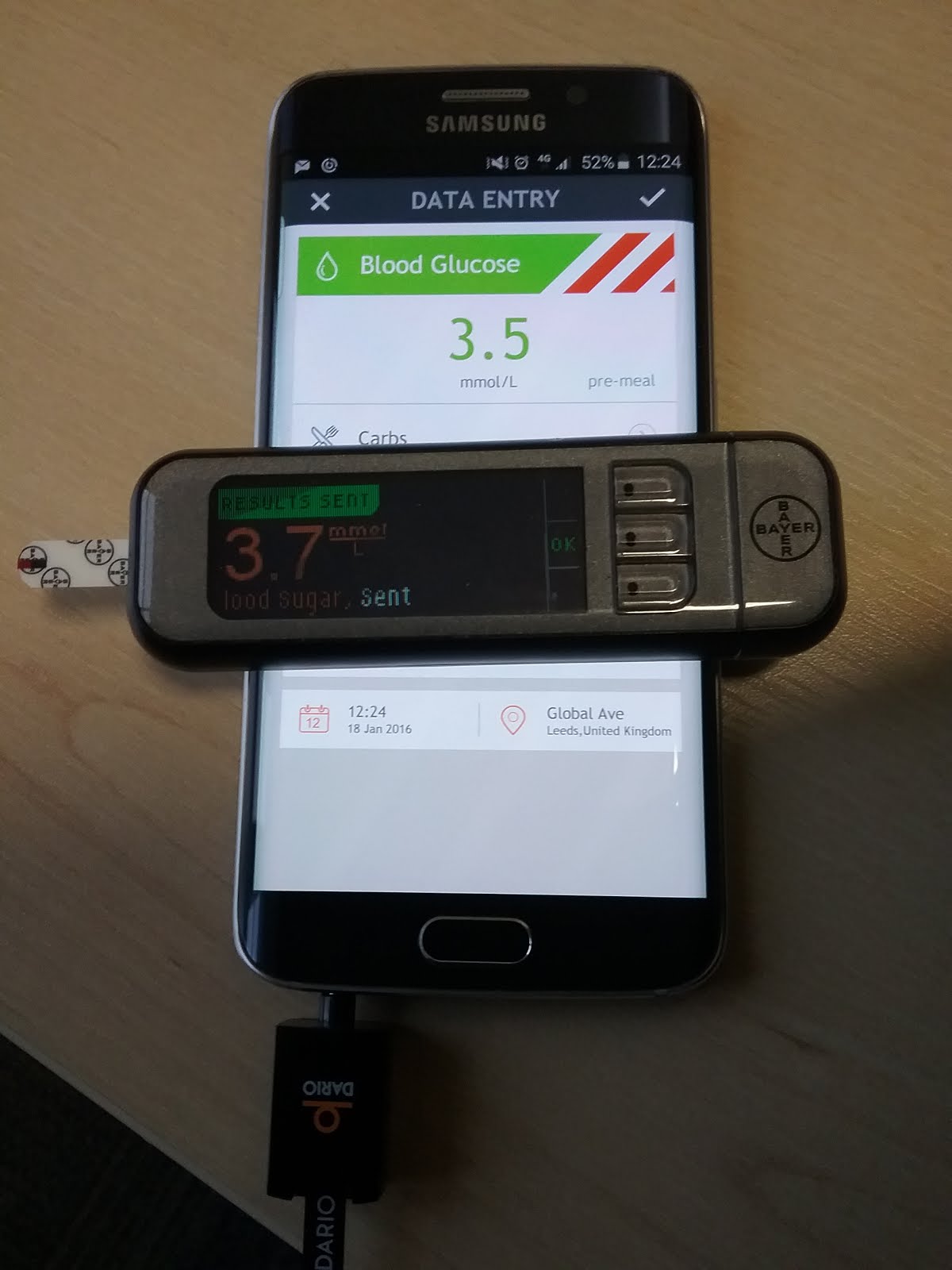 |
| Dario 3.5, Bayer 3.7 |
 |
| Dario 3.5, Bayer 4.0 |

Overall I was pretty happy with how it performed and it was close enough to let me feel comfortable without having to constantly check on my regular meter. I was happy to go out for the day and leave my Bayer behind and felt that I knew whatever I saw would be a fair reflection.
Two other features of the app are that it easily gives you an at a glance view of your recent history and the standard deviation of those results.

It also shows hypos and hypers so you can get an indication if the average is skewed by a lot of high or low readings. I know other meters/software offer this too (my Bayer shows number in range, above and below after a few clicks), but I do like that it's all available immediately.
The last feature I wanted to mention is the estimated HbA1c reading:

You can see here from 30 measurements over the time I'd had the device, it estimated my HbA1c as 6% (which I'd be pleased with if it was true!) I'm not sure how accurate that is but I like the dashboard feature so I can see how I've been doing overall. I'm not sure if you can edit the "ranges" as I think it's reasonable that these may need to be personalised for individual targets. There may be more infor on how to do that, but it wasn't immediately apparent to me after playing about in the menus for a little bit. I'm sure someone will be able to tell me how that's done.
So... how does it fair in the real world?
Overall, I think it has a lot going for it. It's definitely portable, and fits easily in my pocket alongside my phone and my pump. I'm happy that it's accurate and I think the information presented in the dashboards in the app is really helpful. You can use the Dario app without the meter and if you're interested in having that information at your fingertips, you might want to get the app anyway. I think the design is pretty ingenious, and fitting a meter, lancet and test strips into something relatively small (about the size of the Bayer meter itself) is a feat of engineering.
On the other hand, only having 25 strips at a time may put people off. I'm used to carrying 50 and I know roughly how long they last me. It'd be an adjustment to carry half as many and I'd possibly worry about running out when I wasn't expecting it. I'd be interested to see how the lancet part of the device stands up to prolonged use. At the moment it does very well but I'd be concerned that the mechanism could end up being compromised by lint and general bits and pieces that are in people's pockets.
Whilst I also definitely do love the portability factor of it all, I do also wonder about how well people may be able to 'construct' it in the midst of a hypo. It's not overly fiddly by any means, but compare having to get the constituent pieces, unlock you phone and get a reading to using a conventional meter then it's fair to say it does take longer and is a bit more involved.
Finally, from a purely personal point of view, in the testing case with my Bayer meter, I carry around a spare pump battery, some paracetamol and I use the spare pouch to bin the used test strips. Adjusting that kind of behaviour for me has been interesting, and I've ended up with used strips in my pocket on more than one occasion. I also don't believe it links to Diasend in the same way my existing meter does.
So - would I have one full time? I think I could be persuaded but I'd want to run it alongside my existing Bayer device. The Dario doesn't talk to my insulin pump and on more than one occasion I tried to use the Bolus Wizard and found I had to enter the info manually. You can't test if you have headphones in (I spend a lot of time on conference calls using headphones) so there's that practicality to consider too.
But I do really like the fact that it's portable and a little more discrete than my existing meter. I think having the choice when I go out to slip something in my pocket, or bring the bigger kit in a bag (or my wife's bag...) would be good. I've really enjoyed having it around and when you consider the whole package is pretty small, and the info from the app is really useful in my opinion. I don't think it could replace what I use today, but I think it does an excellent job of complimenting it, and makes living with diabetes a bit easier which is certainly no bad thing in my opinion.
If you're interested in finding out more about the Dario Smart Meter, you can head over to the Dario website where you can also see if your device is supported. This link is for the Dario shop if you're interested in buying one for yourself. Check with your diabetes team/GP/local CCG to see if any of it is available on prescription in your area first though. The meter is £19.95 (inc 25 strips) and then it's £14.95 for 50 strips after that. If you're self funding, it could start to add up so do take that into account.
Subscribe to:
Posts (Atom)