Showing posts with label conference. Show all posts

Saturday, 5 March 2016

Glasgow 2016 - some personal highlights

There's more serious stuff to come from #DPC16 - a lot more.  But the conferences (#YDEF16 included) did have a personal side to them as well, and I wanted to get things down on paper before I forget them.

There's a good chance I'll return to this as and when another memory fights its way through the current brain fog, but these are the things that have stood out for me on a personal level over the last four days:


  • Meeting members of the #doc.  It's always top of the list when you get to meet people you spend so much time talking to.  Finally getting to meet (in no particular order) Laura, Kelly, Kris, Sandie, Dani, Mike, Ellie, Bob, Helen, Partha, Pratik, Emma, Becky, Ali, Neil, Pete, Sophie, Lis, Jon, Jane, Amy, Hannah, Jane-Claire and anyone else who I've definitely forgotten (sorry - can barely remember my own name right now).  Memories were made - I thank you.


  • Getting to speak at both conferences.  I think Kelly and I delivered a solid couple of workshops at #YDEF16 to say we'd only met for the first time the night before (and only had one practice run).  Standing up in the Arena on the first day of the conference and being given a platform to give my experiences on education at #DPC16 was a real highlight and I'm grateful to Bridget from Diabetes UK for allowing me to share the stage
  • Watching my friends speak.  I saw Kelly deliver a great speech about her Sugarbuddies experience, and Laura talk so passionately about NICE guidelines, both within a few hours of each other.
  • The 5k fun run.  It take a lot to motivate me out for a run before 7am.  But it WAS fun (sorry Ali) and it lead tomy fastest 5k time and the creation of...
  • The #DPC16 #DOC T-Shirt... a sixth form leavers present for the Conference Age
  • Sanofi Coffee.   The Sanofi stand was the default meeting place for everyone and I think it was a unanimous vote that their coffee was the best (other pharma coffee stands are/were available)
  • Seeing people you weren't expecting to.  Basically half of my diabetes team in Sheffield showed up for the conference which is not wholly unexpected, but running into so many of them in such a busy environment was a surprise, but a very welcome one
  • Hearing the conclusion of something I'd been a part of.  The very first lecture at #DPC16 gave the results of the clinical trial I took part in for two years.  I'd heard the headline news, but to see the presentation was very interesting (and a little controversial)
  • Meeting so many people.  Obviously putting faces to names from the #doc was incredible, but having the chance for a few words with those who'd spoken so passionately or chaired incredible discussions was a great opportunity.
  • Being part of something.  I wrote a quick overview of what seemed to be the messages of #DPC16 and I think to have been there and be part of that rising tide of change was a real highlight.  Having the chance to add my voice to the huge buzz that was already there is a highlight, and to be able to share what's going on with everyone was a real privilege
  • A couple of quotes.  Nick Oliver said at #YDEF16 "I don't know if any of you have had a hypo, but we tell people with diabetes to eat 15g of carbs and wait 15 minutes.  I dare you to do that".  Partha Kar told a room full of diabetes clinicians "None of you are experts. People with diabetes are the experts. We're all just specialists, at best".  It's reassuring how much they get it.
I think there's more to add to that list, and I'll no doubt return to this in the coming days as my brain settles down.  But for now, that's just a few of so many things that made this week special.

Thursday, 3 March 2016

Individual Care

This post is a bit of a mashup of a few different sessions that I attended on Day 2.  For the sake of consistency, today for me consisted of:

Janet Kinson Lecture

  • It's education Jim but not as we know it - Helen Rogers

Debate: Prevention of diabetes: Popping a Pill or Running a Mile
  • Popping a pill - Kamlesh Khunti
  • Running a mile - Naresh Kanumilli

Service redesign and attention to detail: can it improve outcomes in children and young people?
  • Improving paediatric outcomes: the Diabeter Experience - HenkVeeze
  • Target setting: what's new in the NICE guidelines? - Julie Edge
  • Blood glucose monitoring: Making the most of downloads - Iain Cranston

Quality in Care (QiC) Diabetes
  • My Diabetes My Way - Scott Cunningham
  • Sugarbuddies - Sarah Woodward, Kelly Carden

Individualising targets in diabetes: NICE or not NICE
  • Setting the scene: a patient's perspective - Laura Cleverly
  • Which target for which patient - Brian Frier
  • NICE guidelines: Type 2 diabetes - David Millar-Jones
  • NICE guidelines: Type 1 diabetes: a utopian fantasy? - Partha Kar

There was a lot of variation in the sessions I attended, and a great many highlights (including Kamlesh Khunti arguing against some of his own research in the Prevention debate, and seeing some of the people I class as friends deliver some great talks).

But what's becoming more and more apparent the more talks I sit in are a few key themes that are common:
  • Education plays a hugely important role in helping people with diabetes
  • Diabetes is an individual condition and care has to be individual (linked to education above)
  • Changes to care don't neatly adhere to a one size fits all strategy
What I'm going to try and do is bring in elements of both the Service Redesign and NICE guideline sessions to (hopefully) get across some of the ideas that make diabetes care challenging, both for people with diabetes, and for those delivering care.

The session on NICE guidelines in service redesign highlighted one very simple point - nothing is really that new.  The guidelines today and the guidelines from 1993 are markedly similar, though that doesn't necessarily make it easier for families to meet those guidelines.

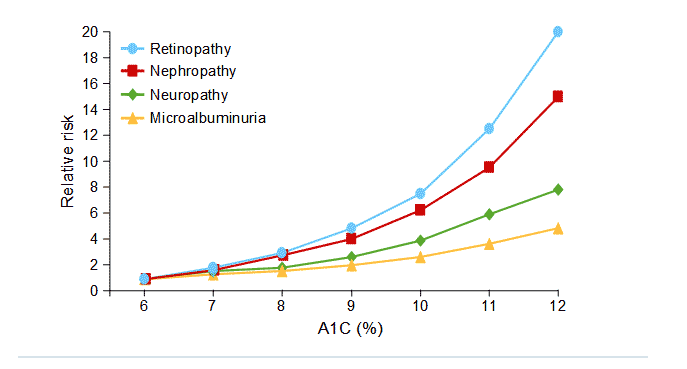
What was clear (and came up in other sessions) was that taking the HbA1c guideline of 48mmol/mol (or 6.5% in old money) definitely won't work for everybody.  Evidence suggests that an HbA1c at that level will reduce your risk of complications - but again that  doesn't make it easy to get to, or appropriate for everyone.

Relative risk of different complications vs HbA1c level

Julie Edge gave a great archery analogy - make 6.5% the middle of an archery target (i.e. what you aim for), sometimes you might hit it, other times you won't.  The further away you are, the more you need to make adjustments.

But making adjustments and setting the targets is where it gets tricky.  The target can't be 6.5% for everyone (and nor should it).  Making adjustments when you don't hit the 'bullseye' needs support and help.  Interestingly, even aiming for a target of 6.5% may not help you - studies show that if you aim for 6.5%, chances are you'll achieve 7%.

Aim for the left, you'll probably hit the right
What people need is individual support to understand what's appropriate for them and what's achievable based on their current circumstances.

In the afternoon, the NICE Guideline discussion started to a packed room (and an overflow room listening in).  Laura began with a stark statement - "Some of the NICE guidelines have made me feel like I've been put in a box where I don't belong" and I think that made a lot of people sit up and take notice.

Working through some of the new guidelines, Laura explained that clinic appointments with her consultant worked through her circumstances and looked at what external factors were impacting on her outcomes (such as HbA1c).  A visit to her GP was different - "You need to improve your control".  A question at the end of her talk asked for her views on individual targets for the guidelines - the answer was a simple one "Yes there should be individual targets, and NICE guidelines encourage it.  But how often is it actually done".

Brian Freer followed and spoke well about how targets could/should be set for individuals, and at the end there were a few questions/comments from the audience:
  • "If we say to a patient that their target HbA1c is 6.5% but we don't expect you to get there, then should be surprised if/when they don't?"
  • "If you pay GPs to hit specific targets, are they really going to set individual goals?"
  • "You can't treat diabetes by guidelines. You have to treat the individual in front of you."
There's a theme developing...

Partha took to the stage to talk about the practicalities of the Type 1 NICE guidelines.  He made some stark points that really should give food for thought.  He was keen to stress he wasn't criticising the guidelines but had some points he wanted to raise.

You could summarise his talk into a discussion of the language used in the guidelines.  
  • "People with diabetes should be offered an education course with proven benefit.... well we do offer it - it's just no-one goes.  Is 'offer' the right word?"
  • "NICE guidelines says people with Type 1 should have access to a minimum of four test strips per day.  Using four strips per day exists only in Narnia"
Partha rightly questioned the need for updated guidelines, asking if the last document hadn't made significant differences, why would the new one?  What I took away from what Partha said was that we know what the right things are, and the guidelines make that clear - they're grounded in evidence.

What needs to be better is the implementation of all this.  Writing the guidelines is a long process.  Making sure they contain proper guidance that will positively impact people with Type 1 (in this case) is no easy challenge.  But writing the guidance doesn't magically bring about change in how that guidance is translated to real world care.

Mike stood up at the end and spoke in response to Partha's session.  The one thing he said so passionately that resonated with the entire room was "I don't want you to tell me what's easy, I want to know what works.  If an HbA1c of 6.5% means I have fewer complications, I can understand how hard I have to work to get there.  How much 'better' is it and how much more effort is it to get from say 7% to 6.5%?  Then I can make that decision about what I think my target should be."

I think the theme of individual care has come across really strongly in many sessions in the conference already.  No-one I've heard thinks it's a bad idea - far from it.  There's a clear desire from healthcare professionals (and people with diabetes) to champion individual care.  We can't all fit into one box, we can't be given a one size fits all target.  We all have different support needs, we all have different requirements when it comes to how we engage with education.

The argument isn't about individual care.  The argument is about how we change the system to make sure that individual care is delivered to everyone with diabetes.

Wednesday, 2 March 2016

Taking education to the masses

I’d had my eye on the Education session on Day 1 with equal excitement and trepidation.  The education campaign is one I feel personally connected to.  I felt like the DAFNE course I did has made a huge difference to how I manage my own diabetes, and so hearing a number of professional views on the subject was something I was looking forward to.

Equally, I’d been asked to give a short view of my experiences of education to the assembled professionals, so I was a little nervous about how that was going to go.

If you’ve not had a look at the Diabetes UK Taking Control campaign yet, I’d urge you to start there.  The campaign launched towards the end of last year, and is aimed at making sure everyone is given the chance to learn about their diabetes.  I think we’re at a point now where the evidence for education is no longer in question, we’re now looking at how best to get that education out to as many people.

The session was split down into five talks:
  •           Taking Control campaign – Bridget Turner
  •           Making the case for diabetes education – Charles Gostling, Helen Hopkinson, Alison White
  •           Getting people there – Vivien Coates, Anne Scott
  •           Adding options to the education menu – Sarah Newall, Rebecca Owen, Kingshuk Pal
  •           Addressing specific local barriers – Tahseen Chowdhury, Seonaid Morrison

Bridget set the scene, explaining why Diabetes UK are championing education and how using an adapted House of Care can be used as a model to deliver education to more people.

Bridget Turner (Director of Policy and Care Improvement at Diabetes UK),
discussing the adapted House of Care model for education

I gave my own (short) view on my personal experience of DAFNE, and why I think education is important.  I won’t dwell on my own personal views too much here, but I generally believe that education helps people become more active in their own healthcare and that in turn helps them achieve better outcomes.  I’ll save that for a separate post outside of the conference.

The stage was set for the other examples from the rest of the speakers.  Charles Gostling started off talking about how they deliver education to people in South London.  He made a great reference to the latest National Diabetes Audit (NDA) data, saying that without clear data, we don’t know where we do things well.  I think that’s a point that can’t be stressed enough.  Without getting side-tracked into a debate on NDA submissions, I think it’s really important to understand your starting position and data is the way you do that.

We know diabetes education referrals are generally low, the take up rates even lower.  Two key messages Charles got across were simple (but important ones).  Firstly, find out why people don’t take up the offer of education.  Secondly, share local success stories.  If someone is doing something well, make sure it’s publicised across your local area so others can learn from it.

Helen Hopkinson then moved onto how the education offering was redesigned, talking through the journey they went on to get to DAFNE (‘because it’s evidence based and we know it works’).  She made a great point that redesigning your education offering can be cost free but when looking at how to do that, you need to engage all your stakeholders.

Why choose DAFNE?
That second aspect sounds so fundamental, that it almost beggars belief that you’d have to say it at all.  It’s a pretty short-sighted approach to try and design something one group of people, that’s paid for by another, provided by a third and ‘marketed’ by a fourth without including them all in the process.  You wouldn’t expect it for iPhones, so why should diabetes education be any different?  It was eye opening in its simplicity.

“Getting People There” looked at reasons why people with diabetes choose not to attend courses (“I learned from other sources”, “more important things to do”, “don’t see the point”).  Some of these struck a chord with me.  I started out with the view that I didn’t need education, but now I’m a big advocate for it.  I think we need to do more to sell the benefits of people who could be persuaded to go if they knew what they’d get from it.  Others need a different model of support – as with everything related to diabetes, one size doesn’t fit all.

As we moved to the discussion on “Adding options to the education menu”, we saw some interesting and innovative ways Lambeth were engaging with different groups within their area.  As with the other parts of the session, there’s some blindingly obvious bits in there too.  If you’ve got an education offering, tell people about it.  Spread the word as much as you can, use community centres, library groups, church meetings – anyone you can – to widen the circle of people who know you have something for them.

One of the most interesting things that came up was the concept of taster sessions.  These are short (90 mins) sessions that act as an introduction to the larger scale education courses on offer.  They’re typically targeted at groups or populations that are historically harder to reach (the example they gave was the Sri Lankan community in Lambeth), or those where Did Not Attend (DNA) rates are higher.   With all the taster sessions, people were ‘followed’ to see how many attended a full course later.  That stood at about 10% for the first year, but it’s hoped to be higher for 2016.

The last bit I’d like to talk about was HeLP Diabetes – an online learning option for people with Type 2 diabetes.  I think it’s important to cover as a lot of people want more online support and if we return to this ground breaking idea of providing what people want, this ticks the boxes.
Around 50% of visitors to the HeLP Diabetes site come outside ‘regular’ working hours, when it’d obviously harder to provide traditional education like DESMOND.  Interestingly, despite some of the upsides to the online delivery (24/7 access, anonymity etc), it still faced some of the more traditional barriers, such as spreading the word about its availability.

I’m a huge advocate of education because I’ve got a deeply personal experience about how it transformed my ability to be in control of my diabetes.  I think the case for things like DAFNE is huge (given its evidence base), and I think that by selling the benefits of the education, we can convince those who have the time, but no inclination, to attend a course and hopefully go on a similar journey to the one I went one.

That said, it’s naïve to think there’s only one way to persist, and if we want to give the benefits of education to as many people as possible, we need to consider how best we offer that education to meet the needs of the many.  “Education is about interaction with others, whether that’s other people with diabetes, healthcare professionals, of your friends and family” – I think many of us who’ve been on a course, or have used social media to help us with our diabetes would agree with that.

The last word should go to Seonaid Morrison from Argyll & Bute on the West Coast of Scotland.  She gave an incredible talk (without slides after a technical problem), on how she crosses a huge geographical area to try and bring education to as many people as possible…


“When you provide education to people, you see the change in them. That's what gets me up and out of bed in a morning”.

DPC16 - Impressions from Day 1

DPC Day 1

This is the standard ‘my first impressions’ blog about attending the Professional Conference.  I appreciate it’s probably a bit cliché, but hopefully it adds context to the rest of what you read about the conference.  Blogs on specific sessions will follow throughout the week (and probably into next week too).

No matter who you talk to, how much past experience you try and take on board, nothing can really prepare you for how BIG the Diabetes UK Professional Conference (DPC) is.

I felt like I’d had the benefit of a gentle lead into the chaos, having spent the day before the DPC at the Young Diabetologist & Endocrinologist Forum, running a couple of workshops with Kelly (@DiabeticQueen1) on what it’s really like to live with an insulin pump (I’ll save that for another time).  I’d had a day to get my bearings for the most part and I’d been through the session planner a week in advance so I had a good idea of what I wanted to see.

But DPC is BIG.  There’s over 3000 people at the conference, many of them great leaders in their fields, others desperate to hear them speak, even if it’s just for a short time.  Typically, there’s six sessions running concurrently with a few coffee breaks sprinkled in throughout the day in the huge exhibition room.  It sounds chaotic but it’s not.  It’s busy, but it’s an incredibly well-oiled machine.
Having hunted down our badges for the week, we piled into the main auditorium for the first round of lectures.  At this point it’s worth explaining how the day is split up – it sounds like overkill (and it’s a bit long to read here), but I think the context is important…

There’s roughly four big time blocks per day, each between 60 and 90 minutes long, each with an overarching theme.  There are six rooms that each run one of those time blocks concurrently.  And each time block contains two or three lectures.  That means in any given day, you’re likely to hear 10-12 individual talks across a variety of topics.  The 2016 Programme is here if you’re more of a visual person.

For the first day, I tried to split between things I had some interest in (it makes it easier to try and understand/write about), and things I felt were of a wider appeal.  Day 1 consisted of 14 individual talks:

Opening Plenary lecture session
  •           The Relative Effectiveness of Pumps over MDI and Structured Education (REPOSE) – Simon Heller
  •           Peptide Immunotherapy for Type 1 Diabetes – Colin Dayan
  •           Exercise for beta cell preservation in Type 1 diabetes: The Exercise for Type One Diabetes (EXTOD) trial – Rob Andrews and Parth Nardendran

Multidisciplinary approaches to managing admissions for DKA session
  •           A combined diabetes case manager and mental health approach for supporting people with multiple hyperglycaemic admissions – David Simmons
  •           The role of emotional wellbeing in DKA and one care pathway approach – Kirsty MacLennan
  •           Walking the tightrope of hyperglycaemia: education is not enough – Clare Shaban

Diabetes education: reaching the masses session
  •           Taking Control campaign – Bridget Turner
  •           Making the case for diabetes education – Charles Gostling, Helen Hopkinson, Alison White
  •           Getting people there – Vivien Coates, Anne Scott
  •           Adding options to the education menu – Sarah Newall, Rebecca Owen, Kingshuk Pal
  •           Addressing specific local barriers – Tahseen Chowdhury, Seonaid Morrison

What’s new in hypoglycaemia session
  •           Cardiovascular effects of hypoglycaemia – Simon Heller
  •           Evidence based pathway for the management of problematic hypoglycaemia – Pratik Choudhary

  • Mary MacKinnon Lecture

  •           West Hampshire Community Diabetes Service: re-commissioning community services and beyond – Kate Frayers


Fourteen talks across five broad subjects is a lot of information to take in.  I feel incredibly lucky to be here at the conference (and to have had the opportunity to speak for a few minutes within the Taking Control session) but it takes a lot of brain power to be on the go all the time.  Hopefully those of you following me (@BroomOwl) or the hashtag (#DPC16) on Twitter have got some sense of the huge amount of information being shared.  So back to the day…

The conference centre is big and you often find yourself rushing from one session into another, trying to grab a coffee on the way if you’re lucky enough.  The exhibition hall is where people tend to gravitate between sessions, though I’ll confess I’ve not actually taken a close look at anything there yet.

What really struck me was the mix of passion and knowledge on show, as well as the desire to make overwhelming change to the lives of people with diabetes.  That sounds a bit obvious really, but the sheer number of people devoting their time outside seeing patients to research, service changes and sharing best practice is really incredible.  It’s inspiring as a person with diabetes, I imagine as a healthcare professional it’s very motivating.

I’m writing this in the hotel bar at the end of the first day, reflecting back on what feels like a week’s worth of information I’ve had shoved into my head within the space of eight hours.  I’m trying to pick a favourite session, but it’s genuinely difficult.  I’ll freely admit some of them were very fast paced, and whilst I got the main messages from some, I couldn’t explain the research to you well enough.  Some (like REPOSE which I was a part of), were personally important to me, others, like the whole DKA session gave me something entirely new to think about.

Perhaps the one that struck the biggest chord with me was the education session.  REPOSE had shown in the morning that people using insulin pumps do no better than people on multiple daily injections (MDI) when proper high quality education is given.  The afternoon session showed that there were a huge group of committed individuals across the UK looking to deliver that message out to as many people as possible.  I’ll follow that up in a separate blog.


Thanks for reading my opening post, and thanks if you’re following along on Twitter.  Hopefully you’ll understand that a huge post on each lecture (or even session) is a bit impractical.  I’ll try and do one in detail and summarise some of the others along the way.